
Search
301 items
-

GoodLands
GoodLands is a nonprofit organization that recognizes the potential for the land owned and managed by Catholic dioceses. They provide the tools for communities to understand the land they own and how to best manage them to provide the greatest ecological benefit possible. -

What is your 5784 Climate Resolution? Shana Tova from Adamah
This video contains a quick overview of the year and interviews with members of the Adamah community on their goals for the Jewish New Year in relation to the environment and climate action. It encourages the viewer to make their own climate goals and reflect on their environmental actions. -
World Resources Institute
Founded in 1982 by Gus Speth in Washington, D.C., World Resources Institute (WRI) has staff around the world using research- and evidence-based approaches in an effort to mobilize partnerships for the protection and restoration of the environment. They aim to help create resilient and sustainable communities, with a focus on the production and usage of food and energy, as well as the planning and building of cities. "WRI’s mission is to move human society to live in ways that protect Earth’s environment and its capacity to provide for the needs and aspirations of current and future generations. Our mission and values guide all the work we do." (WRI Mission and Values) -

Pohoda Music Festival
"Pohoda is a music and arts festival with an international acclaim, where alternative, indie, electronica, world music, & punk meet classical; alongside literature, dance, visual art, film, and theatre." First organized in 1997, this festival takes place in Slovakia each summer. It is renowned for its social and ecological consciousness and promotion of community and sustainability. Pohoda received the Green Operations Award in 2017. Multi-cultural and environmentally friendly, Pohoda has set high operation standards for its festival counterparts. -
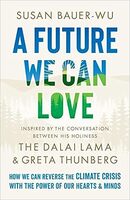
A Future We Can Love: How We Can Reverse the Climate Crisis with the Power of Our Hearts and Minds
"Discover wisdom and guidance to face the climate emergency from the most influential spiritual and environmental leaders of our time, including the Dalai Lama, Greta Thunberg, Joanna Macy, Vandana Shiva, Paul Hawken, Katharine Hayhoe, and Matthieu Ricard.
When the Dalai Lama and Greta Thunberg spoke for the first time in January 2021, millions of people around the world took notice. “It is encouraging to see how you have opened the eyes of the world to the urgency to protect our planet, our only home,” the Dalai Lama wrote to Greta before their meeting.
A Future We Can Love shares the words of these two great figures, generations apart, bringing them into dialogue with dozens of visionary scientists, activists, and spiritual luminaries. These include indigenous scholar and artist Lyla June, medical biochemist and author Diana Beresford-Kroeger, climate scientist and Zen teacher Kritee Kanko, interfaith environmental leader Dekila Chungyalpa, Buddhist teacher Willa Blythe Baker, Rabbi Steve Leder, and many more. Through this world-changing conversation, readers embark on a four-part journey toward active hope in the face of the climate crisis: from knowledge of climate science, through the capacity for change, and to the will that is needed and the actions we can take." -

Moving Forward: A Guide to Climate Action For Your Congregation and Community
This guide was created by ecoAmerica and the Blessed Tomorrow coalition. It includes actions that individuals, household, and community groups can take with regard to the eliminating of pollution, conserving energy, transitioning to clean power. It also focuses on supporting policies that support care for creation. -
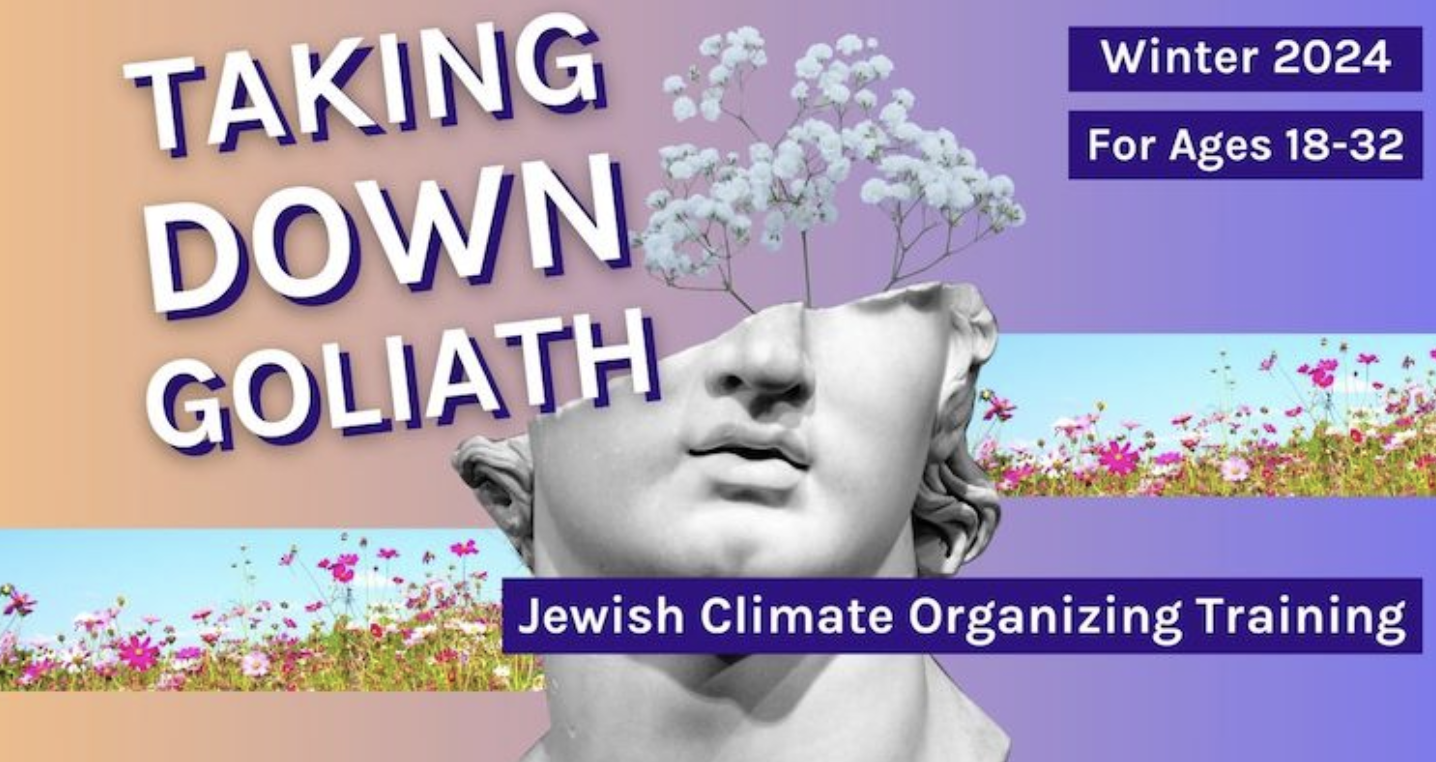
Taking Down Goliath
"It can be daunting to confront the climate crisis and move toward effective action – but there’s so much we can do together. Dayenu has developed a Jewish climate organizing training especially for young people, and it has empowered and motivated hundreds of us already.
Join us in the new year for Taking Down Goliath, Dayenu’s signature program for people ages 18-32.
This four-part virtual training takes place during two consecutive weeks on Monday and Wednesday evenings. The dates for Winter 2024 are January 29, January 31, February 5, and February 7. Participants should plan to attend all four sessions.
During the first week, we’ll focus on themes of POWER and JUSTICE. In our second week together, we’ll talk about building RELATIONSHIPS and taking ACTION.
More than 350 young people have already engaged in Taking Down Goliath. This is your chance!
All participants who complete the course will be offered a $50 stipend.
Dayenu is committed to racial equity and accessibility. Sephardi and Mizrahi Jews, Black and Indigenous people, people of color, people with disabilities, and LGBTQIA people are strongly encouraged to register.
The early bird registration deadline is Friday, January 19, 2024!" -
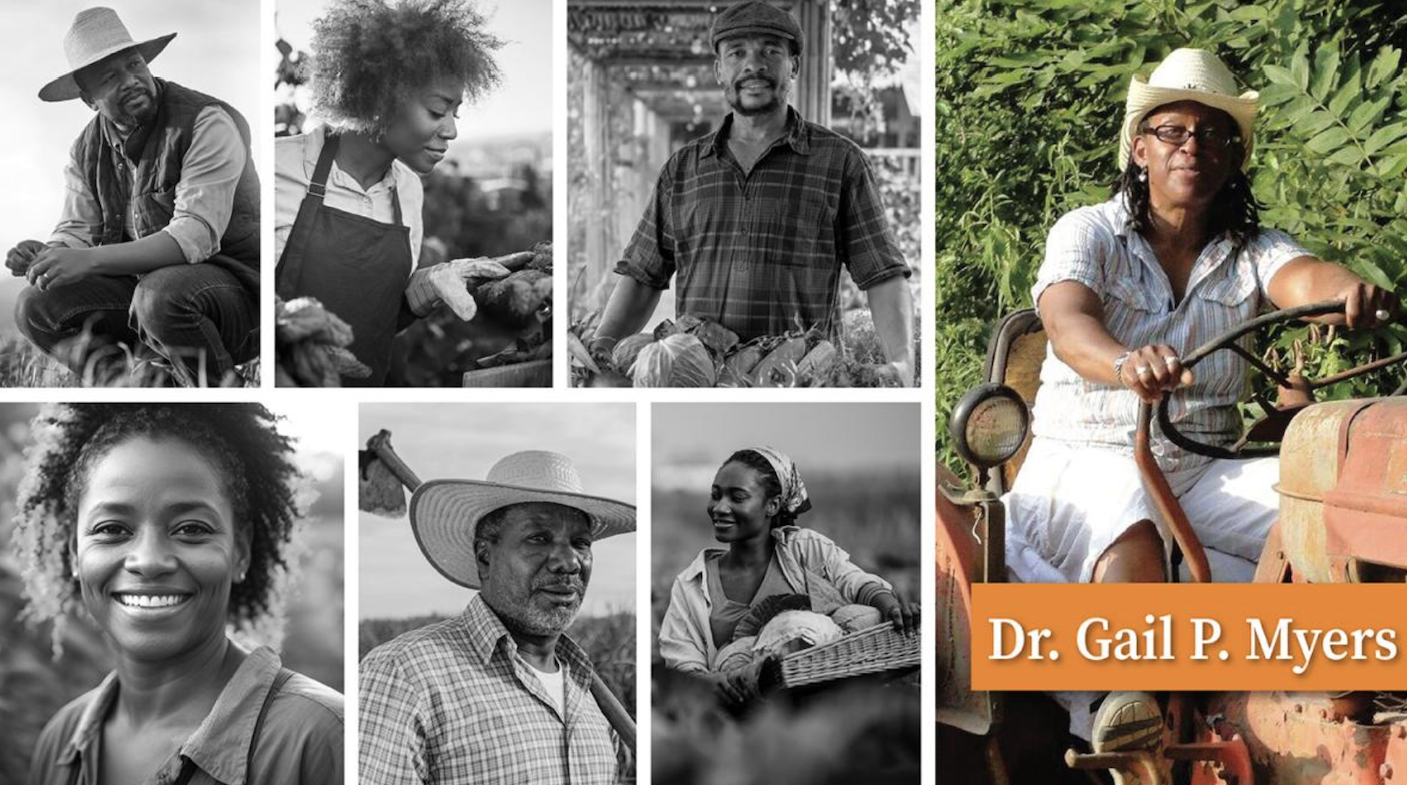
EPN Breakfast: Recognition of historical injustices in agriculture and the importance of environmental experiences for racial healing
"This program, on the 8th annual National Day of Racial Healing, addresses land access and explores the human connection to the environment through farming, gardening and other active outdoor activities and the ability for agricultural experiences and acknowledgement of historical injustices to serve as healing towards racial equity. The National Day of Racial Healing, part of the W.K. Kellogg Foundation’s Truth, Racial, Healing & Transformation efforts, is a time to contemplate our shared values and create the blueprint together for #HowWeHeal from the effects of racism. Launched on Jan. 17, 2017, National Day of Racial Healing is an opportunity to bring ALL people together in their common humanity and inspire collective action to create a more just and equitable world."
1/16/2024, 7:15-9:30 a.m.
Nationwide and Ohio Farm Bureau 4H Center
Columbus, OH
$25 for non-students, $5 for students, free for virtual participants -

God's Creation Needs You Video Series
"'God’s Creation Needs You' is a new video series featuring six Catholic communities across the nation caring for our common home through climate action, advocacy, farming, community organizing, service to others, solar energy, education, prayer and a focus on environmental justice.
Watch for a new video each week!"
This page contains a compilation of the videos involved in this series, as well as a preview to the series. -
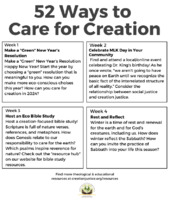
52 Ways to Care for Creation: January 2024
"Download the January 2024 52 Ways to Care for Creation bulletin insert! Use this resource to deepen your congregation’s commitment to creation justice. Each week highlights a creation justice idea for action or reflection for yourself and your community." -
Climate Justice Resource Page
This web page from the West Ohio Conference of the United Methodist Church contains information about climate change, as well as a variety of related resources. These include how people can advocate for the issue, reflect on their actions, connect with related organizations, and find a number of other resources. -

The Clan of One-Breasted Women
In this excerpt, Terry Tempest Williams reflects on her family's long-running history of developing cancer that traces from nuclear testing in Nevada. Williams emphasizes her experience of coming to terms with deviating from Mormon norms if it means advocating for the U.S. government to take responsibility for liabilities regarding human health. Williams decides blind obediance will not get her anywhere, and she needs to start asking questions. -

Save Soil
This resource details a campaign to improve soil practices to be more sustainable through building up consciousness. The leader of this movement is Sadhguru, a spiritual leader. Sadhguru advocates for connecting inner spiritual processes to an affinity for nature. This is an international organization that started in Tamil Nadu, India. -

Golden Temple, Grey Air: Pollution in Amritsar
This article describes how increasing tourist activity and reliance on the Bhgatanwala dumping site is creating air pollution that is threatening the integrity of the Golden Temple in India. While the Management Committee Golden Temple (SGPC) has taken action to reduce pollution from its kitchen and energy production, the government is failing to intervene and reduce pollution in surrounding areas. -

The Rewiring America Handbook: A Guide to Winning the Climate Fight
"The COVID-19 pandemic showed the world the dire consequences of ignoring science and its predictions of global crises. But the pandemic was just a rehearsal for the climate disasters humanity will face – unless we act now.
In his new book, Rewiring America, Saul Griffith, PhD argues that we can still address the threat of climate change, but only if we respond with a massive war-time mobilization effort to transform the fossil fuel economy into a fully electrified one, run on wind, solar, and other renewable energy sources. Based on the vast data about energy flows in the U.S. economy that his company, Otherlab, has mapped, Griffith details how to not only save us from climate disaster, but to help us enjoy a cleaner, healthier, and more prosperous future." -

Self Portrait
"This 35mm film photo is a self portrait taken on Rachel Carson Way in Ithaca, NY. To me, sustainability is taking small actions every day to better the people and the planet. This photo is representative of many sustainable actions I take in my day to day life, including shopping second hand, buying from small businesses, supporting local artists, supporting women in science, and traveling ethically."
Taken by Lydia Derrico. Submitted to the RESTORExchange Sustainability Contest. -
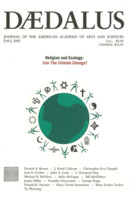
Envisioning the Daoist Body in the Economy of Cosmic Power
"From a sociological perspective, religious traditions represent and construct the collective values and systems of meaning of human societies. As such, religious traditions influence the way their adherents interpret their experience of the world and, consequently, influence their actions upon it. Religious ideologies, however, are themselves always in medias res. Even though their adherents may uphold an eternal vision of archaic principles handed down from the gods, in actuality this vision is continuously renegotiated and reconstructed in conversation with the changing demands of historical and cultural context." -
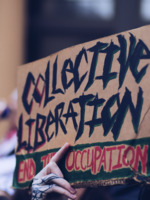
Collective Liberation
"An activist protesting the violence in Gaza holds a sign calling for collective liberation for all . What speaks sustainability about this to me is how something is being reused , for a greater cause , in the cardboard , which instead of being thrown away is being used to uplift . The Palestinian cause is one of not only liberation of a peoples but liberation of the land. Palestinian culture is rooted in sustainabile agriculture practices , and sustainability within familia systems ." Taken by Paul Hill. Submitted to the RESTORExchange Sustainability Photo Contest. -
Fifth National Climate Assestment, Chapter 16: Tribes and Indigenous Peoples
In this chapter of the Fifth National Climate Assessment, the NOAA outlines and describes three key messages regarding the relationship between Native communities in the U.S and our changing environment. This report goes over how Indigenous peoples face a high risk of changing livelihoods due to climate change and environmental injustice, and how they are responding to these threats. The report also explains the nature of their resilience to such change and how Indigenous leadership can guide our response to climate change. -

Greening the Parish - Greek Orthodox Archdiocese of America
Greening the Parish is an initiative started by the Department of Inter-Orthodox, Ecunemical and Interfaith relations. It was inspired by the work of Patriarch Bartholomew, who is more commonly known as the Green Patriarch. On this website, there are initiatives, practices, and educational materials that teach environmental stewardship. -

From Egoism to Ecoism: Psychedelics Increase Nature Relatedness in a State-Mediated and Context-Dependent Manner
This article describes the correlations between psychedelic use and nature relatedness. The surveyors used questionnaires 1 week before, 2 weeks after, 4, and 2 years after the dose given. They concluded that due to the consistent positive affects on the subjects, the use of psychedelic treatment bears relevance on mental and planetary health. -

Catholicism and the Natural World
Religious writer Thomas Storck's field guide for navigating environmentalism for devout Catholic congregation members takes an in-depth look into the Catechism of the Catholic Church and how it portrays creation of the environment and instructs Catholic followers on how to relate with that creation and behave accordingly. It touches on Pantheism and Deism and how they clash with traditional Catholic ideas of creation and environmentalism. -

Traditional Ecological Knowledge: Learning from Indigenous Practices for Environmental Sustainability
In this book, a number of scholarly writers share their works regarding Indigenous culture and environmentalism. There are a total of four parts that discuss Indigenous practices, ecological ethics, and nature-human relationships. The compilation of these viewpoints and topics makes for a compelling read and push towards a greener, sustainable Earth. -

Jessica Locke on Buddhism and Environmental Engagement
In this podcast, Jessica Locke begins her talk about the intersectionality of Buddhist religion and environmental engagement by describing how upholding tradition while trying to address modern issues is difficult. There are different Buddhisms, as the original religion has been interpreted differently over the years; however there are commonalities throughout such as the idea of karma. Locke states that the unit of analysis for Buddhist ethics is changing from an individualistic perspective to larger scale in order to analyze environmental problems. -

Why Does the Church Care About Global Climate Change
This article explains why the Catholic Church is invested in climate change as an issue and why their religion requires them to take a stance on it. It pulls on scripture from the Bible and moral roots in caring for the poor and the common good to make this argument.