
Search
122 items
-

Event: Family Fun for a Clean Planet
The youth at First Presbyterian Church in Delaware are celebrating Earth Day on Sunday, April 23 from 11:30-2:00 at Blue Limestone Park with games nature walks and recycled artwork. -

Evangelical Lutheran Church in America Downloadable Resource
The Evangelic Lutheran Church in America offers downloadable resources to help encourage others to care for creation. The resources include Hunger & Climate Change, Awakening to God’s Call to Earthkeeping, Poverty and Hunger in a Changing Climate, and more. -

Environmental Statement: Evangelical Lutheran Church in America
Caring for Creation: Vision, Hope and Justice is a social statement that explains the Evangelical Lutheran Church in America’s (ELCA) teachings on ecology and the environment, grounded in a biblical vision of Gods intention for the healing and wholeness of creation. This statement provides a Christian understanding of the human role to serve in creation. The ELCA believes in caring for creation through active participation, solidarity, sufficiency, and sustainability. -

Engaged Organization: Evangelical Lutheran Church in America World Hunger
The Evangelical Lutheran Church in America World Hunger is an initiative with domestic and international Lutheran churches to reach communities in need. They recognize the universal human right to food and work to provide immediate relief to those who are hungry. They strive to not only give food, but to connect people with the resources they need to produce food and gain access to clean water, education, health-care and sources of income. -

Walk for Water
In 2015, The Evangelical Lutheran Church in America Word Hunger held Walk for Water which was a youth-led fundraiser challenge to raise 500,000 dollars for water projects around the world. They exceeded their goal and raised one million dollars to support water related projects. Their website offers facts and tool kits to help others start their own walk for water. -

Engaged Organization: Lutheran Disaster Response
Lutheran Disaster Response brings God’s hope, healing, and renewal to people whose lives have been disrupted by disasters in the United States and around the world. They strive to provide emotional and spiritual support, coordinate volunteers through their local affiliates, assist refugees in a holistic way, and provide long-term recovery efforts. They are currently assisting with the drought in Africa, flooding in West Virginia, refugee crisis in the Middle East, and more. -

Engaged Organization: Evangelical Lutheran Church in America Malaria Crisis
Over the past five years, the Evangelical Lutheran Church in America has worked to save lives impacted by malaria. They have educated 2 million community members, distributed 50,000 insecticide-treated bed nets, tested 160,000 people for malaria and provided treatment if positive, trained 10,000 local volunteers in prevention and treatment, empowered 12,000 households to be economically stable, and provided 32,000 pregnant women medication. -

Evangelical Lutheran Church in America HIV and AIDS Strategy
The Evangelical Lutheran Church in America has adopted the ELCA HIV and AIDS Strategy and called on members to respond faithfully and effectively to this pandemic. They aim to halt the spread of HIV through effective prevention, treatment and care, to eliminate the stigma and discrimination experienced by those who are HIV positive, and reduce the conditions of poverty that contribute to the spread of HIV. -

Lutheran Immigration and Refugee Service
Since 1939, Lutheran Immigration and Refugee Service has welcomed more than 379,000 refugees to the United Stated. They believe their work to be driven by God’s love for all people and a vision for congregations to be welcoming and generous centers for mission and ministry. Their work includes responding to people caught in conflict and facing persecution, advocating for their needs and interests, helping people access resources for basic human needs, working with foster care programs for minors, legal assistance, developing new and innovative service programs and partnerships, and much more. -
Environmental Statement – American Baptist Churches
Environmental problems that exists today have stemmed from humanity’s current and past greed. Science and technology are being abused and threaten to make problems worse, even though they have the power to make things better. American Baptists advocate that we must be stewards of our home and not abuse it if we wish to continue on as a species. In order to fix what humans have caused, we are called to recognize and preserve the earth and natural resources we have. -
Environmental Statement – Church of the Brethren
The Bible is filled with examples that demonstrate our responsibility to care for all creation on our planet. From Genesis to the parables of Jesus, it is explicitly stated that we must be caring stewards of the earth. In order to reverse the damage that humankind has done, the Church of the Brethren is calling its own members and all people to action. In addition, they are also calling upon the government to be more supportive of environmental policies and clean up. -

Environmental Statement – Presbyterian Church
The Presbyterian Church has an environmental statement that is similar to many other churches, citing biblical text and discussing our responsibilities as stewards of the earth. This document goes into what humanity has done, and why the Presbyterian church is responding to the massive amount of environmental degradation. -

United Church of Christ – Environmental Ministries
The United Church of Christ has taken an active role in environmental stewardship. They have made multiple statements about various aspects of the environment. This link provided by Environmental Ministries discusses various critical environmental justice issues. If you are looking for ideas on how to live more Eco-friendly in your own life, or simply searching for a great set of resources, check them out! -

Environmental Statement – Mennonite Church
Like many other religions, the Mennonite Church has released a statement about the need to take care of our environment. They are encouraging this attitude of caring for our planet among their members by using biblical text. It focuses on helping people choose simpler lifestyles, and seeking justice for the environment. -
Environmental Statement – Episcopal Church
The Episcopal Church has issued multiple environmental statements over the years. Their foundational statement in the 1990’s was released in parts. The first part discussed environmental policy, and what must be done to preserve creation. The second part addressed taking action through the church. It involves advocacy, leadership involvement, and education. -
Environmental Statement – Lutheran Church
The Evangelical Lutheran Church in America adopted a robust environmental social statement in 1993. Many themes are similar to those voiced by other religions in that it focuses on humanity’s responsibility to the environment and the call to act as the stewards of the earth. The statement notes that problems of environmental degradation have been caused by humanity, and it is up to us to restore nature to its former condition. All people of the earth need to take part, and this statement calls for action by everyone. -

Environmental Statement – Reformed Church in America
In 1982, the Christian Action Commission of the Reformed Church in America (RCA) released a document titled “Care for the Earth: Theology and Practice.” This was given to General Synod, who then passed several resolutions outlining the Reformed Church in America’s stance on environmental issues. The Action Institute wrote the article below that discusses the resolutions that were passed. -

Green Justice Congregations
Sustainability and becoming “green” are more than just simple actions. Many people believe that to truly achieve environmental stewardship, the culture and how we look at things needs to be changed. The United Church of Christ has provided a resource to help faith communities make this change. Their program can be adopted by anyone who wants to help make an impact in their own community. -
Official Denominational Environmental Webpage – Presbyterian Church
The Presbyterian faith has an online resource for all members of its community. This website helps provide information and links for people and congregations to become more Eco-friendly. Another valuable resource on their page is their Earth Care Congregations, which provides projects, education, and outreach programs. -
Official Denominational Environmental Webpage – Lutheran Church
The Lutherans have their own environmental resource, Lutherans Restoring Creation. This site is full of education, success stories, environmental news, and even resources for preaching. -
Official Denominational Environmental Webpage – Episcopal
The Episcopal ecological Network is the Eco-based resource for the Episcopal faith. Their home website contains information on how churches and congregations can become more environmentally friendly and aware. They do this through a three part program involving reflection, education, and action. -
Official Denominational Environmental Webpage – United Methodist
The United Methodist Church addresses environmental issues in a different way. They call their page that focuses on these issues: Social Principles, The Natural World. Through this, you can find information about the Methodists viewpoints on water, energy, animal life, or even space. -

St. John’s Lutheran Church and Solar Power
Churches have turned to solar power to bring down energy costs for their sanctuaries. St. John’s Lutheran Church in San Antonio has begun to use a large array of solar panels, as well as more energy efficient lights to cut costs. -
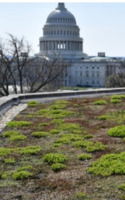
United Methodist Agency Green Roof
John Hill, from the Board of Church and Society at the United Methodist Agency, narrates the video below about their recent green roof addition. The series of squares used covers the entire area of the flat roof, reducing energy consumption, making the building cooler in the summer and warmer in the winter. In addition, and equally important, it reduces storm water runoff. When it rains, the water remains in the roof rather than adding pollutants into the nearby watershed, which feeds into the Chesapeake Bay. -

Hunger and Climate Change
As a country full of natural resources, the impact of climate change is not always realized. However, our actions impact countries all over the world that have no choice in the matter. Hunger and Climate Change describes the effects that climate change has on places around the globe and future impacts on the United States.