
Search
294 items
-

The Spirit of the Rillito
This article explores the ideas of animism and new animism. Animism is the belief that all things, living and non-living, have a spiritual essence. The author connects this system of beliefs to their local river, the Rillito. -

St. Francis of Assissi Novena
This novena from the autumn of 2022 contains nine days of prayers to St. Francis of Assissi.
"Though he chose not to be ordained a priest, St. Francis is one of the most revered saints of the church. The great respect accorded to St. Francis is primarily due to his life of service, insistence on the practice of absolute poverty, and great humility. He founded the Order of the Friars Minor, co-founded the Poor Clares, and the Order of St. Francis...He is renowned for his love of animals, the environment, and his desire for peace." -

Faith and the Environmental Movement: A Franciscan Perspective
This blog post was written by a member of WE ACT, which is an environmental justice-based organization located in Harlem, NYC. The post discusses the relationship between Catholicism and environmentalism. The author argues that Catholics are key environmental changemakers because Catholic teachings and religious leaders, like Pope Francis, emphasize protection for God's creation and care for the poor. -

Methodist Church Climate Commitment to Net-Zero Emissions
The United Methodist Church has acknowledged their responsibility in climate action. They have committed to converting all facilities associated with the church to achieve net-zero emissions by 2050. They provide an explanation for this commitment based on scripture. -
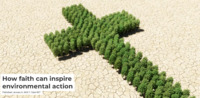
How faith can inspire environmental action
As majority of the world associates with a religion, we can see how it effects one's view on nature. As climate change is becoming more and more of a problem, faith and religion can be a driving factor in making a change. What isn't talked about enough is how faith and religion can strike social environmental change. Faith and religion point of views on the environment can lead people to think about the environment as sacred, with compassion, empathy, and kindness. We can make progress on climate change with the help of faith and religions. -

Environmental underpinnings in Rosh Hashanah Liturgy: We are stewards of our world…take better care of the earth!
David Golinkin explains in this article the connection between the Jewish holiday, Rosh Hashanah, and environmentalism. He explains certain Jewish phrases and their significance in respect to our responsibility to the world. -
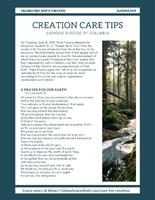
Creation Care Tips Summer 2019
This Creation Care bulletin insert provides quotes from Pope Francis, encouraging Christians to utilize their talents, while drawing upon their culture and experiences to care for the environment. It also provides ways to support Pope Francis's message to care for the Earth, such as reading the Laudato Si' encyclical, encouraging children to go outside, and hosting creation care events and retreats. -
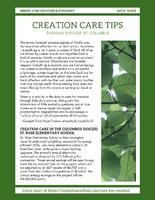
Creation Care Tips Autumn 2019
This creation Care bulletin insert provides benefits of changing over to energy-efficient LED bulbs. It also provides additional cost saving suggestions such as turning off unnecessary lights, where to set your thermostat, and purchasing the most efficient appliances. -

Creation Care Tips Spring 2020
This Creation Care bulletin insert focuses on creating sustainable landscapes within the Columbus metro area. One section describes how first and second graders from Sts. Peter & Paul School work in gardens as a way to learn about concepts of sustainability. Specific topics/tips for readers include composting for gardens, planting native plants, and creating a community or prayer garden. -
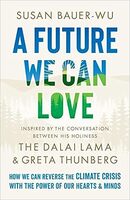
A Future We Can Love: How We Can Reverse the Climate Crisis with the Power of Our Hearts and Minds
"Discover wisdom and guidance to face the climate emergency from the most influential spiritual and environmental leaders of our time, including the Dalai Lama, Greta Thunberg, Joanna Macy, Vandana Shiva, Paul Hawken, Katharine Hayhoe, and Matthieu Ricard.
When the Dalai Lama and Greta Thunberg spoke for the first time in January 2021, millions of people around the world took notice. “It is encouraging to see how you have opened the eyes of the world to the urgency to protect our planet, our only home,” the Dalai Lama wrote to Greta before their meeting.
A Future We Can Love shares the words of these two great figures, generations apart, bringing them into dialogue with dozens of visionary scientists, activists, and spiritual luminaries. These include indigenous scholar and artist Lyla June, medical biochemist and author Diana Beresford-Kroeger, climate scientist and Zen teacher Kritee Kanko, interfaith environmental leader Dekila Chungyalpa, Buddhist teacher Willa Blythe Baker, Rabbi Steve Leder, and many more. Through this world-changing conversation, readers embark on a four-part journey toward active hope in the face of the climate crisis: from knowledge of climate science, through the capacity for change, and to the will that is needed and the actions we can take." -

Moving Forward: A Guide to Climate Action For Your Congregation and Community
This guide was created by ecoAmerica and the Blessed Tomorrow coalition. It includes actions that individuals, household, and community groups can take with regard to the eliminating of pollution, conserving energy, transitioning to clean power. It also focuses on supporting policies that support care for creation. -

Catholic Diocese of Columbus: Creation Care Guide
The Creation Care Team of the Catholic Diocese of Columbus has created a Creation Care Guide based on the teachings of Laudato Si’. This guide contains information on energy conservation and efficiency, purchasing and recycling, transportation, and water conservation. Additionally, they have a section on making Laudato Si’ more accessible to younger generations. The inspiration for this guide came from the Archdiocese of Atlanta who wrote a document titled, An Action Plan for the Roman Catholic Archdiocese of Atlanta. -
Laudato Si' Discussion Guide
"Pope Francis’ encyclical letter Laudato Si’ was released in June 2015. Five years later, in 2020, Pope Francis invited all Catholics and people of good will to celebrate the fifth year anniversary of this important encyclical and to take action to better care for our common home. Also in 2020, Pope Francis issued an apostolic exhortation, Querida Amazonia [Beloved Amazon], which drew heavily from Laudato Si’ and from the reflections of participants in the Special Synod of Bishops for the Pan-Amazonian Region on October 6-27, 2019 on topics such as “the cry of the poor,” exploitation of the resources and the original peoples of the Amazon region, and action to care for God’s creation. The guide includes materials for prayer, reflection and discussion, as well as ideas to help Catholics respond to Pope Francis’ call in Laudato Si’. The discussion section of the guide includes quotes and discussion questions on a variety of themes highlighted in Laudato Si’. The facilitator should decide in advance which topics will be covered during this session. Given the number of rich themes on which Pope Francis focuses in Laudato Si’, you may wish to spread the topics among several sessions. A separate study guide for Querida Amazonia is also available." -
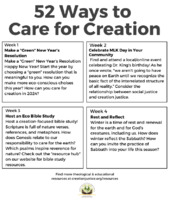
52 Ways to Care for Creation: January 2024
"Download the January 2024 52 Ways to Care for Creation bulletin insert! Use this resource to deepen your congregation’s commitment to creation justice. Each week highlights a creation justice idea for action or reflection for yourself and your community." -
Envisioning the Daoist Body in the Economy of Cosmic Power
"From a sociological perspective, religious traditions represent and construct the collective values and systems of meaning of human societies. As such, religious traditions influence the way their adherents interpret their experience of the world and, consequently, influence their actions upon it. Religious ideologies, however, are themselves always in medias res. Even though their adherents may uphold an eternal vision of archaic principles handed down from the gods, in actuality this vision is continuously renegotiated and reconstructed in conversation with the changing demands of historical and cultural context." -

Krka National Park
"Admire the peaceful charm of Krka National Park: a majestic waterfall draws attention, and a small cabin can be found away among dense trees. Here, travelers appreciate the peace of nature while finding shelter from the busy life of the city. This picture serves as a reminder of our responsibility to protect these havens for coming generations and is the epitome of sustainable peace." Taken by Balint Horompoli-Toth. Submitted to the RESTORExchange Sustainability Photo Contest. -

Catholicism and the Natural World
Religious writer Thomas Storck's field guide for navigating environmentalism for devout Catholic congregation members takes an in-depth look into the Catechism of the Catholic Church and how it portrays creation of the environment and instructs Catholic followers on how to relate with that creation and behave accordingly. It touches on Pantheism and Deism and how they clash with traditional Catholic ideas of creation and environmentalism. -

Why Does the Church Care About Global Climate Change
This article explains why the Catholic Church is invested in climate change as an issue and why their religion requires them to take a stance on it. It pulls on scripture from the Bible and moral roots in caring for the poor and the common good to make this argument. -

El Niño caused the greatest ever mass extinction
This article describes new updated research that shows the weather event El Niño has led to the worst mass extinction. El Niño causes the ocean to become warmer all leading back to climate change. Marine ecosystems and terrestrials are suffering greatly because of volcanic eruptions occurring. Mass extinctions are very damaging and mess up multiple ecosystems causing more destructiveness than we realize.