
Search
294 items
-

12 Days of Christmas Recycling
12 Days of Christmas Recycling is an article from Evangelical Environmental Network about all the “stuff” that accumulates over Christmas. December is the highest month for landfill deposits with household waste increasing by 25% between Thanksgiving and Christmas. An average of 30 million Christmas Trees will end up in landfills and 4 million tons of wrapping paper and gift bags will be used. The article gives 12 ways to “reduce the overuse” and to move the focus of Christmas back to the birth of Jesus. -

Skits & Readings - Creative Arts and Educational Resources
Worship resources on the themes of justice, peace, and care for creation curated by the New Community Project. This is a list of activities to engage and educate students on christian and sustainability teachings. -

Fasting for Climate Justice
Fasting for Climate Justice is a resource from Global Catholic Climate Movement (GCCM ) on the practice of fasting for climate action through two initiatives: meatless Fridays and monthly fasting. The GCCM encourages abstinence from meat on Fridays as a way to reduce one’s negative impact on global climate change. The GCCM also promotes fasting for the climate which takes place the first day of each month. -

Start 2018 by Speaking Up for God’s Creation
Young Evangelicals for Climate Action posted an article on how to speak up for God’s creation. The article focuses on The Clean Power Plan and how to effectively speak up to stop the repeal and replace of the plan. -

Tu' B'Shvat: The Green of Judaism
Tu B’Shvat: The Greening of Judaism is a handout from Interfaith Family. It offers a brief overview of Tu B’Shvat and different activities to celebrate the holiday. It also offers examples of how to be caretakers of the earth. To read the entire handout, click below. -
Tu B’Shvat Seder Leader’s Guide
Hazon has created a handout on Tu B’Shvat and how to properly celebrate the holiday. The guide offers a history of Tu B’Shvat, activities, songs, and more. The program is meant to aid people in celebration of the holiday by giving them important information and history. -

Quotes on the Preservation of Israel’s Environment
The Green Zionist Alliance has created an article of quotes that focus on Israel’s environment. All of the quotes come from a variety of speakers and from several points in time. All of the quotes were compiled to raise awareness for environmental justice. -

The Green Zionist Alliance
The Green Zionist Alliance offers a place for all people who care about humanity’s responsibility to preserve the Earth, specifically the Jewish peoples responsibility to preserve the ecology of Israel. They work to educate and mobilize people around the world for Israel’s environment and to improve environmental practices by working for positive change in all people. -
The Worship of Nature
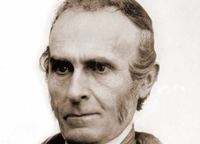
The Worship of Nature is a poem by John Greenleaf Whittier published in 1867. The poem describes nature and forests as a holy place and Whittier makes a comparison to it being an altar. He describes the winds as hymns of praise and the blue sky as the temples arch. -

Sikh Statement on Climate Change
EcoSikh has created the groundwork for a Sikh environmental theological foundation, and the inspiration to connect Gurbani (hymns in the central text of the Sikhs) to the state of the environment today. This is the first of its kind from the Sikh community and it outlines new actions Sikhs can take to strengthen their connection to their faith through environmentalism. The following quote is an excerpt from the statement:
“You, Yourself created the Universe, and You are pleased…You, Yourself the bumblebee, flower, fruit and the tree. You, Yourself the water, desert, ocean and the pond. You, Yourself are the big fish, tortoise and the Cause of causes.” -

Evangelical Environmental Network: Trump Budget would harm National Parks and the Protection of God’s Other Creatures
The president of the Evangelical Environmental Network, Rev. Mitch Hescox, made a statement saying that the budget proposed by the Trump administration is a “devils bargain,” which would harm national parks and the protection of God’s creatures.
“The Trump Administration’s budget, if implemented, would be an abdication of our stewardship of our public lands, which are entrusted to each generation to pass on to their children.” -

Catholic Climate Covenant: Earth Day 2018
Catholic Climate Covenant has created their 2018 Earth Day with the theme of reducing waste. Titled Beyond a Throwaway Culture: Reduce Waste- Grow Community, the focus is on single-use disposable plastics and how they contribute to land and marine pollution. The program includes prayers, readings, actions, and a video. -

Climate Change: A Matter of Faith
Climate Change: A Matter of Faith is a list of talking points created by Blessed Tomorrow. The talking points are meant to be a starting point for faith communities providing a prophetic voice to inspire others to work towards a healthier and safer world. The list also offers possible counterpoints and how to respond. -
Catholic Bishops Push Ohio Towards Clean Energy
The Catholic Bishops of Ohio are against an indefinite freeze of Ohio’s clean energy target standards. The Ohio Mandates Study Committee has called for this freeze due to a need for continual studying of energy standards and their impact on the state. The Bishops, however, feel that there is no need to freeze the standards, as alternative energy sources benefit the environment as well as society.
This is not the first time that the Bishops of Ohio have voiced such a stance. Back in 2014, a similar issue arose with SB 310, which proposed the original freeze of Ohio’s advanced energy portfolio standard that was established by SB221. The Bishops voiced opposition to SB 310 at that time. -

Water Issues in Appalachia
Some people may think that water issues in the United States only exist in the west. This is far from the truth. In addition to algae bloom issues throughout the midwest, the Appalachian region of the United States has been experiencing severe water contamination due to mining and chemical spills for the past several years. Fortunately, the residents of this region are kept informed by the Catholic Committee of Appalachia. Once a year, residents from all over the state meet in one location to discuss the issues of their region and try to come up with solutions. -

Environmental Statement – Evangelical Church
Evangelical Christians are calling for all people to be stewards of the earth. It is our fault that there has been so much damage done to the planet. We were entrusted to look after all of creation, and therefore, must start to take responsibility for our actions.
According to the Evangelical Declaration, The Bible tells us what our role is and what it is we must do. This statement by the Evangelical faith concedes that we must develop the earth to an extent, but we have taken it too far. We owe it to the future generations to preserve resources and help stop environmental degradation. To truly live out the Word of God, we must become more sustainable. -
Environmental Statement – American Baptist Churches
Environmental problems that exists today have stemmed from humanity’s current and past greed. Science and technology are being abused and threaten to make problems worse, even though they have the power to make things better. American Baptists advocate that we must be stewards of our home and not abuse it if we wish to continue on as a species. In order to fix what humans have caused, we are called to recognize and preserve the earth and natural resources we have. -
Environmental Statement – Church of the Brethren
The Bible is filled with examples that demonstrate our responsibility to care for all creation on our planet. From Genesis to the parables of Jesus, it is explicitly stated that we must be caring stewards of the earth. In order to reverse the damage that humankind has done, the Church of the Brethren is calling its own members and all people to action. In addition, they are also calling upon the government to be more supportive of environmental policies and clean up. -

Environmental Statement – Presbyterian Church
The Presbyterian Church has an environmental statement that is similar to many other churches, citing biblical text and discussing our responsibilities as stewards of the earth. This document goes into what humanity has done, and why the Presbyterian church is responding to the massive amount of environmental degradation. -

Environmental Statement – Mennonite Church
Like many other religions, the Mennonite Church has released a statement about the need to take care of our environment. They are encouraging this attitude of caring for our planet among their members by using biblical text. It focuses on helping people choose simpler lifestyles, and seeking justice for the environment. -
Environmental Statement – Episcopal Church
The Episcopal Church has issued multiple environmental statements over the years. Their foundational statement in the 1990’s was released in parts. The first part discussed environmental policy, and what must be done to preserve creation. The second part addressed taking action through the church. It involves advocacy, leadership involvement, and education. -
Environmental Statement – Lutheran Church
The Evangelical Lutheran Church in America adopted a robust environmental social statement in 1993. Many themes are similar to those voiced by other religions in that it focuses on humanity’s responsibility to the environment and the call to act as the stewards of the earth. The statement notes that problems of environmental degradation have been caused by humanity, and it is up to us to restore nature to its former condition. All people of the earth need to take part, and this statement calls for action by everyone. -

Environmental Statement – Greek Orthodox
In 1989, Patriarch Dimitrios I of the Greek Orthodox Church issued a statement on concern for the environment. Like many other faiths, he cited the messages and teachings of the Bible, saying that man was intended to be the steward of nature. To raise awareness for environmental causes and stewardship, September 1st of each year since 1989 has been dedicated to preserving and praying for the environment. -
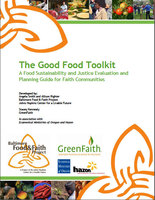
The Good Food Toolkit
The food that we eat can have a huge impact on the environment. The Good Food Toolkit is helping congregations to find food that is both produced sustainability as well as raised humanely, and is economically sound by providing the food producers with a livable wage. These are all areas that we sometimes overlook when it comes to purchasing our foods, but The Good Food Toolkit helps to identify each of these areas to help improve the quality of food we are purchasing. -

Steps to Sustainability
Catholic Churches have been attempting to go green for years. One resource that has helped them to achieve this goal is a series of steps explained in the National Catholic Reporter. This site shows simple and easy steps that a congregation can take to being green, from conserving water and energy to educating and building communities.