
Search
294 items
-

A Bluer Theology: Protecting and Restoring God’s Marine Creation
"Blue Theology was founded in 2008 by Rev. Dan Paul and Rev. Deborah Streeter. Streeter coined the term “Blue Theology” as a theological approach that weaves together marine biology and Christian theology. Over the next few years, the Church, only blocks from the Pacific Ocean, began hosting weeklong groups to engage in learning-serving experiences with God’s marine creation. Over the last two years, Blue Theology Outposts have opened in Newport Beach, CA, Texas City, TX, and Beaufort, NC. The mission of the Blue Theology program is to provide learning and serving experiences in ocean conservation while fostering heart connections to the sea." -

Sacred Lands, Sacred Waters: Theological Reflections on This Sacred World
"The lands and waters of this world are sacred places. We know it when we rest in them and we know it from our sacred texts. As Christians, to see the world as creation is to see the world as sacred.
This resource includes theological reflections from Karyn Bigelow, Avery Lamb, Dr. Miguel A. de la Torre, Rev. Victoria Loorz, Rev. Dan Paul, and Rev. Dr. Randy Woodley.
This resource was originally published for Season of Creation 2022." -

The Great Global Cleanup
This toolkit is intended to help guide people and groups on how to start and execute a cleanup project to restore communities.
"Follow our simple guide to make the most out of your cleanup. If you need any help, reach out to us at info@earthday.org." -
Laudato Si’ -- On Care For Our Common Home
Laudato Si appears to be increasing interactions between environmental professionals and faith communities, and as such, is a very important document for all people to understand–not just Catholics! Roman Catholicism is the largest religious denomination in the world (1.2 billion). An encyclical is one of the most authoritative declarations that a Pope can put forth. Laudato Si is both a reflection of the larger moral and religious landscape of environmental values, and perhaps simply the most prominent such statement of values yet crafted. It is symbolic of this moment in time when religious and ethical voices are gaining currency in environmental thinking, regardless of any particular doctrine.
-

ESA Baltimore Religion-Ecology/Faith Justice Links
Here are live links and further speaker information for OOS44 and OOS56, two organized oral sessions on Religion and Ecology that were presented at the 100th Anniversary meeting of the Ecological Society of America in Baltimore, MD, in August of 2015:
OOS 44: Ecologists and Faith & Justice Communities: A Journey from Antagonism to Earth Stewardship Partnerships for the Next Century
(Wed. 8/12, 8am-11:30am; 337, BCC; primar organizer: Greg Hitzhusen; co-organizers: Leanne Jablonski and Terry Chapin)
David Lodge, Biological Sciences, University of Notre Dame, ESA President-Elect. Ecology, Environmentalism, and Religion: A Nexus in Flux.
Including insights from the book Religion and the New Ecology; Recent essay in Nature: http://www.nature.com/news/faith-and-science-can-find-common-ground-1.18083
Mary Evelyn Tucker, School of Forestry and Environmental Studies, Yale University, CT. Global Perspectives on the Vital Relationship Between Ecology and Religion. Director, Yale Forum on Religion and Ecology: http://fore.yale.edu ; see also related podcast
Leanne Jablonski, University of Dayton, OH, Marianist Environmental Education Center. Pope Francis’ Environmental Encyclical, Catholic Environmental Social Teaching, and Implications for Ecologists (co-author: Dan DeLio, Catholic Climate Covenant); http://meec.udayton.edu.
George Middendorf, Biology, Howard University, Washington, DC. Skeptical Scientists Approaching Religion on Common Ground of Earth Stewardship. Related research: behavioral ecology and population demographics of lizards; race, ethnicity and gender in ecology and STEM
Cal DeWitt, University of Wisconsin-Madison. Evangelical Contributions to Earth Stewardship: Laudato Si’ and Stewardship as Con-Service. Paper available at: http://faculty.nelson.wisc.edu/dewitt/
Kerry Ard, School of Environment and Natural Resources, Ohio State University. Social Science Perspectives on Ecology and Religion: Implications for Environmental Justice and Ecology (co-author: Greg Hitzhusen, Ohio State University)
The Most Reverend Dr. Katharine Jefferts Schori, Presiding Bishop, The Episcopal Church. Comprehensiveness and the Middle Way: Anglican Perspectives on Religion and Ecology. http://www.episcopalchurch.org/page/katharine-jefferts-schori-biography.
Terry Chapin and Carl Safina; University of Alaska, Fairbanks; Safina Center. Religious, But Not Necessarily Theological. http://terrychapin.org; http://carlsafina.org
Munjed Murad, Harvard Divinity School, Harvard University, MA. Islam and Nature Today: Insight Into Traditional Discernment. Related work: http://hds.harvard.edu/news/2014/09/23/conversation-on-sustainability-and-religion# ; http://cswr.hds.harvard.edu/news/seeing-god-everywhere.
Ron Trosper, American Indian Studies, University of Arizona, Tucson, for Nigel Haggan, Interdisciplinary Studies, University of British Columbia, Vancouver. Creative Justice: Restoring Art, Indigenous Spirituality and Religion to Environmental Impact Assessment and Ecosystem-Based Management. http://www.fisheries.ubc.ca/students/nigel-haggan ; http://courses.ais.arizona.edu/people/ronald-l-trosper
OOS 56: Ecologists and Faith & Justice Communities: Evaluating Opportunities and Challenges for Outreach and Partnership for the Next 100 Years
(Wed, 8/12, 1:30pm-5:00pm; 341 BCC; primar organizer: Leanne Jablonski; co-organizers: Greg Hitzhusen and Kellen Marshall)
Shantha Ready Alonso, Executive Director, Creation Justice Ministries. The American religious environmental landscape: Opportunities and challenges for ecologists. Creation Justice Ministries serves 38 member Christian denominations; its 2016 Earth Day Sunday study and prayer resources will focus on biodiversity and endangered species. (co-author: Cassandra Carmichael, National Religious Partnership for the Environment)
Indigenous perspectives on ecology, justice, ways of knowing, and the Earth
(Gail Woodside CANCELLED) Speakers to be introduced Dorothy Boorse, Professor of Biology, Gordon College, Wenham, MA (see Boston Globe coverage). Loving the least of these: Lessons from the climate change report of the National Association of Evangelicals; available at: http://nae.net/loving-the-least-of-these/; see also God and Nature
Dan Misleh, Executive Director, Catholic Climate Covenant, Washington, DC. Growing catholic engagement and voice in climate change, environmental justice and policy: From St. Francis to Pope Francis to people and planet.
Lisa Benham, Insight Garden Program, San Quentin State Prison, CA; Department of Environmental Studies, San Jose State University, Buddhist Eco-chaplain. From longing to belonging: Combining mindfulness practice and ecological understanding in prison rehabilitation; Related research: From utility to significance: Exploring ecological connection, ethics, and personal transformation through a gardening and environmental literacy program within San Quentin Prison: http://gradworks.umi.com/15/67/1567980.html
Kellen Marshall, Department of Biological Science M/C 066, University of Illinois at Chicago.Ecological equity and spatial assimilation: A justice paradigm for 2nd Centennial ecologists.
Jacqui Patterson, Director, Environmental and Climate Justice, NAACP. Lessons for ecologists from the NAACP’s Environmental and Climate Justice Program. Related Research: Just Energy Policies: Reducing Pollution, Creating Jobs
http://www.naacp.org/blog/entry/naacp-just-energy-policies-report-released;
Equity in Resilience Building for Climate Adaptation Planning: An Indicators Document:
http://www.naacp.org/blog/entry/equity-in-resilience-building-for-climate-adaptation-planning.
Jessica Lewis, Right to Housing Alliance, Baltimore, MD. Working at the intersection of water, housing, and economic and environmental justice
(co-authors: Vicente Lara, Daisy Gonzalez, Colin Bailey, Environmental Justice Coalition for Water).
Greg Hitzhusen, School of Environment and Natural Resources, The Ohio State University. Ecologist dialogue and outreach with faith communities: Lessons from experience and study in the Ecological Society of America (co-author, Leanne Jablonski, University of Dayton).
Fred Scherlinder Dobb, Rabbi, D.Min., representing Adat Shalom Reconstructionist Congregation (www.adatshalom.net); Interfaith Power and Light (www.gwipl.org); Coalition on the Environment and Jewish Life (www.coejl.org). Old-time religion and cutting-edge climate: Jewish and interfaith intersections with ecological science;
available at: https://scherlinders.wordpress.com/2015/08/10/esa-presentation-august-2015/. -

Laudate Deum
"Eight years have passed since I published the Encyclical Letter Laudato Si’, when I wanted to share with all of you, my brothers and sisters of our suffering planet, my heartfelt concerns about the care of our common home. Yet, with the passage of time, I have realized that our responses have not been adequate, while the world in which we live is collapsing and may be nearing the breaking point. In addition to this possibility, it is indubitable that the impact of climate change will increasingly prejudice the lives and families of many persons. We will feel its effects in the areas of healthcare, sources of employment, access to resources, housing, forced migrations, etc.
This is a global social issue and one intimately related to the dignity of human life. The Bishops of the United States have expressed very well this social meaning of our concern about climate change, which goes beyond a merely ecological approach, because 'our care for one another and our care for the earth are intimately bound together. Climate change is one of the principal challenges facing society and the global community. The effects of climate change are borne by the most vulnerable people, whether at home or around the world'. In a few words, the Bishops assembled for the Synod for Amazonia said the same thing: 'Attacks on nature have consequences for people’s lives'. And to express bluntly that this is no longer a secondary or ideological question, but a drama that harms us all, the African bishops stated that climate change makes manifest 'a tragic and striking example of structural sin'.
The reflection and information that we can gather from these past eight years allow us to clarify and complete what we were able to state some time ago. For this reason, and because the situation is now even more pressing, I have wished to share these pages with you." -
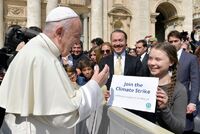
In 'Laudate Deum,' Pope Francis presents a compelling climate crisis apologia
"With a degree of urgency appropriate for the planetary catastrophe we face today, Pope Francis' latest apostolic exhortation, Laudate Deum, 'to all people of good will on the climate crisis,' builds on the important insights of his 2015 encyclical letter 'Laudato Si', On Care for our Common Home.' That the pope has explicitly described the current state of the climate as a 'crisis' could be viewed as affirming what climate activist Greta Thunberg said in her 2019 address at the World Economic Forum in Davos, Switzerland: 'Our house is on fire. I am here to say, our house is on fire.' " -

Prayers and Meditations for UNCOP28
"Our invitation to you and request of you on behalf of the ILC? We encourage people of all faiths to offer their prayers and meditations towards a beneficial UNCOP 28.
Our prayer and meditation around the world has helped the previous COP’s .This was the feedback we have received. The picture above is of Prayer and Meditation at COP26 in Glasgow. Not pictured are those who offered their spiritual practice at that time from many other places in the world. Our invitation is that we continue what we have begun with a renewed sincerity of commitment." -

Critique of Religious Patriarchy
"This supplement is about transcending religious patriarchy in order to foster integral human development and a healthy mutuality between humans and the human habitat. Some meditations are proposed on the mysteries of the creation, the incarnation, and the redemption. They explore the Christian understanding that all men and women are consubstantial in one and the same human nature, and are consubstantial with Jesus Christ as to his humanity. The meditations are based on a layman's reading of the Sacred Bible, the Catechism of the Catholic Church, and the Theology of the Body as they pertain to the consubstantial complementarity of man and woman, which transcends the patriarchal binary of mutually exclusive male-female opposites. This understanding of the "complementarity in consubstantial unity" of man and woman applies to all the sacraments, sheds light on the great nuptial mystery of Christ and the Church, and would seem to support the ordination of women to the ministerial priesthood and the episcopate. The meditations are preceded by recent news on patriarchy in religion, society, and human ecology, and are followed by articles and research notes, a summary of points for discernment on the ordination of women, an annotated timeline of religious patriarchy in the Judeo-Christian tradition, and links to relevant literature, substantive research, and the synodal process of discernment currently underway in the Catholic Church." -

Evolution of the Collective Unconscious
"The collective unconscious is made up of experiential knowledge, symbols, and imagery that humans are naturally born with (no tabula rasa) and are rooted in ancestral experience and shared by all persons in all cultures. After millennia of evolution, the current collective unconscious of humanity would seem to include human exceptionalism, patriarchal hegemony, short-terminism, delusions of grandeur, illusions of unending growth, and the idolatry of technology. As the planet becomes overloaded with industrial civilization, our collective mindset seems to be unwilling to think long-term and face the realities of ecological overshoot. It remains to be seen whether our collective mindset can evolve to voluntarily refocus human agency toward contraction of the human enterprise, simplification of lifestyles, and peaceful resolution of conflicts before it is too late to prevent a chaotic collapse of industrial civilization." -
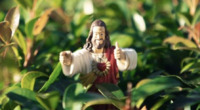
Plastic Jesus: Real Faith in a Synthetic World
"Everywhere we look in our culture you will find plastic. One place where you will not find plastic, however, is in the Bible.
This resource is designed to help congregations think more deeply about the ways that plastics impact our lives and God's creation. It is also intended to equip people of faith to take actions to address this epidemic in faithful and practical ways.
Download this resource to find stories of individuals and communities making a positive impact, sermon starters to spark meaningful discussions in your church, worship resources to unite in prayer and reflection, and actionable steps to address the plastic crisis in your life, community and, our world." -

Why Conservative Christians Don’t Believe in Climate Change
"American Christians have become increasingly polarized on issues of climate change and environmental regulation. In recent years, mainline Protestant denominations and the Roman Catholic Church have made explicit declarations of support for global climate action. Prominent Southern Baptists and other evangelical Protestants, on the other hand, have issued statements that are strikingly similar to the talking points of secular climate skeptics, and have attempted to stamp out 'green' efforts within their own ranks. An analysis of resolutions and campaigns by evangelicals over the past 40 years shows that anti-environmentalism within conservative Christianity stems from fears that 'stewardship' of God's creation is drifting toward
neo-pagan nature worship, and from apocalyptic beliefs about 'end times' that make it pointless to worry about global warming. As the climate crisis deepens, the moral authority of Christian leaders and organizations may play a decisive role in swaying public policy toward (or away from) action to mitigate global warming." -

Taoist monks find new role as environmentalists
This article details the efforts of Taoist leaders in China to incorporate sustainability in Taoist temples and promote a culture of environmentalism. Since 2006, the Daoist Ecological Protection Network has gained the support of 120 temples who have converted to the use of solar panels and biofuels. Taoist monks noticed many people to be ignorant towards their environmental impact, living a life of hyper-materialism. Monks wanted to help educate society about the actions that can be taken to ameliorate environmental issues both at the temples and in daily life. This pursuit is driven by a fundamental belief in Taoism to live in harmony with nature, a value that could have large impacts on society if adopted. -

Threat of Global Warming/Climate Change - 2006 Statement of Conscience
This resource contains the climate statement of the Unitarian Universalist Association.
"Earth is our home. We are part of this world and its destiny is our own. Life on this planet will be gravely affected unless we embrace new practices, ethics, and values to guide our lives on a warming planet. As Unitarian Universalists, how can our faith inform our actions to remedy and mitigate global warming/climate change? We declare by this Statement of Conscience that we will not acquiesce to the ongoing degradation and destruction of life that human actions are leaving to our children and grandchildren. We as Unitarian Universalists are called to join with others to halt practices that fuel global warming/climate change, to instigate sustainable alternatives, and to mitigate the impending effects of global warming/climate change with just and ethical responses. As a people of faith, we commit to a renewed reverence for life and respect for the interdependent web of all existence." -
How Religion Intersects With Americans' View on the Environment
Through this study, they intended to obtain information about how religious Americans view climate change. This article explains the results of a survey. It shows how some religious Americans express little concern about climate change, and carry the belief that “there are much bigger problems in the world, that God is in control of the climate.” Additionally, some say that “they do not believe the climate is actually changing.” This survey also sheds light on other concerns religious Americans carry, such as fear surrounding the consequences of environmental regulations (fewer jobs, increased energy prices, and loss of individual freedoms).
Additionally, the survey extends to other religious affiliations as well as the religiously unaffiliated population. -

Turning Around Our Relationship with Earth is a Teshuvah Project
The author recounts an unsettling encounter with a utility worker who downplayed the environmental harm of her gas leak. From here, she explains the true negative impacts of methane emissions on both people and the climate, and encourages us to act in a way that "turns around our relationship with Earth". She connects this with the Jewish tradition of Teshuvah, the time in between Rosh Hashanah and Yom Kuppur meant for repentance. -
Care for Creation - Catholic Conference of Ohio
"The Catholic Bishops of Ohio invite you to study the issues related to the stewardship of God’s creation. Care for the environment is a fundamental principle within Catholic Social Teaching. We applaud efforts already underway in many Catholic homes and institutions that help conserve energy, protect the environment, and advance a greater understanding of faithful stewardship. We hope that Catholic families and institutions around the state will continue in such efforts."
This resource includes a statement calling to care for God's creation and contains information and links to several other resources related to religion and environmentalism. -

Al-Mizan: Covenant for the Earth
"The Covenant presents an Islamic outlook on the environment in a bid to strengthen local, regional, and international actions to combat the triple planetary crises defined by the United Nations as climate change, biodiversity loss and pollution. It is a global endeavour to engage Muslims from all levels of society in the development and adoption of this call...
Al-Mizan - A Covenant for the Earth is a restatement of the principles governing the protection of nature in a form that meets current challenges. It examines the ethics behind the social patterning of human existence and enquires into how they could be brought to life today working in harmony with the heartbeat of the natural world." -

Rising: Dispatches from the New American Shore
This resource contains a series of vignettes following Elizabeth Rush as she meets people all around American who have been affected in some way by global sea rising, as well as some of her own personal experiences. She gives voice to those otherwise not heard, and shares eye opening testimonials from those who experience the effects firsthand. -

Voting and Our Common Home: Reflections from the Catholic Tradition
This resource shares information and resources related to the importance of voting for environmental issues on the basis of Catholic religious beliefs. This document is available in both English and Spanish and raises multiple different issues and considerations connecting religion, environmental issues, and voting. -

How Religion Influences Our Relationship With the Environment
The article shows how religious change can effect trends in the environment and how it can produce better environmental conditions attitudes. It lists statistics on which countries have certain environmental issues and how religion may play a role in certain situations. -

5 reasons why people of faith are a powerful force in the fight against climate change and environmental crises
This article is from the environmental outreach group Greenpeace. It highlights why religious groups globally have a powerful voice in climate justice. It is a digestible first article if you want to familiarize yourself with religious environmental activism. -

Green Corner Bulletin (St. Camillas Parish, Silver Spring, MD)
St. Camillas periodically issues their Green Corner Bulletin, in support of their stance on creation care as indicated on their website:
"Our preaching and liturgical music deepens our love of creation. Moreover, St. Camillus Church evangelizes by offering the adult faith formation programs on care of creation to parishioners, promoting various activities around Earth Day that spur people to adopt a more sustainable lifestyle, and doing advocacy for policy and legislation.
Our parish community is undertaking an effort to “green” our campus, reduce our energy consumption, and eliminate practices that are wasteful and destructive to God’s creation." -

Catholic Charities USA Prayer for Creation
Catholic Charities USA uploaded a prayer for creation on their website, focusing on cherishing the Earth rather than exploiting, and providing a reminder that we are all connected to each other and the land. This prayer for creation can be used in a variety of setting, especially in liturgical worship. -

Islamic Declaration on Climate Change
In August of 2015, faith leaders, senior international development policy makers, academics and other experts announced an Islamic Declaration on Climate Change at an International Islamic Climate Change Symposium in Istanbul. The United Nations Framework Convention on Climate Change posted the following statement on their website:
"The leaders called on governments meeting in Paris to 'bring their discussions to an equitable and binding conclusion' bearing in mind:
The scientific consensus on climate change, which is to stabilize greenhouse gas concentration in the atmosphere at a level that would prevent dangerous anthropogenic interference with the climate systems; The need to set clear targets and monitoring systems; The dire consequences to planet earth if we do not do so; The enormous responsibility the COP shoulders on behalf of the rest of humanity, including leading the rest of us to a new way of relating to God’s Earth."