
Search
294 items
-

Climate Change and the Common Good: A Statement of the Problem and the Demand for Transformative Solutions
The Pontifical Academy of Social Sciences prepared the following statement on climate change. It covers a wide range of associated sustainability issues. Various suggestions for societal interventions are also included within the statement. -

Declaration of Religious Leaders, Political Leaders, Business Leaders, Scientists and Development Practitioners
Business and political leaders, and scientists from around the world have congregated at the Pontifical Academies of Sciences and Social Sciences to address the climate change crisis. The introduction to the declaration is stated below:
"We the undersigned have assembled at the Pontifical Academies of Sciences and Social Sciences to address the challenges of human-induced climate change, extreme poverty, and social marginalization, including human trafficking, in the context of sustainable development. We join together from many faiths and walks of life, reflecting humanity’s shared yearning for peace, happiness, prosperity, justice, and environmental sustainability.
We have considered the overwhelming scientific evidence regarding human-induced climate change, the loss of biodiversity, and the vulnerabilities of the poor to economic,social, and environmental shocks." -

Catholic Bishops' statement in Lima on the road to Paris
During the High-level event at the COP20 in Lima, Bishops from around the world called for a fair and legally binding climate agreement to be signed at the COP21 in Paris, 2015. One segment of the introduction is shown below:
"Following the evangelical option for the poor, we work closely with the most vulnerable communities and the excluded and as such are closely attuned to how the problem of climate change is affecting them. Our message to political leaders and all people of good will is rooted in the experience and suffering of these poor communities.
Humankind on the Planet Earth is ordained to live in equity, justice and dignity, peace and harmony in the midst of the order of Creation. Humankind is ordered to treat respectfully Creation, which has a value in itself. We Catholic Bishops recognize the atmosphere, rainforests, oceans and agricultural land as common good that require our care." -

Address at the United Nations Climate Change Conference given by H.E. Archbishop James Patrick Green
H.E. Archbishop James Patrick Green provides a statement on the impact of climate change on poverty at the United Nations Conference in Lima, Peru on December 10, 2014. He discusses the interdependence of humans and the Earth. He emphasizes Pope Francis's call for intervention to fight against global warming in order to protect the planet and, in particular, those at the poverty level. -
Message of His Holiness Pope Francis on the Occasion of the 20th Conference of the Parties to the United Nations Framework Convention on Climate Change
Pope Francis's statement on climate change was issued at the High Level segment of the United Nations Climate Change Conference on December 10, 2014. The introduction to the Holy See's message is stated below:
"At this very decisive moment in the history of climate negotiations we have to come to the point where we must overcome inaction. As Pope Francis said in his Message to our Conference, the issues we are debating 'affects all humanity, especially the poor and future generations: […] it is a serious ethical and moral responsibility […] There is a clear, definite and urgent ethical imperative to act […] We can only find adequate solutions if we act together.'
The longer we wait, the more it will cost; more victims will suffer from our inaction and the greatest weight will fall on the most vulnerable, the poorest peoples and future generations: what is at issue here is respect for their fundamental human rights." -
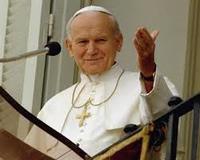
Common Declaration on Environmental Ethics
On June 10, 2002, Pope John Paul II and Ecumenical Patriarch Bartholomew I issued a declaration on the environment. The introduction to the declaration is stated below:
"We are gathered here today in the spirit of peace for the good of all human beings and for the care of creation. At this moment in history, at the beginning of the third millennium, we are saddened to see the daily suffering of a great number of people from violence, starvation, poverty and disease. We are also concerned about the negative consequences for humanity and for all creation resulting from the degradation of some basic natural resources such as water, air and land, brought about by an economic and technological progress which does not recognize and take into account its limits." -

Global Climate Change A Plea for Dialogue Prudence and the Common Good
A Statement of the United States Conference of Catholic Bishops was issued on June 15, 2001. This document covers a multitude of current environmental problems and the resulting negative impact on populations around the world - especially with regard to indigent populations. It stressed the connectivity of human behavior and it's impact on the planet. -

America Baptist Churches USA (ABCUSA) Creation Justice Congregations Bulletin
America Baptist Churches USA (ABCUSA) has created a bulletin insert that discusses how congregations can earn certificates of achievement for implementing eco-justice measures. Further details are discussed below:
"Creation Justice Congregations is an environmental education, stewardship, and justice program sponsored by the Creation Justice Network of the American Baptist Churches USA. Through this program your congregation can earn certificates of achievement for implementing eco-justice measures in your building, within your congregations, and in your ministries of outreach and justice.
Creation Justice Congregations has three stages, each with a checklist of suggested education, worship, and other action items that can help bring Baptist churches into the wider movement for peace, justice, and reconciliation with all of God's creation. " -
Message by His All-Holiness Ecumenical Patriarch Bartholomew to the United Nations Conference of the Parties (COP 24) (Poland)
Ecumenical Patriarch Bartholomew I of Constantinople addressed the United Nations of the Parties (COP 24) in Poland, December 3-14, 2018. He emphasized the collective responsibility among all citizens to alleviate the climate problems. One key point includes the urgency to focus on lighter carbon footprints to preserve the Earth to assist in alleviating poverty and suffering.
-

Message by His All-Holiness Ecumenical Patriarch Bartholomew to the UNFCCC COP-23 Session (Bonn, Germany)
Ecumenical Patriarch Bartholomew I of Constantinople addressed the UNFCCC COP-23 Session in Bonn, Germany on November 6-17, 2017. He laments the continued resistance of some for positive changes with regard to climate issues. One salient theme focuses on the urgent need for radical changes in behavior and attitude regarding the negative impact of growth and development on our planet. -

Message by His All Holiness Ecumenical Patriarch Bartholomew for World Environment Day
Ecumenical Patriarch Bartholomew I of Constantinople delivered the message below for World Environment Day on June 5, 2009. In it, he emphasizes human's responsibility to "serve and preserve" God's creation. This message is a call to all people to take a more active role in coming together to protect and preserve the environment. -

Keynote Address by His All-Holiness Ecumenical Patriarch Bartholomew at the Arctic Circle Assembly
Ecumenical Patriarch Bartholomew I of Constantinople addressed the Arctic Circle Assembly in Reykjavik, October 13, 2017. Below is a section of the keynote address, focusing on the impact of climate change with regard to the Arctic Circle:
"Scientists tell us that the Arctic is a vibrant image and vivid mirror of the state of our planet as a whole. For scientists, the Arctic is the barometer of the globe's environmental health. The ecological misdeeds committed in other regions – including chemical contamination and nuclear radiation – are clearly evident in the Arctic environment. Above all, the dramatic rise in global temperatures is having a palpable effect on the Arctic landscape. Nevertheless, so many industrial societies and activities that cause climate change are often blind to the consequences of their behavior. But here, in the Arctic Circle, it is possible to see all manner of things so much more clearly. When we visit this pristine part of the planet, we cannot hide our eyes, either from the beauty of God’s creation or from the changes which human folly has generated. Nor can we avoid pondering the terrible consequences for the remainder – and the future – of the world, if glaciers continue to melt and sea-levels continue to rise." -

Message of His All Holiness Ecumenical Patriarch Bartholomew on the Day of the Protection of the Environment
Patriarch Bartholomew I of Constantinople delivered a speech on January 9, 2018 for the Day of Prayer for the Protection of the Environment. The following one salient excerpt from the speech:
"The Ecumenical Patriarchate’s ecological initiatives provided a stimulus for theology to showcase the environmentally-friendly principles of Christian anthropology and cosmology as well as to promote the truth that no vision for humanity’s journey through history has any value if it does not also include the expectation of a world that functions as a real “home” (oikos) for humanity, particularly at a time when the ongoing and increasing threat against the natural environment is fraught with the possibility of worldwide ecological destruction. This evolution is a consequence of a specific choice of economic, technological and social development that respects neither the value of the human being nor the sanctity of nature. It is impossible to truly care for human beings while at the same time destroying the natural environment as the very foundation of life, essentially undermining the future of humanity." -

Common Declaration on Environmental Ethics
Pope John Paul II and the Ecumenical Patriarch His Holiness Bartholomew I delivered a speech titled Common Declaration on Environmental Ethics on June 10, 2002. Below is the introduction within the declaration, focusing on the current state of the poor and the consequences of natural degradation:
"We are gathered here today in the spirit of peace for the good of all human beings and for the care of creation. At this moment in history, at the beginning of the third millennium, we are saddened to see the daily suffering of a great number of people from violence, starvation, poverty and disease. We are also concerned about the negative consequences for humanity and for all creation resulting from the degradation of some basic natural resources such as water, air and land, brought about by an economic and technological progress which does not recognize and take into account its limits." -

Lenten Call for ‘Carbon Fast’
This circular Lenten Call for ‘Carbon Fast’, addressed to the Bishops of the Churches in South India, was provided on February 8, 2017 in Chennai, India, at the Church of South India Synod Secretariat. The circular emphasizes the desecration of the Earth as sinful. However, the call for a Carbon Fast can be considered one way to repent. -

Resolution on Global Warming and Atmospheric Degradation
The Church of the Brethren of The General Board issued their Resolution on Global Warming and Atmospheric Degradation on October 21, 1991. The final section of the resolution, discussing the General Board commitment, is as follows:
"FURTHER the General Board commits itself to; support and participate in national and international networks of religious bodies and other non-governmental organizations addressing the greenhouse effect; and continue through its program staff, within the context of a theology based on caring for the earth, and educational effort to acquaint the members of the Church of the Brethren with the nature, causes, and consequences of the greenhouse effect, including suggestions for individual and collective action to help address the problem. This will include the promotion of the use of the General Board’s study resource, Creation in Crisis: Responding to God’s Covenant, in all congregations. We will elicit the cooperation of District Executive as agents within each district to work directly with pastors to reach the membership of the church." -

The Hope We Share: A Vision For Copenhagen
The Anglican Communion Environmental Network addressed the United Nations Framework Convention on Climate Change (UNFCCC)
Conference Of Parties (COP) Meetings, the Fifteenth Session, held in Copenhagen, Denmark in December 2009. They lament the consequences of environmental human footprints, some of which include the lack of drinkable water in various parts of the world, the increased difficulty to grow crops due to the water shortages, rampant consumerism, and subsidies for fossil fuels. -

Climate Change: An Evangelical Call to Action
This statement on climate change from members of the Evangelical Climate Initiative encourages church leaders and congregation members do what they can to take action to protect the Earth. A brief description of the group is provided below:
"The Evangelical Climate Initiative (ECI) is a group of over 300 senior evangelical leaders in the United States who are convinced it is time for our country to help solve the problem of global warming. We seek to do so in a way that creates jobs, cleans up our environment, and enhances national security by reducing our dependence on foreign oil, thereby creating a safe and a healthy future for our children. Our deep commitment to Jesus Christ and his commands to love our neighbors, care for “the least of these,” and be proper stewards of His creation compels us to act. Our views are articulated on the ECI statement page." -

ELCA issues statement on Pope Francis’s encyclical on climate change
In an effort to demonstrate solidarity of interfaith-based environmental action, the Evangelical Lutheran Church in America released a statement in support of Pope Francis's encyclical on climate change. The following concluding excerpt emphasizes the movement of solidarity within the statement:
"Today we join with Pope Francis in calling on world leaders to embrace our common responsibility as work continues toward a global agreement on climate change. We urge leaders to support an ambitious agreement that reduces greenhouse gas emissions, encourages development of low-carbon technologies, and supports the ability of countries to cope with the effects of a changing climate and build resiliency for a sustainable future." -

A Buddhist Concept of Nature
On February 4, 1992, the 14th Dalai Lama delivers a speech in New Delhi, India on the Buddhist view of Nature, the basic elements, and the Universe. He extracts evidence from Buddhist teachings, evolution biology, and social anthropology to emphasize the interdependence and interrelationship between the environment and the inhabitants. By examining the current state of international political tensions and environmental degradation, he calls for the cultivation of universal responsibility which is based on love, compassion, and clear awareness. -

Hymn: Let Every Creature Sing
Let all of us with every creature sing,
praise to our God!
Above us in the air
may we all be aware
of birds and bees in flight,
whether by day or night.
Sing with one voice to celebrate the life
of creatures all!
Let all of us with every creature sing,
praise to our God!
Across the tamed terrain
farmed now for stock and grain;
may woodland also thrive
and wildlife too survive.
Sing with one voice lest any be extinct,
protect them all!
Let all of us with every creature sing,
praise to our God!
Over the oceans wide
with rise and fall of tide
may all the plankton bloom
for fishes to consume.
Sing with one voice to celebrate the life
of creatures all!
Let all of us with every creature sing,
praise to our God!
There deep within the earth,
in darkness comes new birth,
beneath the tread of boots
among the worms and roots.
Sing with one voice lest any be extinct,
protect them all!
Let all of us with every creature sing,
praise to our God!
May we now play our part,
together taking heart;
remembering all God gave,
his creatures here to save.
Sing with one voice to celebrate the life
of creatures all!
Words: Lisle Ryder, written in 2019 -
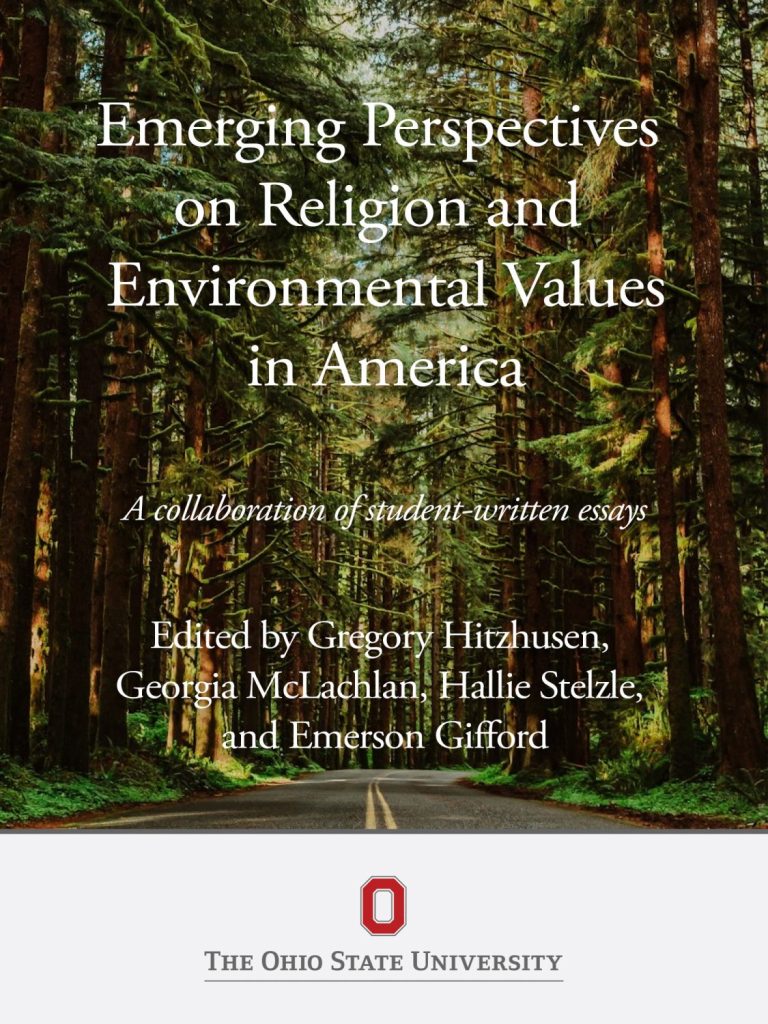
Emerging Perspectives on Religion and Environmental Values in America
"Emerging Perspectives on Religion and Environmental Values in America (EPREVA) is a student-written collaboration which explores the numerous, diverse ways in which religious, spiritual, and philosophical beliefs permeate into environmental topics." -

Religion and Environmental Values in America
"Religion and Environmental Values in America explores the emerging and increasingly important topic of religion and sustainability, with particular attention to first understanding what it takes, philosophically and practically, to overcome polarizing debates about such topics and to understand environmental issues at their roots. The book then examines a range of case studies highlighting key areas of faith-based sustainability solutions." -

The Top Five Regrets of the Dying
"After too many years of unfulfilling work, Bronnie Ware began searching for a job with heart. Despite having no formal qualifications or experience, she found herself working in palliative care.Over the years she spent tending to the needs of those who were dying, Bronnie's life was transformed. Later, she wrote an Internet blog about the most common regrets expressed to her by the people she had cared for. The article, also called The Top Five Regrets of the Dying, gained so much momentum that it was read by more than three million people around the globe in its first year. At the requests of many, Bronnie now shares her own personal story.Bronnie has had a colourful and diverse past, but by applying the lessons of those nearing their death to her own life, she developed an understanding that it is possible for people, if they make the right choices, to die with peace of mind. In this book, she expresses in a heartfelt retelling how significant these regrets are and how we can positively address these issues while we still have the time.The Top Five Regrets of the Dying gives hope for a better world. It is a story told through sharing her inspiring and honest journey, which will leave you feeling kinder towards yourself and others, and more determined to live the life you are truly here to live. This delightful memoir is a courageous, life-changing book." -
Central Ohio Food Waste Action Plan
"Every day, Central Ohioans landfill nearly a million pounds of the very thing that nourishes and sustains us – food. The amount of food wasted in Central Ohio, and throughout the U.S., has grown over the decades and recent years, and the social, economic, and environmental impacts of this wastefulness is enormous. Central Ohio’s community mindset and willingness to collaborate can change this narrative. Reducing food waste is within our control. For this reason, organizations, businesses, non-profits, government agencies, schools, and communities have come together to form the Central Ohio Food Waste Initiative and work collectively to tackle the issue of food waste. Together, we strive to cut food waste in half by 2030. To accomplish this, we need your help. Join us by learning more and taking action."