
Search
1263 items
-

Bishop Hartley High School vermi-composting bins
Bishop Hartley instructors Ann Hawk and Rick Kohut maintain vermi-composting bins in each of their classrooms. They enjoy having it to teach their students the science behind the eco-friendly decomposition process. Maintenance is relatively low - occasionally needing to add shredded paper to soak up some of the moistness. -

Bishop Hartley High School Care 4 Creation faculty committee
Bishop Hartley High School has created a Care 4 Creation faculty committee to plan for long-term school initiatives. The committee is open to instructors from any academic discipline there. -

Bishop Hartley High School Care 4 Creation student association
Bishop Hartley High School Care 4 Creation student association is a student-led organization that promotes and carries out creation care related projects at Bishop Hartley High School. One example includes the student led climate strike at the school. -

Engaged Organizations: Orita's Cross Freedom School
The mission of Orita's Cross Freedom School is to cultivate student's natural sense of curiosity and skills to become agents of change within their community. They are a solution-oriented group, addressing pressing societal issues such as racism, gentrification, gender inequality, and the prison industrial complex. Some ways that the school promotes learning through doing includes civic engagement demonstrations, mentoring, and cultural awareness programs. -

Engaged Organizations: Black Church Food Security Network
The Black Church Food Security Network strives to provide fresh produce to historically Africa American churches within the Baltimore Metro area. Their popup farm stands provide convenience to the public as they are able to set up during times when congregation members typically gather. Ideally, members will either start their own gardens on site or expand ones that they currently maintain. Often, the farmers or urban growers will offer to lead bible studies and include food security issues as part of the sessions. -

Toledo Grows: Community Supported Agriculture (CSA)
Community Supported Agriculture is run by grassroots organization Toledo Grows. Benefits of being a CSA shareholder include receiving weekly shares of quality, fresh farm products. Shareholders also can choose between a full share (portioned for a family of 3-4 for the week) or a half share (portioned for 1 or 2).
Members support local farmers using sustainable growing methods—no harmful chemicals; receive a variety of vegetables and herbs, including many “staples” such as carrots, lettuce, peppers, onions, etc.—whatever is ready that week; experience new vegetables; and receive recipes and tips on cooking them. -

Engaged Organizations: National Council of Churches Eco-Justice Programs
The National Council of Churches (NCC) discuss their work through their eco-justice programs on their website:
"The National Council of Churches has been a prophetic voice for justice and peace for its entire existence. In recent years, the NCC has been involved in a diverse range of issues such as poverty alleviation, protecting the environment, racial justice, and responding to the particular concerns of women. The NCC continues to remain engaged in these areas; however the primary program work in some cases has been spun off to new organizations that continue to bring the ecumenical community together to struggle for justice." -
Engaged Organizations: Web of Creation
The Web of Creation website discuss their organization aim and services that they provide:
"The Web of Creation was established to foster the movement for personal and social transformation to a just and sustainable world from religious perspectives. To that end, the information at this site will:
-Connect you with ideas, resources and strategies for doing eco-justice
-Inform, inspire, encourage, educate you about eco-justice
-Support you in your efforts to live, work and pray in ways that promote eco-justice
The Web of Creation has also been developed to provide information and connections for theology students interested in environmental ministry." -

The Yale Forum on Religion and Ecology at Yale
The Forum on Religion and Ecology at Yale website provides an overview of the scope of the environmentally related topics covered on their forum:
"The Forum on Religion and Ecology at Yale is an international multireligious project. With its conferences, publications, and website, it is engaged in exploring religious worldviews, texts, and ethics in order to broaden understanding of the complex nature of current environmental concerns. The Forum recognizes that religions need to be in dialogue with other disciplines (e.g., science, economics, policy, gender studies) in seeking comprehensive solutions to both global and local environmental problems." -
Pedal Power Report
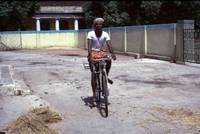
Technology for the Poor, a non-profit charitable organization based in Westerville, Ohio, discuss their design and construction of their dual-purpose bicycle in this excerpt from their manual below:
"This manual describes the design and construction of a device which, when attached to a standard bicycle, will permit it to be used as a pedal‑power machine. The resulting machine, known as a dual-purpose bicycle, can be used to power numerous small‑scale mechanical devices such as grain threshers, grinders, water pumps, electrical generators, and a variety of small machine tools. When desired, the dual-purpose bicycle can be converted from its transportation mode to its pedal‑power mode, or vice versa within a matter of minutes." -
Wind Energy for Earthkeepers
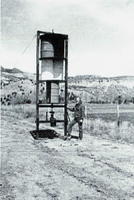
Technology for the Poor, a non-profit charitable organization based in Westerville, Ohio, discuss their design for low cost wind energy in this excerpt from their manual:
"In recent decades due to the search for renewable energy, many efficient wind generators have been developed and tested. Today, we see enormous wind generators dotting the landscapes of many states. Wind generators, especially the recent ones, are quite sophisticated, costly and needs expertise to maintain and operate. The most appropriate wind machine for use in less income countries was found to be a simple machine invented by a Finnish Engineer, Savonius." -

Low-Cost Construction Techniques for Earth Keepers
Technology for the Poor, a non-profit charitable organization based in Westerville, Ohio, discuss their techniques for low cost construction from an excerpt from their manual:
"The Construction Techniques described in this manual use straw as filler in wall sections. It further describes how one need not have to bale the straw to use it for wall construction. The author used the techniques described in this manual to build plastered straw structures in India and Pennsylvania. The pictures in the following pages should provide sufficient information for anyone to construct a low-cost, earth-friendly building using straw as building material for the walls." -
Engaged Organizations: Wild Church Network
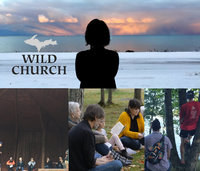
The Wild Church Network website describes their focus on spiritually re-connecting to the outdoors:
"We are a growing network of pastors and spiritual leaders, who have made bold moves to launch new expressions of church outside to re-acquaint, re-cover, and re-member our congregations as loving participants of a larger community. In this age of mass extinctions, we feel burdened by the love of Christ to invite people into direct relationship with some of the most vulnerable victims of our destructive culture: our land, our waters, the creatures with whom we share our homes.
And, there, people remember that they belong to a larger beloved community. Along the way, we have remembered that our Christian tradition of spiritual transformation has always been rooted in the actual local wilderness." -

Engaged Organizations: Scaling Up Nutrition
Scaling Up Nutrition discuss their vision and goals on their website:
"Since 2010, the SUN Movement has inspired a new way of working collaboratively to end malnutrition, in all its forms. With the governments of SUN Countries in the lead, it unites people—from civil society, the United Nations, donors, businesses and researchers—in a collective effort to improve nutrition. The SUN Movement Strategy and Roadmap (2016-2020) has helped illuminate the importance of nutrition as a universal agenda – and one which is integral to achieving the promise of the Sustainable Development Goals (SDGs).
To realise the vision of a world without hunger and malnutrition, the SUN Movement Principles of Engagement guide actors as they work in a multi-sectoral and multi-stakeholder space to effectively working together to end malnutrition, in all its forms. These principles ensure that the Movement is flexible while maintaining a common purpose and mutual accountability." -

Engaged Organizations: 1,000 Days
1,000 Days non-profit organization for women and children discuss the work that they do on their website:
"1,000 Days works to win support for investments in the nutrition and well-being of mothers, babies and toddlers in the U.S. and around the world. We make the case to policymakers, global leaders and those who influence them that brighter futures begin with ensuring mothers and children everywhere have a thriving first 1,000 days.
From advocating for evidence-based dietary guidelines for pregnant women and young children to providing parents with educational resources and content on baby and toddler feeding, 1,000 Days is committed to nourishing healthy beginnings. " -
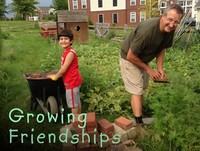
Profile: Todd Marti
Todd Marti, a parishioner at St. Francis of Assisi Parish in Columbus, serves as a “garden steward” for the community garden located on the grounds of the Upper Arlington Lutheran Church at Mill Run. Todd’s garden stewardship is a clear reflection of his care for creation and his fellow man. Each year vegetables are planted on two-thirds of the 12,500 square feet garden. When the tomatoes, beets, squash, lettuce and other vegetables are harvested they are donated to the Hilliard Free Lunch Summer Camp for Kids, and Mid-Ohio Food Bank partner pantries. On average 10,000 pounds of produce is harvested and donated annually. Over the life of the garden 130,000 plus pounds of produce have been donated. The recipient of the Franklin Park conservatory Growing to Green Gardener of the Year Award in 2012, Todd utilizes innovative gardening practices such as companion planting and sequencing of multiple crops to enhance output. The garden helps preserve God’s creation by composting food waste and coffee grounds from local coffee shops and restaurants. Yard waste is also composed including that generated by St. Francis of Assisi from its flower and vegetable gardens.
When he is not working in the community garden—which he is every Saturday from spring until mid-November--or recruiting volunteers to help with weeding, planting and harvesting, Todd can be found at his day job as an Assistant Attorney General for State of Ohio.
-
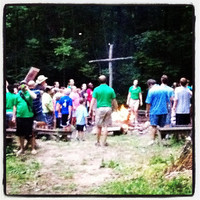
Engaged Organizations: Lutheran Outdoor Ministries in Ohio
Lutheran Outdoor Ministries in Ohio discuss their camp facilities, their mission, and their vision on their website:
"Lutheran Outdoor Ministries in Ohio owns and operates 2 camp facilities, Camp Luther and Lutheran, Memorial Camp with support and direction from the Evangelical Lutheran Church of America.
Mission: Bringing people together to experience Christ through natural settings and programs.
Vision: Connecting all people to faith and nature for a changing world."
The 5th graders at St. Vincent de Paul in Mt. Vernon, OH participate annually in the summer camp program at Lutheran Memorial Camp. -
-

Cardinal Peter Turkson to present Laudato Si, the Pope's environmental encyclical letter
The School of Environment and Natural Resources, the College of Food, Agricultural and Environmental Sciences, and many other partners are pleased to announce the preliminary details of Cardinal Peter Turkson’s visit to Ohio State from Oct. 30-Nov. 2, 2015. Information about the visit and related events can be found at the link below -

OSU Creates Opportunity to Support Food Security Efforts in Ohio and Ghana
In association with Cardinal Peter Turkson’s visit to OSU and his presentation with OSU President Michael Drake at Mershon Auditorium on Monday, Nov. 2, 2015, at 7:00pm, 100% of ticket proceeds will go towards supporting urban gardening projects in Columbus and in Accra, Ghana.
If you would like to make a donation to support these projects beyond the donation made to reserve your ticket for the Nov. 2 event, please make donation checks payable to “The Ohio State University” and indicate on the memo line: “For Columbus-Ghana Urban Gardening Projects” and send checks to:
The School of Environment and Natural Resources
Ohio State University
210 Kottman Hall
2021 Coffey Rd.
Columbus, OH 43210
ATTN: Columbus-Ghana Donations -

Bloomberg Business Posts Infographic to Show “What’s Really Warming the World?”
Occasionally, an outstanding graphic emerges to help us understand some of the complexities of climate science, such as this recent series of graphs published by Bloomberg Business. If you have wondered how all the various factors and forcings involved in global warming interact, these infographics based on data from NASA’s Goddard Institute for Space Studies are very helpful. -

Cardinal Turkson Generates Keen Response at OSU
This is an account of the presentation by Cardinal Turkson during his visit to the Ohio State University on November 2, 2015. Cardinal Turkson came to OSU to discuss Pope Francis' Laudato Si. This account's author, Gregory Hitzhusen, teaches Religion and Environmental Values at OSU and was an attendee. This detailed description makes the reader feel like they attended the event in reality! -

Laudato Si' Adds Catholic Voice to Diverse spectrum of Religious Creation Care Views
Here are some links to the encyclical and related educational materials and statements that have been developed by different religious communities, including a letter of support from over 400 Rabbis, and a new Islamic statement on the environment:
Laudato Si’: Praise Be To You: On Care for Our Common Home: (html)
Laudato Si’ study guide from the US Conference of Catholic Bishops: (pdf)
National Catholic Reporter Reader’s Guide to Laudato Si: (pdf)
The Shalom Center with its history of ecological practices: (url)
Announcement of the Rabbinic Letter on the Climate Crisis: (url)
Islamic Declaration on Global Climate Change: (url)
United Methodist Bishops Pastoral Letter: God’s Renewed Creation: Call to Hope and Action: (url)
Lutheran Study Guide to Pope Francis’ Letter on Climate Change: (pdf)
Evangelical Declaration on the Care of Creation: (url)
National Association of Evangelicals 2015 Call to Action on Creation Care: (url)
A Buddhist Declaration on Climate Change: (url)
Buddhist Climate Change Statement to World Leaders 2015: (url)
Black Church Climate Statement: (url)
-

National Association of Evangelicals Approves Resolution on Creation Care
On Oct. 20, 2015, the National Association of Evangelicals (NAE) announced a resolution to adopt the creation care principles of the Lausanne Cape Town Commitment. The NAE press release describes the following:
The Lausanne Cape Town Commitment calls Christians worldwide to:
Adopt lifestyles that renounce habits of consumption that are destructive or polluting;
Exert legitimate means to persuade governments to put moral imperatives about political expediency on issues of environmental destruction and potential climate change; and
Recognize and encourage the missional calling both of (i) Christians who engage in the proper use of the earth’s resources for human need and welfare through agriculture, industry and medicine, and (ii) Christians who engage in the protection and restoration of the earth’s habitats and species through conservation and advocacy. Both share the same goal for both serve the same Creator, Provider and Redeemer.
This resolution signals a strong commitment from the NAE, a member organization of Evangelical groups representing approximately 30 million Americans, and it follows from the principles outlined in an NAE report from 2011, Loving the Least of These: Addressing a Changing Environment.
The NAE’s position on care of creation adds another significant voice to the examples of environmental statements from religious communities in 2015, alongside the Pope’s encyclical, Laudato Si’ and many others -
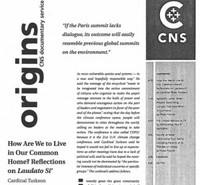
Origins Publishes Full Text of Cardinal Turkson's Ohio State Speech; Highlights Link to COP-21
The Catholic News Service publication “Origins,” which is delivered to Catholic bishops, clergy, and diocesan staff across the country, recently gave front page attention to the full text of Cardinal Peter Turkson’s November 2 address at The Ohio State University (OSU). This prominent placement has provided a broad, national reading for the speech that Turkson delivered to a live audience of nearly 1,500 at Mershon Auditorium and several hundred other live stream viewers across Ohio. The remarks published in Origins also include some expanded text beyond what Cardinal Turkson was able to present in his evening program at OSU, which can inform further dialogue and response at OSU and beyond.
In these remarks, Turkson highlights the role of the encyclical, Laudato Si’, in calling attention to the great environmental challenges of our time, sparking individual and political commitment to address climate change and other challenges, and inspiring an “ecological conversion” towards an “integral ecology” that joins natural, social, and spiritual dimensions to effect positive change. Within this integral framework, Turkson highlights several issues that receive particular attention in Laudato Si’, including: the relation between the poor and the planet, the interconnection of everything, a critique of the new “technocratic paradigm,” the value of all creatures and the importance of humans to ecology, the need for “forthright and honest debates,” the serious responsibility of international and local policy, the “throwaway culture,” the need for new lifestyles, and an “invitation to search for other ways of understanding economy and progress.”
The full speech closes with a short overview of the six chapters of Laudato Si’ and looks forward to the hope that the encyclical will inspire real dialogue and meaningful political action at the COP-21 negotiations in Paris that began today.