
Search
1263 items
-

The People’s Climate March
The People’s Climate Movement is planning a march on April 29 in Washington DC. They are aiming to stand up to protect the future of the planet, the safety of communities, and the health of families. Their website contains their platform, which includes rapidly reducing greenhouse gas and toxic pollution, protecting human rights and native ecosystems, and many more goals. Disclaimer: this event is highly political. -

Theology and Ecology: How to Keep Updated
The relationship between faith groups and the environment is constantly developing and expanding. One way to stay informed or learn more is to explore the insightful websites and articles posted below.
The National Catholic Reporter is a news source that reports on church and social issues, and they publish a regular column called Eco Catholics. They keep an updated list of articles about the Catholic faith and it’s relation to issues related to the environment.
The United Methodist Women is a faith community with a huge focus on environmental justice. They have made climate justice one of their four social justice priorities and started an organization, “Be Just. Be Green.” Their website includes tools to aid in sustainable living and advocacy in a theological way, a carbon footprint calculator, articles on climate justice, and a simulation experience to better understand environmentally downgraded communities.
The United Methodist Church on Relief focuses on alleviating human suffering around the globe. One of their initiatives is to end undernutrition and hunger through sustainable agriculture and food security. Their program focuses on partnering with organizations that empower families to create sustainable and self-sufficient solutions to assist in food security. Articles related to faith groups and sustainable agriculture can be found on their website.
Creation Justice Ministries educates, equips and mobilizes Christian communions/denominations, congregations and individuals to protect, restore, and rightly share God’s Creation. Based on the priorities of its members, with a particular concern for the vulnerable and marginalized, Creation Justice Ministries provides collaborative opportunities to build ecumenical community, guides people of faith and faith communities towards eco-justice transformations, and raises a collective witness in the public arena echoing Christ’s call for just relationships among all of Creation. Their website contains resources for action and an updated blog.
GreenFaith is an interfaith coalition for the environment that works with houses of worship, religious schools and people of all faiths to help them become better environmental stewards. Their mission is to inspire, educate and mobilize people of diverse religious backgrounds for environmental leadership. They believe that protecting the earth is a religious value, and that environmental stewardship is a moral responsibility. -

Engaged Organizations: United Methodist Church and Sustainable Agriculture
The United Methodist Committee on Relief is a non-profit organization that aims to alleviate human suffering around the world. They are a ministry through the General Board of Global Ministries that believe all people have God-given worth. They advocate for hope and healing in more than 80 countries around the globe. One of their initiatives is to work towards sustainable agriculture and food security.
This program focuses on partnering with organizations that empower families and communities to create self-help and sustainable solutions to food security. They are currently partnering with eighteen organizations to implement food security projects in twenty-two countries including the United States. Their key priorities include:
Providing resources and technical support rural families need to grow or buy enough food to maintain a healthy and productive life.
Building the capacity of farmers, pastoralists and fishermen to reverse the trend of poor land and water resource management.
Strengthening the impact of agricultural projects by improving household health and nutrition behaviors with a specific focus on pregnant women and children under age 5.
Supporting the introduction and use of appropriate agricultural technology that is suitable to the knowledge, skills, capacities, interest, and economics of people and communities.
In conjunction with these priorities, the UMCOR places a focus on nutrition. Through their sustainable agriculture and food security program, they educate farmers, raise awareness of global undernutrition, and urge governments in developing nations to support sustainable agriculture. Additionally, they endorse the Scale up Nutrition framework which works to improve nutrition around the globe, especially in young children. Their initiative, called the 1,000 Days Movement, works to improve the nutrition in the first 1,000 days of a child’s life which can have an exponential impact on the future of these lives. The UMCOR encourages faith communities to support and work with the Scale Up Nutrition movement and assist in the end of undernutrition through sustainable agriculture. -
Engaged Organizations: GreenFaith: The Interfaith Partners for the Environment
GreenFaith is one of the oldest religious-environmental organizations in the United States. They were originally named Partners for Environmental Quality and were founded by Jewish and Christian leaders in New Jersey. They believed communities needed an organization to connect religious traditions with the environment. Their early work included promoting the use of renewable energy in religious institutions, convening a conference that drew leaders from religious, academic, governmental, and business sectors to talk about environmental protection, and encouraging the use of green energy to the general public. In the early 2000s, they had their first Environmental Health and Justice Tour in Newark where they explored the different proportions of suffering to urban communities. It was then that they changed their name to GreenFaith.
Since then, GreenFaith has launched programs all over the state of New Jersey and beyond. Lighting the Way is one of their programs that installed solar panels on religious institutions around the state. Between 2004 and 2006, they organized Sustainable Sanctuaries and Green Flag, GreenFaith Schools Pilot Program. Both took initiative to integrate environmental care into the worship of religious communities and faith-based schools to help “green” their establishments. Since then, the have been honored at Windsor Castle, featured in documentaries including Renewal, and recognized with the Energy Star for Congregations Special Award from the EPA.
In order to accomplish these impressive goals, GreenFaith has stayed committed to their beliefs that protecting the earth is a religious value and environmental stewardship as a moral responsibility. Additionally, their three core values, spirit, stewardship, and justice, are what they use to guide their work and define their goals. Spirit is their belief that religious traditions are sacred and that people grow spiritually through a strong relationship with the Earth. Stewardship is their belief that religious members have the opportunity to lessen their impact on the environment. Justice is their belief that all people deserve a healthy environment regardless of their race or income. -
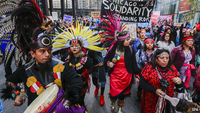
Standing Rock’s Silver Lining
The Standing Rock situation, although a difficult and problematic time, had its own silver lining. Because of this issue and the publicity it received, many religious groups have put their difference aside to support the native people whose land is at risk. This has had an impact on healing the divide that has existed between native tribes and western organized religions. -
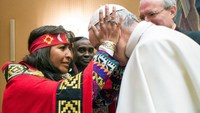
Pope Francis on the Dakota Access Pipeline
Pope Francis has released a statement on the issue of developing land that is spiritually significant to native people. There have been many incidents in recent years where land was taken from natives in order to further economic development of a country at the cost of the rights of native people in regards to practicing their religion. Although it was never officially stated, this statement was in regards to the approved completion of the Dakota Access Pipeline, which will interfere with sacred land of different Native American tribes. -

Currency Causing Issues
The Bank of England released a new £5 note that caused some controversy with many different religious groups recently. The Bank is not disclosing what products are being used to make the tallow in each notes, and different animal products may be the answer. Depending on how these new notes are made, their use may go against the teaching of many different religions, ranging from Judaism to Buddhism. -
Engaged Organizations: Earth Ministry
Earth Ministry is an organization that engages faith communities in environmental stewardship and advocacy. Based out of Seattle, Washington, their mission is to inspire and mobilize the religious community to play a leadership role in building a just and sustainable future. They support many programs in including Faithful Advocacy, Greening Congregations, and Washington Interfaith Power & Light. In addition, they have been working to ban toxic chemicals, protect wildlife habitat and public lands, and promote clean energy for a stable climate and sustainable economy. Earth Ministry has a country wide reach and their website contains many helpful and informative resources. -
The Vocation of Agriculture: to Till and Keep God’s Creation
The Vocation of Agriculture: to Till and Keep God’s Creation is a discussion on the calling of agriculture on Saturday March 25th at St. Joseph Church in Plain City. The challenges of rural workers, rural parishes, and rural communities will be explored. There will be many speakers through the day including Sr. Christine Pratt and Dr. Hitzhusen both of OSU. Participants are encouraged to read Laudato Si and the Vocation to Agriculture by Cardinal Peter K.A. Turkson before attending. -

The United States Conference of Catholic Bishops: Environment Justice Program
The United States Conference of Catholic Bishops considers Environmental Justice to be a core issue that requires the action of all Catholics. Their response to this issue has been the Environment Justice Program. This is a program of the Department of Justice, Peace, and Human Development that educates and motivates Catholics to a deeper reverence and respect for God’s creation. They encourages Catholics to address environmental problems, especially as they affect poor and vulnerable people. -

Engaged Organizations: Catholic Rural Life
Catholic Rural Life is a national, Catholic nonprofit organization dedicated to the importance of rural America. Their mission is to apply the teachings of Jesus Christ for the social, economic, and spiritual development of rural America while strengthening and sustaining the Church. They advance their mission through three distinct areas of impact: ethical food and agriculture, rural outreach and ministry, and stewardship of creation. -

Engaged Organizations: Catholic Relief Services
Catholic Relief Services strives to carry out the commitment of the Bishops of the United States to assist the poor and vulnerable overseas. They promote human development by responding to major emergencies, fighting disease and poverty, and nurturing peaceful and just societies. A major initiative includes fighting the effects of climate change on the poor. -

St. Francis Pledge
The St. Francis Pledge is a commitment to respond to the moral call for action on climate change. The commitment includes praying, acting, and advocating to solve climate change. There have been over 10,000 individuals and 75 institutions that have taken the St. Francis Pledge. They have committed to living out the Catholic values through deep reflection, concrete action, and advocacy. -

Engaged Organization: The Catholic Climate Covenant
The Catholic Climate Covenant is the US Catholics response to the Church’s call to care for creation and care for the poor. They are based out of Washington, DC, and are supported by 14 national partners. Among their many ambitions, they aim to teach Catholics on climate change, equip them to care for creation and the poor, and inspire leaders to take actions. They have helped 140 Creation Care Teams lead their communities, organized 7 national press conferences, and helped supporters send over 10,000 letters in support of climate change. Additionally, their work has been mentioned in over 3,000 media stories. Their website includes environmental programs, teachings, and resources. -
Carbon Fasting
Many faith organizations, including Interfaith Power & Light, Earth Ministry, and Creation Justice Ministries, promote carbon fasting as a way to make small, personal changes while also drawing attention to society’s unsustainable uses of carbon. Especially in the time of Lent, they encourage everyone to be more mindful of their carbon footprint and as a Lenten discipline, participate in self-imposed restrictions of carbon use. There are many resources provided on how and why to take part in a carbon fast. -

Engaged Organizations: Cool Harvest
Cool Harvest is a food, faith, and climate program created by Interfaith Power & Light. Cool Harvest focuses on responding to climate change by educating members on climate-friendly food choices. Their website aims to provide resources in order to help others understand the harsh toll modern agribusiness takes on the atmosphere. They provide tips and recipes on food and gardening and also informational movies and stories on the success of others. -
History Professor Explains Religious Origins of American Environmentalism
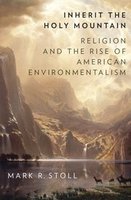
Texas Tech historian Mark Stoll‘s latest book, Inherit the Holy Mountain: Religion and the Rise of American Environmentalism (Oxford University Press, 2015), details how religion provided early American environmental leaders with the moral and cultural basis to champion the protection of the natural world.
Stoll argues in part that Pope Francis’ encyclical, Laudato Si’, is nothing new, but points environmentalism back towards its moral and religious roots. -
Engaged Organizations: Creation Justice Ministries
Creation Justice Ministries is a grassroots organization that works to support ecumenical creation care. Born from the National Council of Churches USA, this group has a long history of advocating for creation justice on local and national levels. Creation Justice Ministries represents the creation care and environmental justice policies of major Christian denominations throughout the United States. They seek justice for all of God’s creation, including the human beings who live in it. They do so by drawing on the rich heritage of Christian scriptures and traditions which not only say to till and keep the Earth, but also to act for racial, economic, and environmental justice. -

Engaged Organizations: The General Board of Church and Society
The General Board of Church and Society (GBCS) is one of four international general program boards of The United Methodist Church. They are defined by its five areas of ministry: Public Witness, Advocacy Administration, Ministry of Resourcing Congregational Life, United Nations Ministry, and Communications. Their website contains ways to get connected, topics to explore, and ways to take action. -

Engaged Organizations: JustFaith Ministries
JustFaith Ministries is a nonprofit organization that forms, informs, and transforms people of faith by offering programs and resources to assist in their commitment to build a more just and peaceful world. They strive to prepare people of faith for the call of the Gospel to help heal the world and experience a deeper faith and more fulfilling life by doing so. Since 2001, over 50,000 people have completed a JustFaith Ministries program. A quote from Jack Jezreel, their founder, on the organizations goals: “We change people – and people change the world.” -

Eco Stewards Program
The Eco-Stewards Program is a grassroots community that shapes young adult leaders through place-based experiences that connect faith and the environment. They are looking for young adults with an interest in faith and the environment to join and explore this year’s theme of Water is Life: Journeying Towards Justice on the James River. The program is held in Richmond, Virginia, from June 5 -10. Applications are due by March 15, and the cost which includes means, housing, and transportation is $375. -

The Vocation of Agriculture: to Till and Keep God’s Creation Postponed
This event has been postponed to a later date. When a new date is decided upon this blog will be updated. The Vocation of Agriculture: to Till and Keep God’s Creation is a discussion on the calling of agriculture. The challenges of rural workers, rural parishes, and rural communities will be explored. There will be many speakers throughout the day including Sr. Christine Pratt and Dr. Hitzhusen both from OSU. Participants are encouraged to read Laudato Si and the Vocation to Agriculture by Cardinal Peter K.A. Turkson before attending. -
Cal DeWitt on Laudato Si’
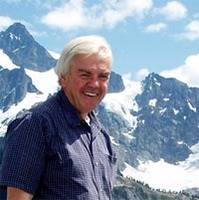
Earth Stewardship and Laudato Si is an article written by Cal DeWitt, a professor of Environmental Studies at the University of Wisconsin- Madison. His article was first presented at a session on religion and ecology at a meeting of the Ecological Society of America. It was then published in the Quarterly Review of Biology and has been one of the top five most read articles in the past five months. Dewitt discusses his response on the Pope’s encyclical Laudato Si pulling from his scientific background in environmental studies and scriptures from the Bible. -
Legal Rights Granted to New Zealand River
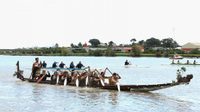
The Whanganui River in New Zealand has been granted the legal rights of a human as of Wednesday March 15, 2017. The Maori tribe, who call the river Te Awa Tupua, have been fighting for its protection since 1873. The case is one of New Zealand’s oldest in history with more than 140 years of legal struggles. The 90 mile Whanganui River will now be represented by two legal guardians, one from the Maori tribe and one from the government. According to NPR, the New Zealand government stated that they recognized the deep spiritual connection between the tribe and its ancestral river and their view of the river as an invisible and living whole. -
Earth Day 2017: Know the Creator through Creation
The Catholic Climate Covenant has produced Know the Creator through Creation, an educational program to help celebrate Earth Day. This is the second year they have offered this resource that includes prayers, scripture readings, videos, discussion questions, and suggested activities to help teach about climate change. Their goal is to increase climate literacy and assist Catholics in embracing their call to care for creation. There are three different age specific programs between 30 minutes to an hour long.