
Search
1263 items
-
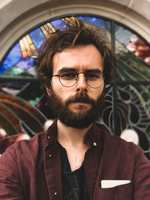
Religion-Environment Photo Contest Winner: Jacob Taylor Biography
Jacob Taylor is a lifelong resident of the Mill Creek watershed in SW Ohio. He earned his BA at the University of Cincinnati for literary and cultural studies, and is currently studying environmental theology at the Methodist Theological School in Ohio. His interests include community gardening, herbalism, reading the mystics, and pining for the revolution.
Jacob’s photo won first place with the title, “Theotokos in the Apothecary.” He states this about his photograph: “The guiding question behind my work concerns what it means to live incarnationally & eucharistically in the age of the Anthropocene. How can I, with Mary as a model, bear Christ into a world where the heavy foot of human domination and extractive economics has driven our common home into a mass extinction event? I continue to draw strength and meaning from my tradition’s central sacred story of incarnation — it gives me the courage to keep moving and struggling towards shalom against the odds, trusting the mystery of “God with us” as we face this bewildering moment in human/geological history. Theotokos calls me to remember that something profound occurs when we consent to the invitation of God. At the core of the Christian eschatological vision is the unwavering assertion that all things are being made new and that human beings are invited to conspire with God in this process of restoration. May we, with Mary, have the courage to say yes, come hell or high water. ” -

Religion-Environment Photo Contest Winner: Tony Losekamp Winner
Tony Losekamp is a second year seminarian in the Roman Catholic Archdiocese of Cincinnati, Ohio. He graduated from The Ohio State University with a Bachelor of Science in Environment and Natural Resources in 2017. He has been Catholic his whole life and chose to study environmental sciences out of a love of science and nature and a desire to help make the world a better place. While in college his faith became his own when he had to decide for himself to go to Mass on Sundays, go on retreats, join Bible Studies, go to adoration to worship Jesus in the Eucharist, and build a personal relationship with Jesus. At some point he realized that if he was going to be Catholic, he was going to have to give everything to the one who gave him everything. In giving himself completely to Jesus, he became more free to love. He finished his degree while giving more and more time to Saint Paul’s Outreach and the Newman Center, gaining missionary experience and building a love for life. That is what brought him to Mt. St. Mary’s Seminary of the West.
Tony’s photo won second place in the Religion-Environment photography contest with “Spiritual Tree.” Tony stated that, “I took this photo in Hocking Hills, Ohio, on the trail between Old man’s cave and Cedar Falls. It was spring and the forest was exploding with life. The air hummed with excitement and power that is comparable with excitement and power of a rich spiritual life in communion with God.” -

EarthConnection Cincinnati
EarthConnection, a ministry of the Sisters of Charity of Cincinnati, is a center for learning and reflecting on how to live lightly on Earth. They focus on the interconnections of all of Creation and strive to integrate spirituality and sustainability throughout their programs. Their website lists all of the programs they have to offer and they all include a focus on sustainable agriculture, alternative energies, ecojustice, and ecospirituality. -
Engaged Organizations: Cincinnati Climate Change Task Force
In 2009, the Archdiocese of Cincinnati signed on to the St. Francis Pledge to Care for Creation. Since then, they have started their own Climate Change Task Force. This task force has adopted the mission of committing themselves to work towards a sustainable world based off of the responsibility to Care for God’s Creation. They work to implement the five pillars of the pledge: praying, learning, assessing, acting, and advocating for the environment and the poor. -
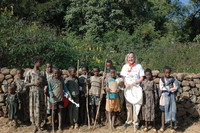
Ethiopia’s Church Forests
The beautiful forests of Ethiopia are rapidly disappearing due to human activity. However, the forests around the Ethiopian churches remain intact and teeming with diverse life. Dr. Margaret D. Lowman, known as Canopy Meg, has teamed up with one of these churches to study and survey the wildlife, mostly insects in the area. The children of the church community are being engaged to become the next generation of stewards in order to ensure that the forests and creatures are preserved. Project leaders also aim to help build walls in order to keep these forest areas more protected from human development. -
Catholic Bishops Push Ohio Towards Clean Energy
The Catholic Bishops of Ohio are against an indefinite freeze of Ohio’s clean energy target standards. The Ohio Mandates Study Committee has called for this freeze due to a need for continual studying of energy standards and their impact on the state. The Bishops, however, feel that there is no need to freeze the standards, as alternative energy sources benefit the environment as well as society.
This is not the first time that the Bishops of Ohio have voiced such a stance. Back in 2014, a similar issue arose with SB 310, which proposed the original freeze of Ohio’s advanced energy portfolio standard that was established by SB221. The Bishops voiced opposition to SB 310 at that time. -
Balinese Water Temples
Balinese Water Temples have been an integral part of the agricultural rice paddy systems in Bali for over 1,000 years. Water is distributed from the Supreme Water Temple of Bali throughout the land. This distribution cycle involves neighbors meeting in a democratic subak to discuss the synchronization of their planting.
Steve Lansing's video link below goes into further detail about the Bali water temples. -
The People’s Pilgrimage
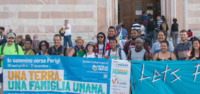
COP-21 was recently held in Paris, where leaders from countries all over the world met to discuss potential climate change plans. In addition, hundreds of thousands of people of various faiths made their way to the convention. They journeyed to Paris in a pilgrimage of solidarity. People of all faiths were in attendance to rally together and show how religious consciousness is now linked with environmental stewardship.
One group walked 1,500 km. from Rome to Paris. Among this group was Yeb Saño, the representative of the Philippines in COP-19. He has become a well-known activist, as his homeland was ravaged by Typhoon Haiyan during COP-19. The pilgrimage brought copies of Laudato Si, the Islamic Declaration on Global Climate Change, and the Buddhist Climate Change Statement to World Leaders 2015 to show how invested the faith communities are when it comes to climate change and environmental issues. -
The Francis Effect
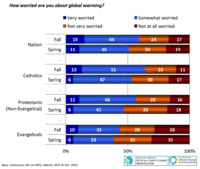
With the release of Laudato Si’ and the visitation of Pope Francis to the United States, there has been a noticeable increase in the number of both Americans and Catholic Americans who have demonstrated concern over Climate Change. Individuals of various faiths have expressed more trust the Pope due to the overwhelmingly positive reception of his message. -

The People’s March
In addition to the People’s Pilgrimage, the People's March was another religious based event that took place during COP-21. The People’s March, was an organized demonstration in major cities around the world. For those who could not attend the convention in Paris, marches were held around the world to demonstrate solidarity for environmental stewardship and justice. Many people who participated in this march in Paris were also members of the People’s Pilgrimage. However, in Paris there was also conflict due to lingering tensions from the November 13th terrorist attack. -

Water Issues in Appalachia
Some people may think that water issues in the United States only exist in the west. This is far from the truth. In addition to algae bloom issues throughout the midwest, the Appalachian region of the United States has been experiencing severe water contamination due to mining and chemical spills for the past several years. Fortunately, the residents of this region are kept informed by the Catholic Committee of Appalachia. Once a year, residents from all over the state meet in one location to discuss the issues of their region and try to come up with solutions. -

Environmental Statement – Evangelical Church
Evangelical Christians are calling for all people to be stewards of the earth. It is our fault that there has been so much damage done to the planet. We were entrusted to look after all of creation, and therefore, must start to take responsibility for our actions.
According to the Evangelical Declaration, The Bible tells us what our role is and what it is we must do. This statement by the Evangelical faith concedes that we must develop the earth to an extent, but we have taken it too far. We owe it to the future generations to preserve resources and help stop environmental degradation. To truly live out the Word of God, we must become more sustainable. -
Environmental Statement – American Baptist Churches
Environmental problems that exists today have stemmed from humanity’s current and past greed. Science and technology are being abused and threaten to make problems worse, even though they have the power to make things better. American Baptists advocate that we must be stewards of our home and not abuse it if we wish to continue on as a species. In order to fix what humans have caused, we are called to recognize and preserve the earth and natural resources we have. -
Environmental Statement – Church of the Brethren
The Bible is filled with examples that demonstrate our responsibility to care for all creation on our planet. From Genesis to the parables of Jesus, it is explicitly stated that we must be caring stewards of the earth. In order to reverse the damage that humankind has done, the Church of the Brethren is calling its own members and all people to action. In addition, they are also calling upon the government to be more supportive of environmental policies and clean up. -

Environmental Statement – Presbyterian Church
The Presbyterian Church has an environmental statement that is similar to many other churches, citing biblical text and discussing our responsibilities as stewards of the earth. This document goes into what humanity has done, and why the Presbyterian church is responding to the massive amount of environmental degradation. -

United Church of Christ – Environmental Ministries
The United Church of Christ has taken an active role in environmental stewardship. They have made multiple statements about various aspects of the environment. This link provided by Environmental Ministries discusses various critical environmental justice issues. If you are looking for ideas on how to live more Eco-friendly in your own life, or simply searching for a great set of resources, check them out! -

Environmental Statement – Mennonite Church
Like many other religions, the Mennonite Church has released a statement about the need to take care of our environment. They are encouraging this attitude of caring for our planet among their members by using biblical text. It focuses on helping people choose simpler lifestyles, and seeking justice for the environment. -
Environmental Statement – Episcopal Church
The Episcopal Church has issued multiple environmental statements over the years. Their foundational statement in the 1990’s was released in parts. The first part discussed environmental policy, and what must be done to preserve creation. The second part addressed taking action through the church. It involves advocacy, leadership involvement, and education. -
Environmental Statement – Lutheran Church
The Evangelical Lutheran Church in America adopted a robust environmental social statement in 1993. Many themes are similar to those voiced by other religions in that it focuses on humanity’s responsibility to the environment and the call to act as the stewards of the earth. The statement notes that problems of environmental degradation have been caused by humanity, and it is up to us to restore nature to its former condition. All people of the earth need to take part, and this statement calls for action by everyone. -

Environmental Statement – Reformed Church in America
In 1982, the Christian Action Commission of the Reformed Church in America (RCA) released a document titled “Care for the Earth: Theology and Practice.” This was given to General Synod, who then passed several resolutions outlining the Reformed Church in America’s stance on environmental issues. The Action Institute wrote the article below that discusses the resolutions that were passed. -
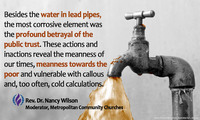
Flint Water Crisis – Religious Leaders Respond
The Flint Water Crisis has affected a large community of mostly impoverished people for a long time; however, it has only recently begun to gain attention. Pastors of different churches are claiming that the situation displays a crime against humanity itself. Many religious leaders have cited biblical texts to encourage people to reevaluate what is happening here, and to start to take better care of the earth. Some hope that attention to this crisis will help people all around the country become more aware of issues of justice and realize the importance of environmental stewardship. -
The Big Church Switch
A movement has started in the United Kingdom to get more renewable energy usage in churches and individual homes. This is due to many Christians joining together and giving up fossil fuels for lent this year. There is a simple process to get involved, which can be seen in the video. -

Flint Water Crisis – Activism
Due to the extreme conditions in Flint, Michigan, recently, many church communities of varying faiths have stepped up to provide aid. From Catholics to Jews to Muslims, all are involved in distributing free bottled water to the residents of the area. They are also committed to making sure that this sort of situation never happens again. -

Food Steward’s Pledge
The EPA is engaging faith communities on the issues of climate change and food shortages. Many people do not have access to enough nutritional food to have a healthy lifestyle. On the flip side, there are huge amounts of food that are simply wasted every day in the United States. The EPA is hoping to bridge this gap by reaching out to faith communities and helping spread the message of reducing food waste. -
The Supreme Court and The Clean Power Plan
The Clean Power Plan was designed to allow states the greatest flexibility in implementation, attempting benefiting the health of individuals by improving the quality of the air for everyone. The Supreme Court has ruled to stay the implementation of the Clean Power Plan (5-4 ruling). Many churches and faiths have banded together to express their dissatisfaction with this decision. A predominant tenet of most religious organizations is their concern with protecting the health and well-being of vulnerable communities and God’s Creation.