
Search
1263 items
-

The Case for Animal Spirituality - Part 1: Conceptual Challenges, Methodological Considerations, and the Question of Animal Consciousness
This article, written by Paul Cunningham, explores the case for nonhuman animal spirituality. Spirituality goes beyond language, reflective consciousness, or conceptual thought. Animal spirituality and participation in religious phenomena are growing areas of research at the intersection of animal studies and religious studies, this article is a small but emerging discussion of this subfield. -
Faith groups increasingly join fight against climate change
There are many faith groups that help with climate disasters. In the article, places like Louisiana, and how places that have been very important to people could soon disappear. It talks about how faith leaders and environmentalists have been working together. -
United Church of Christ Environmental Justice Ministries
"From the birth of the environmental justice movement in the 1980s to the local ministries of churches throughout the country today, the United Church of Christ has been making a profound difference in caring for God’s creation. Learn more about our history, the Creation Justice Church program, Earth Day resources, the Pollinator newsletter, Creation Justice Webinars, and the work of the UCC Council for Climate Justice." -
Faith in the Environment: The Religious Fight to Save Planet Earth
An article discussing the interfaith panel “Ways of Knowing, Ways of Living: Exploring Faith and Conservation” at the 2022 Smithsonian Folklife Festival. The author introduces the four panelists, their faiths, and their respective perspectives on encouraging intersections of faith and environmentalism, with Imam Saffet Abid Catovic representing Muslim faith, Jakir Manela representing Jewish faith, Michael Nephew representing Native American faiths, and Dr. Rachel Lamb representing (Evangelical) Christian faith. -
Tikkun Olam
"Tikkun olam is a concept in Judaism, which refers to various forms of action intended to repair and improve the world. In classical rabbinic literature, the phrase referred to legal enactments intended to preserve the social order. In the Aleinu prayer, it refers to the eradication of idolatry." -

Columbus/Central Ohio Resources
The following links are to different resources and links regarding religion and the environment in central Ohio.
Diocese of Columbus Resources:
Diocese of Columbus for Care for Creation Website
Catholic Diocese of Columbus: Creation Care Guide
Columbus Diocese 150th Anniversary Tree Planting
The Catholic Times: The Diocese of Columbus News Source
Other Columbus Resources:
Columbus Church Earns Green Spot and Energy Star Certification
Columbus Catholic School becomes Designated GreenSpot School
Columbus bonds with Ghana sister city through agriculture project
Columbus YMCA Youth Engage in 4-H Urban Gardening Program for Cultural Exchange with Youth in Accra, Ghana
Seven Congregations of Dominican Women Collaborate to Offer Sept. 10 Earth Stewardship Program in Columbus
Learn More about Climate Change in Ohio
God’s Creation, Our Common Home
Events in Columbus:
Building Regional Food Hubs: A Conference Connecting Healthy Food, Farms, and Communities
Laudato Si’ in Columbus: Bishop Campbell Regales OSU Students with Historical Overview of Catholic Tradition -

Hunger and Climate Change
As a country full of natural resources, the impact of climate change is not always realized. However, our actions impact countries all over the world that have no choice in the matter. Hunger and Climate Change describes the effects that climate change has on places around the globe and future impacts on the United States. -
International Indigenous Youth Council
The International Indigenous Youth Council is a youth-led organization of 9 chapters across Turtle Island. They seek to protect Indigenous land and culture through spiritually-guided community organizing and nonviolent direct action. IIYC was founded after the Standing Rock Indigenous Uprising of 2016, and is credited with successfully defending protecting the Cannonball and Missouri Rivers from the Dakota Access Pipeline construction. Today, they spearhead actions against policy, pipeline construction, and climate finance contributing to the climate crisis directly effecting their communities. -

An Existential Analysis of Environmental Values and the Other
This chapter from the student-written book “Emerging Perspectives on Religion and Environmental Values in America” examines nature and environmental values from a philosophical standpoint. The authors uses an existential standpoint to assess environmental ethics. Below is the first paragraph of the chapter to introduce the discussion.
"Foremost, the existential doctrine is one of choice and freedom. This creates an interesting set of implications for the area of environmental ethics, as the existentialists believe we are responsible for everything we do. In fact, we are not only responsible for ourselves, but the world around us and the effects our actions have on it. Likewise, as with environmental issues, existentialism reveals the intimate relationship one has with others. Just as Sartre expresses, we are always with the other. Similarly, our environmental consequences affect every person in the world, in a multitude of ways. Furthermore, nature itself has been treated as an other and I argue that this is coherent with many existentialist notions. In this sense, I believe existentialism and environmental values share some important similarities which could illuminate how one should act. Moreover, the philosophy of existentialism is one that is deeply related to the human condition, especially as it questions the meaning of existence. For this reason, I will devote a brief portion of this endeavor to reflect on my own relationship with existential values and how they have influenced my worldview. Meanwhile, I provide a substantive comparison with David Loy and Buddhist thinking. In order to develop an understanding of existentialism, I will predominantly draw on the works of Jean-Paul Sartre, Simone de Beauvoir, and Franz Fanon. Finally, I place this existential environmentalism in the context of multiple moral paradigms, including: an existential ethics, virtue ethics and social justice movements. Thus, existentialism provides a unique framework for understanding our relationship with 'the other' and nature, by defining the meaning of our actions. Therefore, I intend to show how this philosophy is particularly useful for directing environmental values, especially with the assistance of ethical theories which bridge the gap between reason and action." -

Love and Environmentalism
This chapter from the student-written book “Emerging Perspectives on Religion and Environmental Values in America” explores how love and care impact how people interact with the environment, and how spirituality views and impacts this. It discusses how religion encourages love and how love encourages environmentalism, and how the three work together. Below is the first paragraph of the chapter to introduce the discussion.
"My mother had one general rule for me as I was growing up: to respect others, respect myself, and respect the environment. Obviously there were more rules that fell under this— 'clean the dishes after school' being one I was just as frequently reminded of—but they all fell under this principle in some form. This was also the basis of my environmental education: respecting the environment, showing it the care, love and awe that it deserved, was a fundamental aspect of our lives. Every time we would go outside or take a hike, I would be reminded not to touch anything I didn’t have to, to leave things the way I found them, and to appreciate the beauty of our surroundings. These ideas of respecting others and your surroundings are common themes in religious doctrines as well—'love thy neighbor' is a common refrain, and one that is often used in religious environmental arguments. As can be seen in many religious statements on environmental crises, protecting those less fortunate than yourself (respecting others) and protecting the gift of creation (respecting the environment) are the focal points of religious arguments in support of environmental action. Yet the love of nature is often underappreciated or overlooked when it comes to discussions of the environment, despite its universality. Perhaps because the concept is emotional rather than scientific, love is more easily dismissed as a weak persuader, but because it is so basic to humans it stands to be one of the more powerful forces we have available to us. As a common religious and moral value, the love and respect that people are asked to treat their surroundings with is a significant driver in environmentalism, both to better understand the environment and to create a sense of responsibility in preserving it." -

The Sacredness of Water
This chapter from the student-written book “Emerging Perspectives on Religion and Environmental Values in America” explores the importance of water across religious traditions and modern life. It explores the importance of water for survival but also as a gift that frequently acts as a spiritual symbol. Below is the first paragraph of the chapter to introduce the discussion.
"Pick up any religious text and you are likely to find at least one reference to water. Whether it is used to cleanse, bathe, heal, restore, replenish, or purify: water is one of the most prolific symbols in major world religions, stretching through time, place, and culture. As human beings, this may come as no surprise seeing how our bodies are composed mostly of water, and we rely on it for our very survival – a truth that continues to become more resonant as the effects of climate change take hold in the forms of drought, rising temperatures, and natural disasters. Like many religious symbols, water appears in scripture, ritual and tradition through its simplicity and use in everyday life. In examining a variety of major world religions, namely Islam, Judaism, Hinduism and Christianity, connections between water as a common resource, and water as a sacred and holy gift become apparent. Drawing from these unique and similar understandings of water, we can begin to consider the spiritual motivations one might have in engaging in water conservation efforts. Furthermore, in exploring these religions specifically, we can identify some beliefs about water that may provide helpful wisdom in the face of more rational conversations surrounding water conservation. Because these religions have such strong relationships with water and large followings worldwide, there is hope that these connections between scripture and our contemporary crisis may be brought to life to move toward a more secure and just future." -
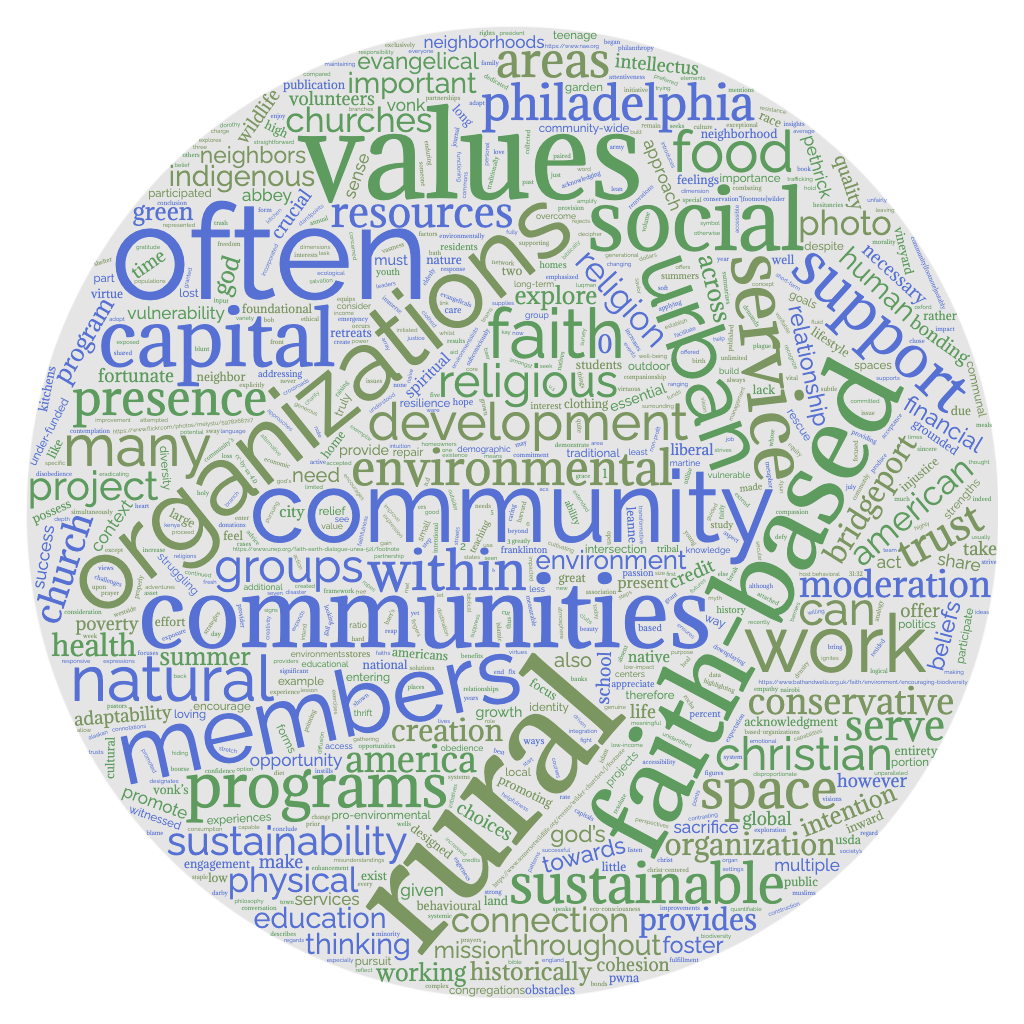
The Essential Presence of Faith-Based Organizations in Sustainable Community Development
This chapter from the student-written book “Emerging Perspectives on Religion and Environmental Values in America” explores the presence of religious organizations providing service to local communities. It discusses the broad range of faith-based organizations and their many projects, and how engaging with these organizations and programs can improve connections to one's environment and spirituality. Below is the first paragraph of the chapter to introduce the discussion.
"The presence of faith-based organizations as social, human, and cultural capital within every community, regardless of demographic dimension, politics, race, and income demonstrate the resilience of religion as an asset essential to the cultivation of sustainable community development. Throughout history, religious groups have served as providers of essential services for the less fortunate, and advocates for social justice and equity in both rural and urban communities. Despite trying circumstances, this resolute effort over time and their relative success in providing support to those in need, has afforded faith based-organizations credibility, and in some cases their role is indispensable." -
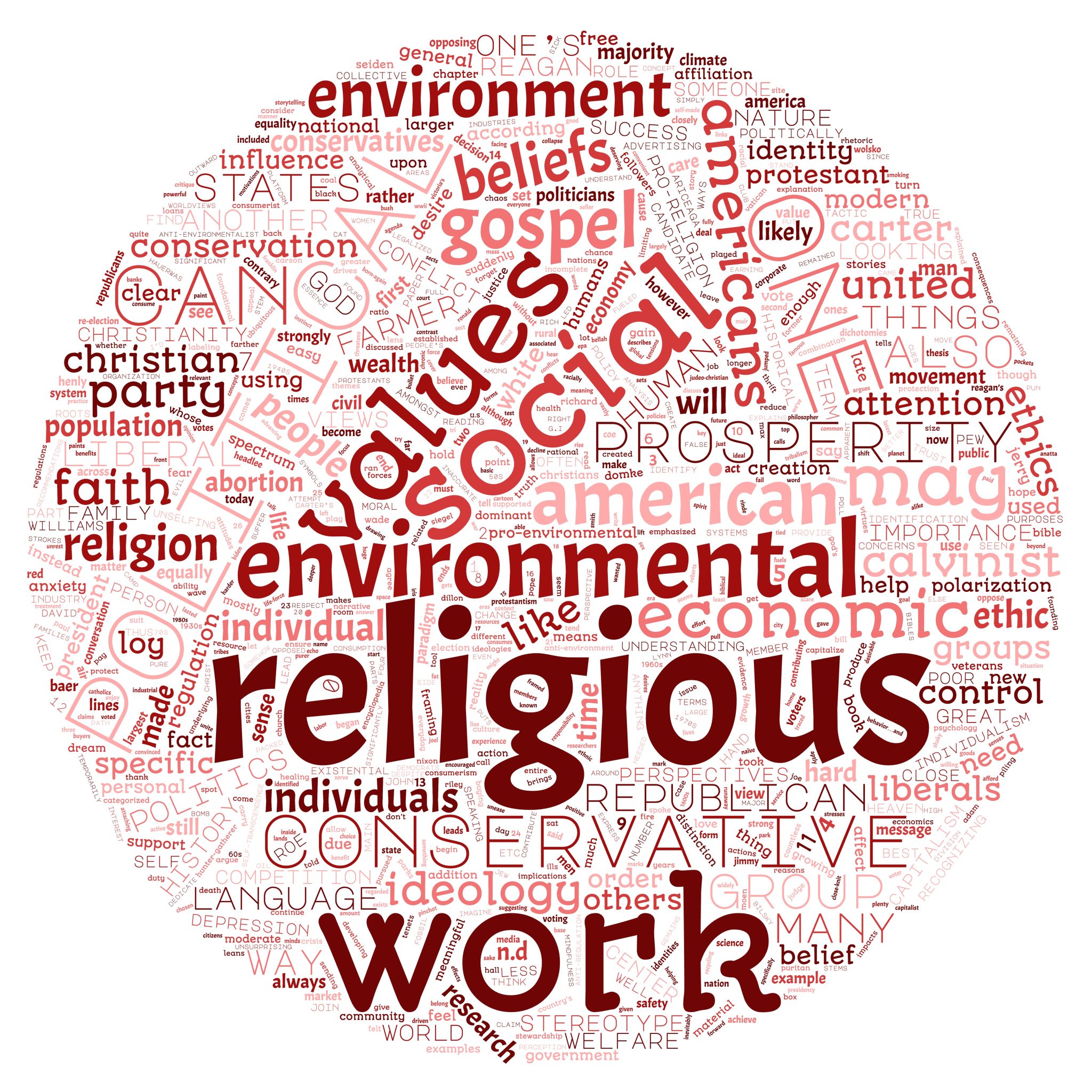
Origins of the Pro-Religion, Anti-Environmentalist Conservative Stereotype
This chapter from the student-written book “Emerging Perspectives on Religion and Environmental Values in America” explores the relationship between political affiliation and environmental values, as well as the stereotypes surrounding them. It examines how religion interacts with political views and the evolution of environmental values thoughout political and religious history. Below is the first paragraph of the chapter to introduce the discussion.
"The conception of someone who is 'anti-environment' usually evokes one of two images: 1) a fat cat in a suit, smoking a cigar while lining the pockets of the fossil fuel industry, or 2) a truck-driving rural American scoffing at the Prius-driving liberals in the cities who preach about their recycling practice. This chapter focuses on the second image...The distinction has been made clear in our minds: liberals care about the environment and conservatives don’t. This, along with another common conception that conservatives are religious while liberals aren’t, paints an inaccurate picture that drives religious conservatives out of the environmental conversation. How did this happen?" -
The Place of Pets in Our Lives: Some Christian and Buddhist Perspectives
This chapter from the student-written book “Emerging Perspectives on Religion and Environmental Values in America” explores the impact of animals and pets on our environmental values. The author discusses their own experiences with pets as well as religious texts and perspectives as they relate to animals. Below is the first paragraph of the chapter to introduce the discussion.
"If you ask a person to tell you about their favorite pet they’ve had, no matter how long it has been since it lived, their faces will most likely light up with joy as they tell you a humorous or heartwarming story about 'the best cat' or 'the best dog in the world!' Love and appreciation for our pets seems to be a relatively universal trait that, for many of us, is also interconnected with our religious or moral values and feelings toward nature." -
Technological Takeover or Technological Makeover?
This chapter from the student-written book “Emerging Perspectives on Religion and Environmental Values in America” explores the recent and rapid development of technology and its impact on our environmental actions. It discusses trends of consumerism, social conflict, and disconnection. Below is the first paragraph of the chapter to introduce the discussion.
"Is it just me or does it feel like the whole world is going crazy? From a global pandemic, to a civil rights revolt, to talk about election fraud, it seems like everything is spiraling out of control and technology seems to be adding fuel to the fire. It feels as if technology is the invisible hand that controls us all on every level, individually and as a culture. As technological advancements push further, the concern for the problems perpetuated by them rises as well. I am not trying to be labeled as a 'Karen' of my generation, but technology is slowly eating away at our brains and degrading the fabrics that hold our society together." -
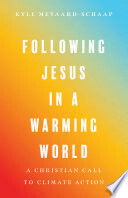
Following Jesus in a Warming World: A Christian Call to Climate Action
"Have you ever looked at the effects of climate change and the apathy of so many around you and wondered, 'What are we missing here?'
Climate activist Kyle Meyaard-Schaap understands this feeling from personal experience. But in his years of speaking to and equipping Christians to work for climate action, he's seen the trend begin to shift. More and more young Christians are waking up to the realities of climate change. They want to help, but they're not sure how.
Through stories from the field, theological and scriptural exploration, and practical advice, Meyaard-Schaap offers hope to Christians paralyzed by the scale of the crisis, helping us turn our paralysis into meaningful action. Following Jesus in a Warming World is a field guide for Christian climate action—one grounded not in a sense of guilt or drudgery, but in the joy of caring for creation." -
An Analysis on the Climate and Energy Provisions of the IRA
"The purpose of this research report is to provide an advocacy tool to Indigenous Peoples and environmental justice communities to help develop strategies, as well as to foster inquiry and information gathering regarding many of the IRA programs and funding schemes. Indigenous Peoples have recognition in the colonial legal system of Tribal Sovereignty, inherent customary rights, and Treaty reserved rights. In addition, Indigenous Peoples also have their respective Traditional Indigenous Knowledge which serves as a foundation among other things of their legal systems, inherent responsibilities to land, air and water, and the inherent relationships embodied in all of this. If unchecked, and without Free, Prior and Informed Consent, or at the very least meaningful consultation standards that are legally enforceable, much of what is in the IRA will potentially have impacts on many Indigenous Tribal interests." -

Scripture Sunday: Invitation to the Thirsty
"Walter Bruggeman has said that the task of the prophet is 'to nurture, nourish, and evoke a consciousness and perception alternative to the consciousness and perception of the dominant culture around us.' Here in Deutero-Isaiah, the Israelites who have been exiled are given a vision of hope, Isaiah is evoking a reality far different from what they know. In the previous chapter, God says, in one of my favorite verses, 'For a brief moment I abandoned you, but with deep compassion I will bring you back. In a surge of anger I hid my face from you for a moment, but with everlasting kindness I will have compassion on you… My unfailing love for you will not be shaken nor my covenant of peace be removed' (Isaiah 54:7-10). This is the climax of the second book of Isaiah, that God’s anger towards injustice and the consequences of it are momentary, but God’s compassion, love, and faithfulness are everlasting, something we can never be separated from. Isaiah 55 then flows into the specifics of that love. God’s invitation into divine care is one that freely gives water, food, and rest." -

Don’t believe the “Hydrogen Hype” - Reject all applications for Department of Energy Regional Clean Hydrogen Hubs (H2Hubs) funding (DE- FOA-0002779)
"Dear Secretary Granholm and Director Crane,
We urge you to reject all hydrogen hub applications, as has been repeatedly requested by environmental and environmental justice organizations nationwide. Here, we write in solidarity with the 2023 letter from the New Mexico No False Solutions Coalition (NMNFS), building on the points they have raised and the fights ongoing in communities from the Southwest to the Northeast. A large-scale buildout of hydrogen infrastructure will further exacerbate the climate crisis and disproportionately harm people of color, low-income communities, and Indigenous peoples..." -

A Bluer Theology: Protecting and Restoring God’s Marine Creation
"Blue Theology was founded in 2008 by Rev. Dan Paul and Rev. Deborah Streeter. Streeter coined the term “Blue Theology” as a theological approach that weaves together marine biology and Christian theology. Over the next few years, the Church, only blocks from the Pacific Ocean, began hosting weeklong groups to engage in learning-serving experiences with God’s marine creation. Over the last two years, Blue Theology Outposts have opened in Newport Beach, CA, Texas City, TX, and Beaufort, NC. The mission of the Blue Theology program is to provide learning and serving experiences in ocean conservation while fostering heart connections to the sea." -

Sacred Lands, Sacred Waters: Theological Reflections on This Sacred World
"The lands and waters of this world are sacred places. We know it when we rest in them and we know it from our sacred texts. As Christians, to see the world as creation is to see the world as sacred.
This resource includes theological reflections from Karyn Bigelow, Avery Lamb, Dr. Miguel A. de la Torre, Rev. Victoria Loorz, Rev. Dan Paul, and Rev. Dr. Randy Woodley.
This resource was originally published for Season of Creation 2022." -

The Great Global Cleanup
This toolkit is intended to help guide people and groups on how to start and execute a cleanup project to restore communities.
"Follow our simple guide to make the most out of your cleanup. If you need any help, reach out to us at info@earthday.org." -

Ologies: Critical Ecology (SOCIAL SYSTEMS + ENVIRONMENT) with Suzanne Pierre
"How do societal structures affect the planet? Why should we get to know our neighbors? What’s the ecological price we pay for … stuff? Yep, there’s an -ology for that. We chat with the founder of Critical Ecology: biogeochemist, National Geographic Explorer, researcher and plant nerd, Dr. Suzanne Pierre. Dr. Pierre’s Critical Ecology Lab is involved with research on the biomes of former plantations, air pollution, agricultural runoff, and even asking questions about wildfire science and the prison system. She explains how the Big Picture can always zoom out and be a little bigger. Before you know it, you’ll see Critical Ecology everywhere you go." -
Creation Care Column
The Creation Care Column is a weekly column by Elliott Bush that is posted through St. Stephens Episcopal Church's (Columbus) website. Here Bush discusses current environmental events, tips for living a sustainable life, and much more all in the name of caring for God's creation. Bush also provides a wide array of environmental sources to allow readers to continue their education on their own. For example, in one of the most recent posts, Bush speaks about changes in plastic pollution efforts and encourages readers to check out Katherine Hayoe's weekly newsletter or Green America to find out more information. -
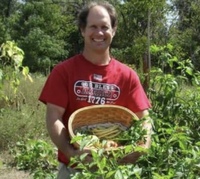
WWOOF: Christian nonprofit residential ministry perched atop the Ozark Mountains
“Perched atop the Ozark Mountains on 101 acres of forest, pasture, rocky bluffs, and old logging trails, we are a rustic Christian nonprofit residential ministry in need of help with the development of planning stages of a 30 acre campus with proposed cabins for housing, a reception lodge, Creator’s Workshop, dining hall, stables, organic garden, vineyard, fruit grove, petting farm, and saw mill. In short, we are a ministry that leans toward sustainability. We are a ranch, not an income-producing farm.”