
Search
1263 items
-
Laudato Si’ -- On Care For Our Common Home
Laudato Si appears to be increasing interactions between environmental professionals and faith communities, and as such, is a very important document for all people to understand–not just Catholics! Roman Catholicism is the largest religious denomination in the world (1.2 billion). An encyclical is one of the most authoritative declarations that a Pope can put forth. Laudato Si is both a reflection of the larger moral and religious landscape of environmental values, and perhaps simply the most prominent such statement of values yet crafted. It is symbolic of this moment in time when religious and ethical voices are gaining currency in environmental thinking, regardless of any particular doctrine.
-

3000-year-old solutions to modern problems | Lyla June | TEDxKC
"In this profoundly hopeful talk, Diné musician, scholar, and cultural historian Lyla June outlines a series of timeless human success stories focusing on Native American food and land management techniques and strategies. Lyla June is an Indigenous musician, scholar and community organizer of Diné (Navajo), Tsétsêhéstâhese (Cheyenne) and European lineages. Her dynamic, multi-genre presentation style has engaged audiences across the globe towards personal, collective and ecological healing. She blends studies in Human Ecology at Stanford, graduate work in Indigenous Pedagogy, and the traditional worldview she grew up with to inform her music, perspectives and solutions. Her current doctoral research focuses on Indigenous food systems revitalization. This talk was given at a TEDx event using the TED conference format but independently organized by a local community." -

Sustainability Photo Contest
This RESTORExchange photo contest is being brought back from the pre-COVID era, and with an added collaboration with the Sustainability Institute. It's based around the question "What does sustainability look like?" This can include sustainability in environmental justice, technology, energy, lifestyle and wellbeing, society and culture, economy and politics, and any other context where you see sustainability in action. We want to see your perspectives and show all the different places that sustainability is practiced! Winning photos will be decided by a panel of judges (yet to be determined), and the top four photos will win a prize! First place will receive $400, second place will receive $300, third place will receive $200, and an honorable mention will receive $100. Submissions will be accepted through March 15, 2023. -
Faith Lifestyles to Beat Plastic Pollution
"Dr. Iyad Abumoghli and Sarah Berg, Acting Director for the Center for Climate Justice and Faith at Pacific Lutheran Theological Seminary, discuss the ways in which faith communities are uniquely positioned to combat the climate crisis.
This GTUx Lecture will specifically focus on actions that can be taken to combat plastic pollution — an area in which faith-based organizations are positioned to be significant catalyzers through educating, activating and inspiring their communities; developing capacity for sustainable practices; advocating policymakers and mobilizing the private sector; and collaborating with their community partners to advance change." -

Faith for Earth Initiative
"Promoting faith leadership, faith-based organizations and communities as custodians of far-reaching, value-based perspectives on environmental sustainability.
Religion and spirituality hold tremendous wisdom for the protection and conservation of our earth, inspiring both religious and secular actors to advocate for stronger political will and lead by example. Find out why faith and environment matters.
A three-pronged approach drives this Initiative:
Strengthening partnership with faith-based organization’s leadership for policy impact;
Greening faith-based organization’s investments, operations and assets; and
Establishing an accessible knowledge-based support system using faith scripts and scientific evidence." -

Faith Action on UN Sustainable Development Goals: Database
"UNEP adopts innovative communication as a driving force for empowered environmental advocacy. For the first time, a database dedicated to the collection of projects and activities demonstrate how faith, indigenous and local communities contribute to the Sustainable Development Goals." -

ESA Baltimore Religion-Ecology/Faith Justice Links
Here are live links and further speaker information for OOS44 and OOS56, two organized oral sessions on Religion and Ecology that were presented at the 100th Anniversary meeting of the Ecological Society of America in Baltimore, MD, in August of 2015:
OOS 44: Ecologists and Faith & Justice Communities: A Journey from Antagonism to Earth Stewardship Partnerships for the Next Century
(Wed. 8/12, 8am-11:30am; 337, BCC; primar organizer: Greg Hitzhusen; co-organizers: Leanne Jablonski and Terry Chapin)
David Lodge, Biological Sciences, University of Notre Dame, ESA President-Elect. Ecology, Environmentalism, and Religion: A Nexus in Flux.
Including insights from the book Religion and the New Ecology; Recent essay in Nature: http://www.nature.com/news/faith-and-science-can-find-common-ground-1.18083
Mary Evelyn Tucker, School of Forestry and Environmental Studies, Yale University, CT. Global Perspectives on the Vital Relationship Between Ecology and Religion. Director, Yale Forum on Religion and Ecology: http://fore.yale.edu ; see also related podcast
Leanne Jablonski, University of Dayton, OH, Marianist Environmental Education Center. Pope Francis’ Environmental Encyclical, Catholic Environmental Social Teaching, and Implications for Ecologists (co-author: Dan DeLio, Catholic Climate Covenant); http://meec.udayton.edu.
George Middendorf, Biology, Howard University, Washington, DC. Skeptical Scientists Approaching Religion on Common Ground of Earth Stewardship. Related research: behavioral ecology and population demographics of lizards; race, ethnicity and gender in ecology and STEM
Cal DeWitt, University of Wisconsin-Madison. Evangelical Contributions to Earth Stewardship: Laudato Si’ and Stewardship as Con-Service. Paper available at: http://faculty.nelson.wisc.edu/dewitt/
Kerry Ard, School of Environment and Natural Resources, Ohio State University. Social Science Perspectives on Ecology and Religion: Implications for Environmental Justice and Ecology (co-author: Greg Hitzhusen, Ohio State University)
The Most Reverend Dr. Katharine Jefferts Schori, Presiding Bishop, The Episcopal Church. Comprehensiveness and the Middle Way: Anglican Perspectives on Religion and Ecology. http://www.episcopalchurch.org/page/katharine-jefferts-schori-biography.
Terry Chapin and Carl Safina; University of Alaska, Fairbanks; Safina Center. Religious, But Not Necessarily Theological. http://terrychapin.org; http://carlsafina.org
Munjed Murad, Harvard Divinity School, Harvard University, MA. Islam and Nature Today: Insight Into Traditional Discernment. Related work: http://hds.harvard.edu/news/2014/09/23/conversation-on-sustainability-and-religion# ; http://cswr.hds.harvard.edu/news/seeing-god-everywhere.
Ron Trosper, American Indian Studies, University of Arizona, Tucson, for Nigel Haggan, Interdisciplinary Studies, University of British Columbia, Vancouver. Creative Justice: Restoring Art, Indigenous Spirituality and Religion to Environmental Impact Assessment and Ecosystem-Based Management. http://www.fisheries.ubc.ca/students/nigel-haggan ; http://courses.ais.arizona.edu/people/ronald-l-trosper
OOS 56: Ecologists and Faith & Justice Communities: Evaluating Opportunities and Challenges for Outreach and Partnership for the Next 100 Years
(Wed, 8/12, 1:30pm-5:00pm; 341 BCC; primar organizer: Leanne Jablonski; co-organizers: Greg Hitzhusen and Kellen Marshall)
Shantha Ready Alonso, Executive Director, Creation Justice Ministries. The American religious environmental landscape: Opportunities and challenges for ecologists. Creation Justice Ministries serves 38 member Christian denominations; its 2016 Earth Day Sunday study and prayer resources will focus on biodiversity and endangered species. (co-author: Cassandra Carmichael, National Religious Partnership for the Environment)
Indigenous perspectives on ecology, justice, ways of knowing, and the Earth
(Gail Woodside CANCELLED) Speakers to be introduced Dorothy Boorse, Professor of Biology, Gordon College, Wenham, MA (see Boston Globe coverage). Loving the least of these: Lessons from the climate change report of the National Association of Evangelicals; available at: http://nae.net/loving-the-least-of-these/; see also God and Nature
Dan Misleh, Executive Director, Catholic Climate Covenant, Washington, DC. Growing catholic engagement and voice in climate change, environmental justice and policy: From St. Francis to Pope Francis to people and planet.
Lisa Benham, Insight Garden Program, San Quentin State Prison, CA; Department of Environmental Studies, San Jose State University, Buddhist Eco-chaplain. From longing to belonging: Combining mindfulness practice and ecological understanding in prison rehabilitation; Related research: From utility to significance: Exploring ecological connection, ethics, and personal transformation through a gardening and environmental literacy program within San Quentin Prison: http://gradworks.umi.com/15/67/1567980.html
Kellen Marshall, Department of Biological Science M/C 066, University of Illinois at Chicago.Ecological equity and spatial assimilation: A justice paradigm for 2nd Centennial ecologists.
Jacqui Patterson, Director, Environmental and Climate Justice, NAACP. Lessons for ecologists from the NAACP’s Environmental and Climate Justice Program. Related Research: Just Energy Policies: Reducing Pollution, Creating Jobs
http://www.naacp.org/blog/entry/naacp-just-energy-policies-report-released;
Equity in Resilience Building for Climate Adaptation Planning: An Indicators Document:
http://www.naacp.org/blog/entry/equity-in-resilience-building-for-climate-adaptation-planning.
Jessica Lewis, Right to Housing Alliance, Baltimore, MD. Working at the intersection of water, housing, and economic and environmental justice
(co-authors: Vicente Lara, Daisy Gonzalez, Colin Bailey, Environmental Justice Coalition for Water).
Greg Hitzhusen, School of Environment and Natural Resources, The Ohio State University. Ecologist dialogue and outreach with faith communities: Lessons from experience and study in the Ecological Society of America (co-author, Leanne Jablonski, University of Dayton).
Fred Scherlinder Dobb, Rabbi, D.Min., representing Adat Shalom Reconstructionist Congregation (www.adatshalom.net); Interfaith Power and Light (www.gwipl.org); Coalition on the Environment and Jewish Life (www.coejl.org). Old-time religion and cutting-edge climate: Jewish and interfaith intersections with ecological science;
available at: https://scherlinders.wordpress.com/2015/08/10/esa-presentation-august-2015/. -

Marianist Environmental Education Center
"The Marianist Environmental Education Center (MEEC) is an environmental education community in the Catholic tradition. In Mary's hope-filled spirit, we preserve and act in communion with the land and educate other communities in sustainability through ecology-based simple living, social justice and spirituality." -
Scientific American Highlights Religion-Environment Potential for Climate Change
Today’s article in Scientific American, "Science and Faith Can Solve Climate Change Together", by Evangelical Christian climate scientist Katharine Hayhoe highlights some of the potential of religions to help solve environmental problems. Hayhoe notes recent survey research showing that Pope Francis’ environmental encyclical and visit to the United States helped shift American perceptions about climate change about 10% toward greater belief in the seriousness of climate change and the need to take action. Hayhoe will attend the COP-21 meetings in Paris as both a scientist and a person of faith.
Dr. Hayhoe spoke about Climate Change: Facts, Fictions, and Our Faith at an Earthkeeping Summit at Ohio State in October of 2014. -

Laudate Deum
"Eight years have passed since I published the Encyclical Letter Laudato Si’, when I wanted to share with all of you, my brothers and sisters of our suffering planet, my heartfelt concerns about the care of our common home. Yet, with the passage of time, I have realized that our responses have not been adequate, while the world in which we live is collapsing and may be nearing the breaking point. In addition to this possibility, it is indubitable that the impact of climate change will increasingly prejudice the lives and families of many persons. We will feel its effects in the areas of healthcare, sources of employment, access to resources, housing, forced migrations, etc.
This is a global social issue and one intimately related to the dignity of human life. The Bishops of the United States have expressed very well this social meaning of our concern about climate change, which goes beyond a merely ecological approach, because 'our care for one another and our care for the earth are intimately bound together. Climate change is one of the principal challenges facing society and the global community. The effects of climate change are borne by the most vulnerable people, whether at home or around the world'. In a few words, the Bishops assembled for the Synod for Amazonia said the same thing: 'Attacks on nature have consequences for people’s lives'. And to express bluntly that this is no longer a secondary or ideological question, but a drama that harms us all, the African bishops stated that climate change makes manifest 'a tragic and striking example of structural sin'.
The reflection and information that we can gather from these past eight years allow us to clarify and complete what we were able to state some time ago. For this reason, and because the situation is now even more pressing, I have wished to share these pages with you." -
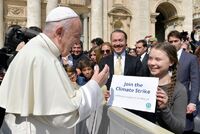
In 'Laudate Deum,' Pope Francis presents a compelling climate crisis apologia
"With a degree of urgency appropriate for the planetary catastrophe we face today, Pope Francis' latest apostolic exhortation, Laudate Deum, 'to all people of good will on the climate crisis,' builds on the important insights of his 2015 encyclical letter 'Laudato Si', On Care for our Common Home.' That the pope has explicitly described the current state of the climate as a 'crisis' could be viewed as affirming what climate activist Greta Thunberg said in her 2019 address at the World Economic Forum in Davos, Switzerland: 'Our house is on fire. I am here to say, our house is on fire.' " -

Cool Congregations
"The Cool Congregations Challenge, is an annual national contest to recognize 'Cool Congregations' that are becoming energy efficient and sustainable role models within their communities. The contest is brought to you by Interfaith Power & Light, a nonprofit organization inspiring and mobilizing people of faith and conscience to take bold and just action on climate. There are no fees to enter. Application period opens November 1 each year. Deadline for entries, December 15. Get ready to enter the Challenge!
Due to Covid the project eligibility window has been expanded again for 2024. Projects completed in 2021, 2022, and 2023 will be eligible to apply. Deadline Dec 15, 2023, awards announced in February 2024.
NEW! Electric Vehicle Leader category for congregations that have encouraged EV adoption. This category includes: EVs (Congregants and Staff) • Congregational EV Charging Stations • Outreach • Educating and Advocating for EVs. (Includes all-electric vehicles, plug-in hybrids and electric bikes. If your congregation is working on reducing transportation emission through public transportation or carpooling, apply to the Community Inspiration category.)" -

The Pope, the Environmental Crisis, and Frontline Leaders | The Letter: Laudato Si Film
"In 2015, Pope Francis wrote Laudato Si’ (The Letter); an encyclical letter about the environmental crisis to every single person in the world. A few years later, four voices that have gone unheard in global conversations have been invited to an unprecedented dialogue with the Pope. Hailing from Senegal, the Amazon, India, and Hawai’i, they bring perspective and solutions from the poor, the indigenous, the youth, and wildlife into a conversation with Pope Francis himself. This documentary follows their journey to Rome and the extraordinary experiences that took place there, and is packed with powerfully moving personal stories alongside the latest information about the planetary crisis and the toll it’s taking on nature and people.
Because, in the words of the Laudato Si’ Movement chair Lorna Gold, 'once you know, you CANNOT look away.' #LaudatoSiFilm
Learn more about the protagonists and how you can take action at
https://TheLetterFilm.org" -
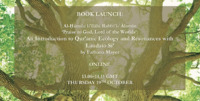
Book Launch: Qur’anic Ecology and Resonances with Laudato Si’
"The Laudato Si' Research Institute and the United Nations Environment Program (UNEP) Faith for Earth Initiative cordially invite you to attend this online book launch for An Introduction to Qur’anic Ecology and Resonances with Laudato Si’, by Farhana Mayer.
The launch will consist of an introduction to the text by Farhana Mayer, followed by responses from scholars and practitioners including Revd Prof. Joshtrom Kureethadam (Vatican Dicastery for Promoting Integral Human Development; Pontifical Salesian University), Prof. Ibrahim Özdemir (Uskudar University; member of drafting team for Al-Mizan: A Covenant for the Earth) and Dr. Iyad Abu Moghli (UNEP, Faith for Earth). There will be an opportunity for Q&A at the end.
This event will take place online [on October 19, 2023 from 1pm to 2:15 EST]. After you have registered, we will be in touch with the link to join." -

Presentation of the Apostolic Exhortation: "Laudate Deum"
This video contains discussion of Pope Francis' newly released Laudate Deum, as well as comments on how it connects with Laudato Si' and applies to future action. Environmental and religious activists, experts, and scholars speak on the issue as it relates to their field. The speakers explain possible ways to incorporate the information discussed in Laudate Deum and other knowledge surrounding climate change can be incorporated and developed into courses of action to address the climate crisis. -

Advent Simplicity Challenge
"This Advent, commit to simplicity. In a season that can mistakenly be focused on gifts and consumption, explore ways to live simply as we hopefully prepare for the coming of Jesus and the restoration of the earth. This year, we’ll be mixing in new daily challenges, as well as accompanying PDFs for folks who prefer not to use the interactive calendar." -
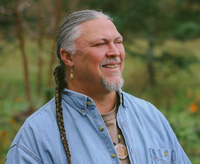
Decolonizing Thanksgiving
"As we head into the Thanksgiving holiday weekend in the United States, it’s great to think about all the things we can be grateful for. It is good to have a time to pause and reflect, to participate in the seasonality of gratitude for the year’s bountiful harvest, and to gather with family and friends. (We’ll ignore the über-consumerism of the day following Thanksgiving…)
Many of us probably know by now, however, that the story many of us learned in school about the first Thanksgiving is rather inaccurate at best, and racist and paternalistic in many ways, with a focus on the Manifest Destiny idea of the divine mandate for Europeans to conquer the “New World” in the name of Christ and country.
A few questions come to mind (at least my mind), for those of us with European-American roots, such as:
Should we even celebrate Thanksgiving, since it’s so tainted with colonialism?
What might it look like to “decolonize” our own understandings and our culture?
How can we do this work in a way that encourages our own folks to partner, rather than making them (our White brethren) feel further ostracized, but while also speaking real truth?
What can we do this Thanksgiving to begin to reconcile relationships damaged in the colonial era, both human to human and human to this land?" -

Prayers and Meditations for UNCOP28
"Our invitation to you and request of you on behalf of the ILC? We encourage people of all faiths to offer their prayers and meditations towards a beneficial UNCOP 28.
Our prayer and meditation around the world has helped the previous COP’s .This was the feedback we have received. The picture above is of Prayer and Meditation at COP26 in Glasgow. Not pictured are those who offered their spiritual practice at that time from many other places in the world. Our invitation is that we continue what we have begun with a renewed sincerity of commitment." -

EPN Breakfast: Yellowstone to Yukon: Enhancing Rocky Mountain animal migration through remote sensing and international collaboration
"Caribou, grizzly bears, bison, and many more megafauna and countless bird species rely upon a major migration corridor of western North America spanning the Yellowstone-to-Yukon (Y2Y) region. Y2Y extends more than 3,400 kilometers from the Greater Yellowstone Ecosystem in the western United States to the Arctic Circle in the Yukon Territory of Canada. These species are impacted by roads and other human infrastructure developed throughout the corridor.
Enter the Room to Roam: Y2Y Wildlife Movements (Room2Roam) project. Room2Roam is funded through the NASA Ecological Forecasting Program and is accelerating data analysis and coordination to improve wildlife management efforts across borders. With coordination from Ohio State’s Dr. Gil Bohrer and representatives of seven agencies and conservation groups from First Nations, Canadian provinces and territories, and American states, launched this project from Whitehorse, Yukon Territory, in 2022...
With support from Ohio State's Translational Data Analytics Institute (TDAI), join this EPN event to learn more about this incredible research and partnership endeavor, and its implications for land and resource managers in Ohio and beyond."
The event will take place on 2/13/2024 from 7:15 a.m. to noon at Nationwide and Ohio Farm Bureau 4H Center.
The cost is $25 for non-students, $5 for students, and free for virtual participants. -
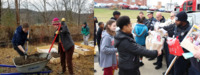
MLK Day 2024
"ServeOhio Funds 19 Statewide Service Projects Taking Place in celebration of MLK Day
These grants support more than 1,300 volunteers engaging in local community service projects across fifteen Ohio cities
ServeOhio, the Governor-appointed commission on service and volunteerism, announces grant awards to support 19 local Martin Luther King Jr. Day of Service projects throughout January totaling more than $25,000. Much like Dr. King’s legacy, these grants will help nonprofits across the state improve their communities through service and volunteer activities. The grants will fund service projects in fifteen Ohio cities led by more than 1,300 volunteers.
Each project commits to bringing volunteers together to create or improve community assets or infrastructure and supports local community engagement and impact. Additionally, every project includes an education component based on Dr. King’s message of peace, unity, and service to create long-term, sustainable change.
ServeOhio awards these grants with support from the American Electric Power Foundation. Each grant totals between $250 - $1,500." -
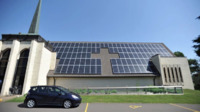
Congregational Solar Resources
"This is a great time to put solar on your church, synagogue, mosque, or other faith community property with the new federal funding available for nonprofits through the Inflation Reduction Act. It’s like a sale on solar, a 30% discount! The 1300 IPL congregations listed in the directory below have the combined capacity of 105 Megawatts of solar – approaching the amount of FaceBook, the 10th largest commercial user. Save on your energy bill and have more for your mission. Read below to find out how to fund solar on your church building, find a solar installer, and get an award." -

The Kirkmont Memories Project
"The Kirkmont Memories Project is my Capstone project for my senior year at The Ohio State University. I originally came up with the idea in 2020, while I was working on Summer Staff at Kirkmont Center and hearing so many interesting stories about the history of camp. I wish that I had done what I wanted to do at the time, which was to sit down with Buzz Reed, press record, and ask him everything he knows about Kirkmont. When I entered into my final semester at Ohio State, I was assigned to create a lasting change within a community through acts of leadership. All I could think of was that idea of sitting with a friend of Kirkmont, listening to their stories about what Kirkmont means to them, and using that knowledge to help create more memories for the future of camp. I created a plan to interview and survey as many Kirkmont alumni and friends as possible to find a collective story of the history of camp and hear about different perceptions of the value of camp, what camp means to them, and what we see for our future. After reaching out to alumni via Facebook, I've had the privilege of collecting over 30 amazing stories! I loved getting to spend time learning more about alumni who I've looked up to for years, as well as folks who I got to know better. Reading through my notes one after another while creating this website has brought up so many emotions and memories of my own experience, and I hope that as you view this project you can also feel some of that nostalgia and appreciation for our Kirkmont family." -

From the Ground Up: An Adult Outdoor Education Program
AKA Our Deen is Green! for Adults"We are happy to announce that applications are now being accepted for From the Ground Up: An Adult Outdoor Education Program (aka Our Deen is Green! for adults). This special program, funded by a grant from the National Park Service Chesapeake Gateways Office, will begin after Ramadan, in late April 2024, and continue into spring of 2025. It is a unique opportunity to become immersed in the various facets of ecology, environmental science, sustainability and stewardship. It will include monthly classes, mostly in-person and outdoors in parks and wildlife sanctuaries in DC, Maryland, and Northern Virginia, focused on specific aspects of and issues pertaining to our local region, the Chesapeake Bay Watershed.
Classes will be led by local subject matter experts and include a variety of topics, including local plants and animals, the interconnectedness of our watershed, the challenges it’s facing, and what we can do to help. Specific classes will include:
· An introduction to the Chesapeake Bay Watershed
· Local herps: reptiles and amphibians
· Monitoring stream health with benthic macroinvertebrates
· Stream restoration and invasive plant removal
· The importance of native plants and pollinator gardens
· Watershed education through an interfaith lens
· Native trees
· Soil health
· Environmental justice
· Local birds and “bugs”
· Solar power and clean energy
· Sustainable living
· Water-quality monitoring
· And more!
We are looking for 10-15 strongly committed local residents who are interested in learning about our local watershed, its needs, and what they can do to help it. Participants will be encouraged to create a long-term project or plan of action describing something they will do to support the watershed and/or encourage their families or communities to pay more attention to environmental issues.
Program participants must be able to commit to the majority of the monthly classes. All in-person classes will take place on weekends and last 2 to 4 hours. (We will do our best to help provide transportation if necessary.)
This entire program is being offered free of charge thanks to a National Park Service Chesapeake Gateways grant. The National Park Service Chesapeake Gateways Office (NPS Chesapeake Gateways) offers competitive grant opportunities to advance the Chesapeake Bay Initiative Act of 1998 within the full 41-million-acre Chesapeake Bay watershed. Chesapeake Gateways grants bring out familiar, untold, under-appreciated, or yet to be uncovered narratives and promote resilient communities & landscapes through tourism, sustainability, conservation & local economies throughout the Chesapeake Bay watershed.
The program begins after Ramadan, with the introductory class set for April 21st! Applications are due by March 8th. Access the application form below. Please reach out to us at contact@greenmuslims.org with any questions." -

Critique of Religious Patriarchy
"This supplement is about transcending religious patriarchy in order to foster integral human development and a healthy mutuality between humans and the human habitat. Some meditations are proposed on the mysteries of the creation, the incarnation, and the redemption. They explore the Christian understanding that all men and women are consubstantial in one and the same human nature, and are consubstantial with Jesus Christ as to his humanity. The meditations are based on a layman's reading of the Sacred Bible, the Catechism of the Catholic Church, and the Theology of the Body as they pertain to the consubstantial complementarity of man and woman, which transcends the patriarchal binary of mutually exclusive male-female opposites. This understanding of the "complementarity in consubstantial unity" of man and woman applies to all the sacraments, sheds light on the great nuptial mystery of Christ and the Church, and would seem to support the ordination of women to the ministerial priesthood and the episcopate. The meditations are preceded by recent news on patriarchy in religion, society, and human ecology, and are followed by articles and research notes, a summary of points for discernment on the ordination of women, an annotated timeline of religious patriarchy in the Judeo-Christian tradition, and links to relevant literature, substantive research, and the synodal process of discernment currently underway in the Catholic Church." -

Evolution of the Collective Unconscious
"The collective unconscious is made up of experiential knowledge, symbols, and imagery that humans are naturally born with (no tabula rasa) and are rooted in ancestral experience and shared by all persons in all cultures. After millennia of evolution, the current collective unconscious of humanity would seem to include human exceptionalism, patriarchal hegemony, short-terminism, delusions of grandeur, illusions of unending growth, and the idolatry of technology. As the planet becomes overloaded with industrial civilization, our collective mindset seems to be unwilling to think long-term and face the realities of ecological overshoot. It remains to be seen whether our collective mindset can evolve to voluntarily refocus human agency toward contraction of the human enterprise, simplification of lifestyles, and peaceful resolution of conflicts before it is too late to prevent a chaotic collapse of industrial civilization."