
Search
1263 items
-

Why Lutherans Care for Creation
This article discusses how various concepts of Lutheran theology are woven into ecological messages with regard to God as creator, human interactions, and ways of worship. The following is a section from the introduction of the article, emphasizing human responsibility towards care for the Earth:
"For Christians, care of the Earth is not an 'environmental cause.' Rather, it is central to our holy calling to treasure the Earth and to care for it as our common home, fully integrating creation-care into our love of God and neighbor. Without sacrificing the transformational effects of the 16th-century Reformation, we are called to embrace an eco-reformation that will re-examine and rethink how we read the Bible, how we can expand the scope of our theology, how we can reconfigure our personal vocation and our common ethic, how we worship, how we organize our church life together, and how we understand ourselves as creatures within creation as a whole. This call to continuing reformation is for the whole church, not solely for the committed. Earth care is not an add-on. It is not just for those who happen to be interested in it. It is a call for all Christians to participate in this great work of our time." -

Caring for Creation Today
This video, put forth by the Evangelical Church in America, encourages individuals to act as stewards by both assisting those in need and caring for our land, as God had intended. The salient message is to do what you can to work for change and care for God's creation, as this is our duty as humans. -

ISNA Green Initiative
The “ISNA Green Initiative” was formed in December of 2014 as one initiative for the Islamic Society of North America (ISNA). The group aims to raise awareness of issues concerning the protection and conservation of the environment, as well as promote a sense of urgency with regard to the catastrophic effects of climate change.
The ISNA Green Initiative Team has created a myriad of ways to promote environmental social justice within the Muslim community. The group has developed standards for transforming Masajid into environmentally friendly places of worship and promoting standards for building Masjid that meet the standards of green architecture. One example of their educational programming includes the promotion of the practice of a “Green Ramadan,” designed to reduce waste, conserve resources, and reduce the use of harmful products such as plastic water bottles and styrofoam. Another example includes promoting the use of solar energy to reduce the use of fossil fuels. -

Columban Center for Advocacy and Outreach
The Columban Center for Advocacy and Outreach was founded in 1985 under the Missionary Society of St. Columban in the United States. They were established under the name The Columban Justice, Peace, and Integrity of Creation Office and changed the name to what it is now in April 2009. The Columban Missionaries primarily advocate for Environmental Justice, Economic Justice, Migation, and Peace and Demilitarization. The Columban Center for Advocacy and Outreach serves as a mediator between the missionaries and the policy makers in America. They seek struc tural change guided by their faith to create a more sustainable, peaceful Earth. From their website;
"We believe that policies and decisions should be informed by the experiences of the people most impacted by those policies and decisions. We advocate for peace and justice, and are guided by the Gospels, Catholic Social Teaching, and the experience of Columban missionaries and the communities they serve". -

The Coalition on the Environment and Jewish Life
The Coalition on the Environment and Jewish Life (COEJL) is a group within the Jewish Council of Public Affairs that focuses on environmental issues within the Jewish community. Their focus is on utilizing Jewish environmental knowledge to serve as a voice within in the broader interfaith community, through outreach and activism. Working among a network of Jewish leaders, institutions and individuals, COEJL seeks to conserve energy, increase sustainability, and advocate for policies that increase both energy efficiency and security. -
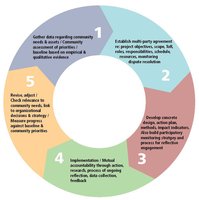
Interfaith Center on Corporate Sustainability- Social Sustainability Resource Guide
The Interfaith Center on Corporate Responsibility published the "ICCR's Social Sustainability Resource Guide: Building Sustainable Communities through Multi-Party Collaboration" to instruct corporations and businesses on how to create a more sustainable environment to grow economically. The ICCR is encouraging projects that have long term impacts on the society rather than short term success. From their website:
"In the same way that we are asking companies to look beyond short-term profits and to focus on creating sustainable growth, we are asking them to understand how their initiatives will enhance the well-being of the communities they are intended to reach not just now, but 10, 20 and 50 years from now." -

Engaged Organizations: Islamic Society of North America
The Islamic Society of North America, headquartered in Plainfield, Indiana, has been described as the largest Muslim community in North America. Their vision includes empowerment of the Muslim community to strengthen interfaith relations, increase civic engagement, and promulgate a better understanding of the Islamic faith. They strive for organizational excellence, achieving this in part through their efficient operations, transparency, and financial stability. They seek to achieve their strategic goals by providing high quality programming and services for the Muslim community, increasing opportunities for civic engagement, and hosting an annual convention to gather in large numbers and discuss current issues that are affecting their community.
Part of the organization's mission is to focus on increasing sustainable practices within the Muslim community. Through the work of the Masjid Development Committee in December 2014, the ISNA Green Masjid Initiative Team was formed as “Green Masjid Task Group” and later renamed the "ISNA Green Initiative." The intent was to create awareness and to provide guidance on transforming mosques/Islamic centers to become more environmentally friendly through the use of sustainable practices. -

Church World Service- Best Gift
Church World Service has created a program called "Best Gift", where people can donate to those who need it in the form of gifts. For $75, you can pay for a refugee family's first meal in America, for $500, you can gift 10 beehives in Kenya. Some other gifts include first aid, hygiene, and school kits, as well as latrines, stoves, and concrete to build houses. You can pay for someones bus tickets, rent, or food for the month. These gifts you can choose from can save lives or make a world of a difference in someone's life. This resource is great for someone who wants to make a difference. From the website;
"The gifts on this site are examples of the hope you bring through CWS programs. When you give a Best Gift, you give fresh food sources to those who are hungry. You provide clean water to those who are thirsty. And you offer welcome to those who are sidelined as strangers. Your generosity goes a long way - and you can feel confident that your gift supports the program sector that the item represents". -

Engaged Organization: Jewish Council for Public Affairs
Jewish Council for Public Affairs (JCPA) organization is considered the national hub of their community relations network. The group represents 125 local Jewish community relations councils and 17 national Jewish agencies, including the four main denominations of American Judaism. JCPA's motto is to educate, advocate, and mobilize. They strategize for peace and security, especially within Israel, and tackle human rights issues around the world. They seek to achieve their goals by convening, coordinating, building consensus, and mobilizing their network on key issues, while serving as the national representative of the network’s public policy and public affairs platform.
One area within the organization that focuses on environmental issues is The Coalition on the Environment and Jewish Life (COEJL). The intent of COEJL is to continually renew the Jewish community’s commitment to stewardship and protection of the Earth. They strive to achieve this through outreach, activism and Jewish learning with regard to conserving energy, increasing sustainability, and advocating for policies that increase energy efficiency and security. -

Profile: Kyle Meyaard-Schaap
Kyle Meyaard-Schaap is the National Organizer and Spokesperson for YECA (Young Evangelicals for Climate Change). Meyaard-Schaap helps unite Evangelical youth to focus national efforts on climate actions. He works to promote awareness of the Christian duty to take care of our neighbors and planet. Meyaard-Schaap has given numerous interviews to publicize YECA and has written numerous advocacy articles for the YECA blog.
Meyaard-Schaap's educational background includes Holland Christian High School, Calvin College (B.A. '12), and Western Theological Seminary (M.Div. '16). He is also ordained by the Christian Reformed Church in North America (CRCNA). -

CROP Hunger Walks
Origins of the Christian Rural Overseas Program date back to 1947 after WWII when farmers were asked to donate excess food to the hungry. Organized by the Church World Service, the CROP Hunger Walks take place all over America to fund projects organized by the CWS to end hunger. In 2019, there have been over 100,000 participants in 800 walks that have raised over $7,600,000 to end world hunger. 25% of all the funds raised go back into the host community.
To register for a walk near you, the is a search tool on their website to locate the next walk closest to you. -

Existentialism an the Ecological Crisis
This segment of The Philosopher's Zone with David Routledge (on the Australian Broadcasting Corporation) focuses on the importance of existentialism in modern times. Specifically, how existentialism can help us understand current relationships between the self and others, as well as with nature. Likewise, the podcast’s contributor, Dr Dalia Nassar points out that existentialism implies a sort humanism (as Sartre argued) that connects each individual to all of humanity through their actions. It is the fact that each of our actions can affect one another is why the existentialists place so much emphasis on how we act. Furthermore, the podcast extends this to the ecological crisis by explaining how this radical humanism can inform how we make environmental decisions. The important point here is that we can derive environmental values based on the inherent freedom that humans have, there is a constant need for action. As the interviewer explains in the podcast, the individual determines the moral future of humanity and nature. Thus, each person has a moral obligation to transcend the current situation and make better choices for the environment. Likewise, there is a special attention to art and literature as a mode of connection, to hopefully shape others moral and environmental values. Therefore, existentialism provides a framework (much like religion) for guiding our actions based on a mutual care for the environment. Finally, I should note that the key points of the podcast (concerning the environment) starts at the 18-minute mark, while the latter half provides background knowledge on existentialism. -
One World, Our Coalition: Religion and Environmentalism Larry Linenschmidt
The One World, One Coalition interview guest of various backgrounds about climate advocacy. In the first episode Matthew Kim and Isla Ferguson interview Larry Linenshcmidt of Hill Country Institute. Hill Country Institute is a Christian organization focused on addressing important issues while encouraging safe discussions on topics like human rights, education, and the environment. As the executive direction Linenschmidt lectures about holistic environmental stewardship in the Christian community. -

Resources for Preaching & Speaking on Climate Change
The resource gives information for preachers and other religious figures to use when talking about climate change. It starts by giving reasons for preaching about climate change and why it is important for us now and in the future. It also gives facts from scientists on the climate which mentions the aspects of climate change such as the causes and effects on the environment, and what humans can do to help. The article then gives biblical themes related to climate change and also gives advice for religious leaders to overcome possible barriers when preaching. -
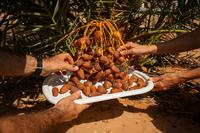
Ancient Judean Dates
A date tree planted in Ketura, Israel from 2000 year old seeds found at an archeological site in the Judean wilderness has finally bore fruit earlier this month (September 2020). The harvest was hailed a modern miracle of science. “In these troubled times of climate change, pollution and species dying out at alarming rates, to bring something back to life from dormancy is so symbolic,”... Date palms were praised in the Bible and the Quran, and became symbols of beauty, precious shade and succulent plenty. -

Engaged Organizations: Global Oneness Project
The Global Oneness Project was founded in 2006 as an initiative of Kalliopeia Foundation, and is focused on education aimed a planting seeds of empathy, resilience, and a sacred relationship to our planet. They are passionate about the power of stories and offer a rich library of multimedia stories comprised of award-winning films, photo essays, and essays as well as companion curriculum and discussion guides focused on world culture, social justice and sustainability. -
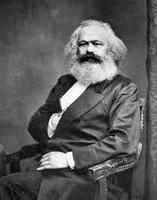
What Karl Marx has to say about today's environmental problems
Ted Benton, a Professor of Sociology at the University of Essex, writes about how Marx's theories can be applied to modern environmental issues such as climate change. He talks about how Marx's ideas about capitalism relate to current exploitation of nature, and specifically about soil degradation which was an issue during the 1860s when Marx was alive. He also includes problematic parts of Marx's attitudes towards nature, such as his praise of increased productivity of land that may have inspired Stalin. -
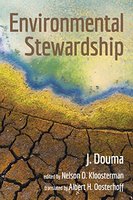
Environmental Stewardship
This book goes into detail about how the Christian religion goes about environmental stewardship. They look at how bible passages talk about preserving the Earth and the morals we should have surrounding it. It dives deep into how science interacts with human interaction with the Earth and the damage that we have done to Earth, as well as what we should do to correct ourselves. -

Jewish Council for Public Affairs
The Jewish Council for Public Affairs (JCPA) represents 125 local Jewish community relations councils and 27 national Jewish agencies, including all four main denominations of American Judaism. The JCPA coordinates positions on issues and serves as the national representative of their public affairs platform. The JCPA are advocates for a just and inclusive America, Israel's peace, and human rights. It was created in 1944 during the Holocuast to safeguard the American Jewish community and give the Jewish community a larger voice and influence. -

How Buddhist monks in Ladakh are fighting climate change
Buddhists Monks in the Himalayas are taking a stand to climate change. On Earth Day 2018, thousands of people came together in the village of Yerat to plant trees. The region is rapidly losing glaciers, causing a shortage in water supply to the villages in the area who rely on snowmelt for water. The volunteers were inspired to participate due to their devotion to His Holiness Kyabgön Chetsang Rinpoche and his vision for "a more verdant and organic Ladakh." -

Seeing true nature: Buddhism and the environment
John Worthington-Hill describes how Buddhism can encourage environmental awareness and sustainability. Embracing individuality is our disconnection from the natural world. In order to live in unity with the earth, we must find the 'middle way' (a buddhist morality based on self-discipline). "Self-centeredness is the great illness from which all imbalance, insensitivity and abuse ultimately stem – an illness directly linked to the Buddha’s ‘three poisons of greed, ill-will and delusion’. These poisonous mentalities seep into the collective consciousness and are instilled in the norms and structures of culture and society, helping to direct how politics and economics deal with the environment." "Environmental destruction is therefore an outer manifestation of an inner affliction. If our thoughts are polluted, then our actions will be polluted too, and so will their consequences." -
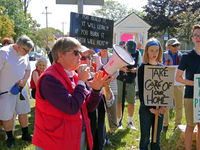
Episcopalians bring spiritual urgency to youth-led climate strikes
The Episcopal News Service shares stories of Episcopalians from around the country engaging in climate strikes. Episcopal leaders spoke on behalf of the environment, bringing the Christian responsibility to protect the earth into the discussion. Episcopal bishops, priests, and students all stood in support of climate change, citing the urgency of the threat. -
Five Years After Speaking Out on Climate Change, Pope Francis Sounds an Urgent Alarm
This article covers Pope Francis's reaction to the world governments responses to climate change. The Pope writes to unite people through religion in an effort to bring awareness to the movement. The article details how the church is divesting in fossil fuel companies. The article also focuses on the political divide and how it affects people's views on the climate crisis. -

Environmental Stewardship and Conservation
An article under the Mormon Newsroom from the official website of The Church of Jesus Christ of Latter-day Saints that explains the Church teachings and stance regarding environmental stewardship and conservation. The article also links other Church video resources, as well as a few articles, resources, and a book titled, “Stewardship and the Creation: LDS Perspectives on the Environment”. The book is a compilation of 17 essays that aim to inspire Latter-day Saints to strongly consider the importance of being environmental stewards and protecting God’s creations. -

GOP Rep. Mike Simpson: "It’s my party, and I’ll fight climate change if I want to"
An article published on Grist.org that covers Congressman Mike Simpson's views on salmon conservation. Simpson's statements are noteworthy for sustainability and religion as he is going against Republican party views by acknowledging an issue with climate change and the environment with his religious views. It is reported that his speech was obviously fueled by a spiritual obligation to preserve salmon as he describes salmon as incredible God created creatures and that their cycle of life should not be messed with. It is also important to note he was already elected for his 11th term in the house, so it is less likely that his more left leaning statements come from a desire to secure votes.