
Search
1263 items
-

Towards A Global Ethic (An Initial Declaration & The Fifth Directive)
This is a statement from Parliament of the World's Religions on coming together as a world to become more sustainable and care for the Earth. The text showcases their commitment to a culture of sustainability and care for the Earth, their support for gender equality, human rights, and a just economic order. -

Texas Impact and Texas Interfaith Center for Public Policy
Texas Impact exists to put faith into action. They equip faith leaders and their congregations with the information, opportunities, and outreach tools to educate their communities and engage with lawmakers on pressing public policy issues. They are an interfaith group that works together on issues such as racial discrimination, climate change, economic justice, and human rights that impact the most vulnerable people in our communities.
The Interfaith Center is Texas Impact’s 501(c)(3) research and education partner. The Interfaith Center’s board includes thought leaders; government affairs professionals; public servants; and communications experts. They provide the political insight and guidance that help Texas Impact offer clear, relevant, information that faith communities need to be effective advocates. -

2020 Lenten Campaign
In the third year of the three-year (2018-2020), Lenten Campaign themed "Caring for Our Common Home." As a part of the campaign, AOHD (Archdiocesan Office for Human Development) has created resources such as posters, power-points, kit books, action sheets, graphic arts, and other materials that could help more faith organizations host Care for Creation campaigns. -

Conference of the Parties (COP)
The COP is the supreme decision-making body of the Convention. All States that are Parties to the Convention are represented at the COP, at which they review the implementation of the Convention and any other legal instruments that the COP adopts and take decisions necessary to promote the effective implementation of the Convention, including institutional and administrative arrangements. -

Plant with Purpose
Plant With Purpose’s programs equip farming families around the world to increase farm yields, heal damaged ecosystems, improve nutrition, and increase household savings and opportunities. Always standing with the world's most vulnerable populations, this integrated approach solves two major issues facing the world today: environmental degradation and rural poverty.
You can plan a tree or fundraise in partnership with Plant with Purpose. -

Federation of Zoroastrian Associations of North America (FEZANA)
FEZANA is a non-profit religious group registered in the state of Illinois and formed to function as the coordinating organization for Zoroastrian Associations of North America. It serves as the coordinating body for 27 Zoroastrian Associations in the United States and Canada.
On this website, you can learn more about the community of FEZANA , Zoroastrianism, their sustainability reports and other social activities.
-
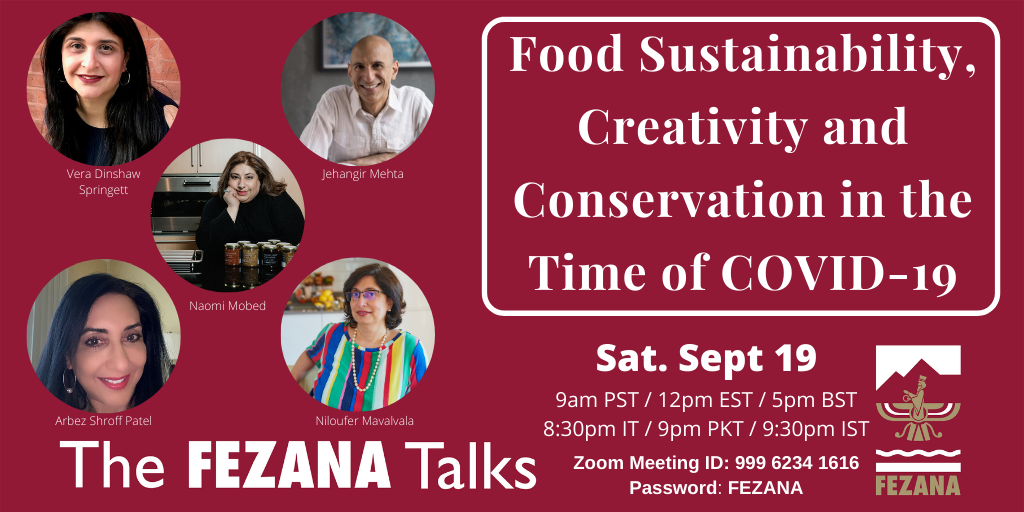
The FEZANA Talks #9: Food Sustainability, Creativity & Conservation During COVID-19
COVID has changed the way we eat, cook and live in many ways — good and bad. This discussion hosted by FEZANA (the Federation of Zoroastrian Associations of North America) focuses on the impact of the pandemic on the food supply chain, and how it affected the availability of the basics, leading people to get more creative in the kitchen. Everything from making our own bread to using leftovers to create new unexpected meals, has allowed people to ramp up their cooking skills, rely on sustainability and be more conscious of food wastage. Historically resembling the ways of our ancestors. -

Religion and Environment Photo Gallery: 2019 Photo Contest First Prize: Todd Wynward, “Ecstacy”
Muralist Dimitri Kadiev caught painting one of four sacred murals we brought from Taos to the Capitol in Santa Fe for Global Climate Strike, Sept 20. Photo credit: Todd Wynward, TiLT [Taos Initiative for Life Together] -

Religion and Environment Photo Gallery: 2019 Photo Contest Second Prize: Mikayla Benjamin
Me and my friends were picking up trash out of a forest for class extra credit and we stumbled across this glass jar with plants growing through it, showing how even when we treat nature bad it still finds beauty in the forgotten treasures such as this glass jar being home to new life. Photo credit: Mikayla Benjamin -
Religion and Environment Photo Gallery: 2019 Photo Contest (tie for) Third Prize: Kelsey Ryan-Simkins, "Reciprocity"
2019 Photo Contest (tie for) Third Prize: Reciprocity – A young girl gently lowers a ladybug onto a flower during a ladybug release at the GrowHaus, a nonprofit urban farm. Photo credit: Kelsey Ryan-Simkins -

Religion and Environment Photo Gallery: Ann Hitzhusen
IPC Intergenerational Neighborhood Clean-up Day! Photo credit: Ann Hitzhusen -

Religion and Environment Photo Gallery: Tony Losekamp, "Hostas for Grandma"
This was in college in Clifton just off campus at University of Cincinnati. We were going to an Italian restaurant for my grandmother’s birthday. It was one of the first photos I took with my first digital camera. I still love it for the fact that these beautiful hostas were surrounded by concrete on all sides in a busy city. In a dessert of a city these were an oasis of life. Photo credit: Tony Losekamp -

Religion and Environment Photo Gallery: Liz Vaisben
Participants in the girls book and social action club, Girls Read and Do, participate in the Jewish New Year ritual of Tashlich as part of an educational session on how to ensure that our Jewish practices are harmonious with the environment (in this case, casting bird seed in lieu of the traditionally used bread crumbs — not healthful for water foul — into the water). Photo credit: Liz Vaisben -

Religion and Environment Photo Gallery: Kyle Meyaard-Schaap (4)
Evangelicals from across the country lobby on Capitol Hill for a price on carbon in 2017. Photo credit: Kyle Meyaard-Schaap -

Religion and Environment Photo Gallery: Tony Losekamp, "Close Sunflower"
This was in the community garden I started at my high school, Archbishop McNicholas High School in Cincinnati, Ohio. The sunflower was huge and the number of seeds it produced was incredible. I wanted to capture the detail in the perfectly organized seed arrangement in the flower that is one of infinite examples of an intelligent designer of creation. Photo credit: Tony Losekamp -

Religion and Environment Photo Gallery: Rongkun Liu, "Abode of Peace"
A Tibetan Buddhist Temple Perched on Hillside for Meditation Retreat. Photo credit: Rongkun Liu -

Religion and Environment Photo Gallery: Jerry Freewalt
Office for Social Concerns, Catholic Diocese of Columbus, held a staff retreat on October 4th, the Feast of St. Francis, at St. Therese Retreat Center. Among many topics we discussed Pope Francis’ encyclical Laudato Si’ and recommitted ourselves to make the world better than we found it. Photo credit: Jerry Freewalt -

Religion and Environment Photo Gallery: 2018 Photo Contest 3rd place photo: Aminta Kilawan-Narine
2018 Photo Contest 3rd place photo: Shiva, the God of Destruction, Destroyed. Hindus have worshipped at the banks of Ganges and the shores of other bodies of water for centuries. Jamaica Bay is basically a closed system, so whatever lands in its waters stays until it is removed. The Ganges and many other bodies of water have become polluted by the use of many user groups. The Ganges, one of the major rivers of India, also known as Ganga Maa, is said to have made her abode in Shiva’s matted hair in order to prevent the destruction of Prithvi (Mother Earth). The flow of the Ganges also represents the nectar of immortality. Shiva is regarded as “the Destroyer” among the Trimurti, the Hindu Trinity of the primary aspects of the divine. He is also regarded as the patron god of yoga and the arts. Here, Shiva is found broken in the sands of Jamaica Bay, during a cleanup organized by the photographer Aminta Kilawan-Narine and her husband Rohan Narine. Photo credit: Aminta Kilawan-Narine -

Religion and Environment Photo Gallery: Tony Losekamp, "Ohio Serving the Poor"
This photo was taken on the gulf cost in Biloxi, Mississippi. It was winter break during my freshmen year at Ohio State (2013). It was a Buck-I-Serve trip. Doing an O-H-I-O is a normal occurrence, but I really like the natural beauty of the silhouette on the beach where we were staying. Photo credit: Tony Losekamp -

Religion and Environment Photo Gallery: Rohan Narine
Kali Maa under transformation after being found at Jamaica Bay during a cleanup organized by the photographer Rohan Narine and his wife Aminta Kilawan-Narine alongside other local Indo-Caribbean Hindus advocating for eco-friendly worship. Kali is an embodiment of the Goddess Durga. She is fierce and associated with empowerment or shakti. Kali means black, time, and death, thus Kali is the goddess of time and change. Although she is sometimes depicted as dark and violent, Kali Maa’s earliest incarnation is as a figure of the destruction of evil. Photo credit: Rohan Narine -

Religion and Environment Photo Gallery: Hemma Kilawan
Headless Baby Krishna. Many of the items used in worship get broken by wave and water action. This depicts what happened after a worshipper with the best of intentions, left the murthi (sculpture of Hindu deity) at Jamaica Bay Wildlife Refuge in New York City. It is said that at midnight on Janamashtami, baby Krishna, who is depicted in this murthi, was born and travelled across the Yamuna River in order to help Mother Earth bear the burden of the sins of the tyrannical leaders of the world. This murthi was found by the photographer Hemma Kilawan, during a cleanup organized by Indo-Caribbean Hindus in the New York City area. Photo credit: Hemma Kilawan -

Religion and Environment Photo Gallery: Jonathan Lacock-Nisly
Catholic school children carry signs with quotes from Pope Francis during the September 20th, 2019 Youth Climate Strike at the Capitol. Photo credit: Jonathan Lacock-Nisly -

Religion and Environment Photo Gallery: Julie Laudick (1)
Composting at Shepherd’s Corner Ecology Center. This process is a great metaphor for reconciliation. When we bring the rotting fruits and invasive weeds of our lives to confession, God transforms them into rich material for new growth. Photo credit: Julie Laudick -

Religion and Environment Photo Gallery: Julie Laudick (2)
A bountiful harvest of paw paws. Foraging for this native Ohio fruit is a Garden of Eden experience. We can share the joys of the harvest without the toil of cultivation. Photo credit: Julie Laudick -

Religion and Environment Photo Gallery: Julie Laudick (3)
Soil samples from the garden plots at Shepherd’s Corner Ecology Center. Can you tell which plot received the heaviest application of sheep manure? Photo credit: Julie Laudick