
Search
1263 items
-

Religion and Environment Photo Gallery: Julie Laudick (4)
Feeding sheep. Long-time volunteer at Shepherd’s Corner Ecology Center gives the sheep a treat after pulling out old collard greens that are bound for the compost pile. The greens were fertilized by previous years of sheep manure. From manure they came, to manure they shall return. Photo credit: Julie Laudick -

Religion and Environment Photo Gallery: Julie Laudick (5)
Volunteers from the OSU Newman Center walk down an alley to return tools to a shed after a satisfying morning of work at Franklinton Farms. Photo credit: Julie Laudick -

Religion and Environment Photo Gallery (Submission by Jennet Nedirmammedova)
A wandering student on campus appreciating the pattern of God’s signature in shaping continuous creation to illuminate Own signs onto awe sensed sentient beings. Photo credit: Jennet Nedirmammedova -
Religion and Environment Photo Gallery (Submission by Sara Miller, "Messenger to the Creator")
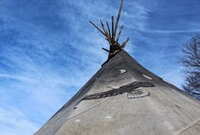
Captured in Hocking Hills State Park, this photo depicts a painting of an eagle on the side of a Native American Tipi. The eagle is sacred in their culture because this high flying bird can get closer to the Creator than any other creature. Photo credit: Sara Miller -
Laudato Si’ Gardens in Schools and Institutions across Italy
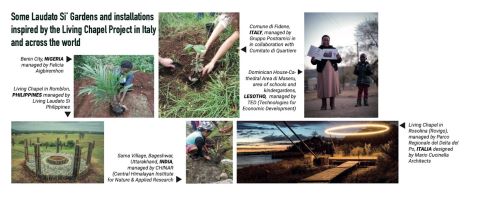
The Living Chapel is expanding outreach for Laudato Si' Gardens to spaces managed by schools, governmental and non-governmental organizations encouraging participation in caring for our common home by supplying indigenous young plant species to various regions. This project distributes young plants throughout Italy for the recovery of degraded areas.
Outside Italy, Laudato Si’ Gardens shared a Four Element Package that symbolizes Air, Earth, Water, and Fire. -

The Living Chapel
The Living Chapel holds the sacrality of life at its core. It embodies a call to hope: a hope for a world in which the sacrality of life is truly recognized and felt by every being to give rise to a kinder, more compassionate, more peaceful life.
In partnership with the Food and Agriculture Organization of the United Nations, Plant for the Planet, and the Global Catholic Climate Movement, the Living Chapel will join the UN Environmental Programme's One Trillion Tree Movement, inspiring the public to reconnect with nature and providing a vehicle for intercultural and interfaith collaboration to restore our common home through the creation of Laudato Si' Gardens and Living Sacred Spaces. -
UNESCO Routes of Dialogue
Throughout history, peoples have exchanged cultural experience, ideas, values and goods through art, trade and migrations.
Human history is the tale of such journeys. As we cross into the twenty-first century, we too have embarked on a journey – whose destination holds out the promise of justice, well-being and a peaceful existence for all.
These encounters, in which individual travellers or communities have conveyed their ideas and customs across whole continents and oceans, are celebrated in a series of UNESCO projects. -
Towards interreligious understanding and global peace: a compendium by The United Religions Initiative (URI) and UNESCO Chair for Peace and Intercultural Understanding
The United Religions Initiative (URI) in collaboration with UNESCO Chair for Peace and Intercultural Understanding and Banaras Hindu University is developing a compendium on Interreligious/Interfaith Dialogue, Good Practices and Future Directions. This Book seeks to collate innovative narratives and good practices of interreligious/interfaith dialogue from across cultures and regions to supplement the expanding scope and outreach of UN engagement with religious entities. To this end, faith leaders, activists, and FBOs are encouraged to contact Tanya Sablok (tsablok@uri.org) to share the vision and contribution to interfaith and intercultural dialogue. Visit the UNESCO page to learn more about their work. -
How Religion Influences Our Relationship With the Environment
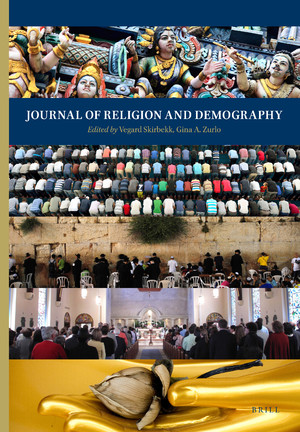
This article, drawing references from a study in the Journal of Religion and Demography, summarizes how religions influence many environmentally relevant behaviors.
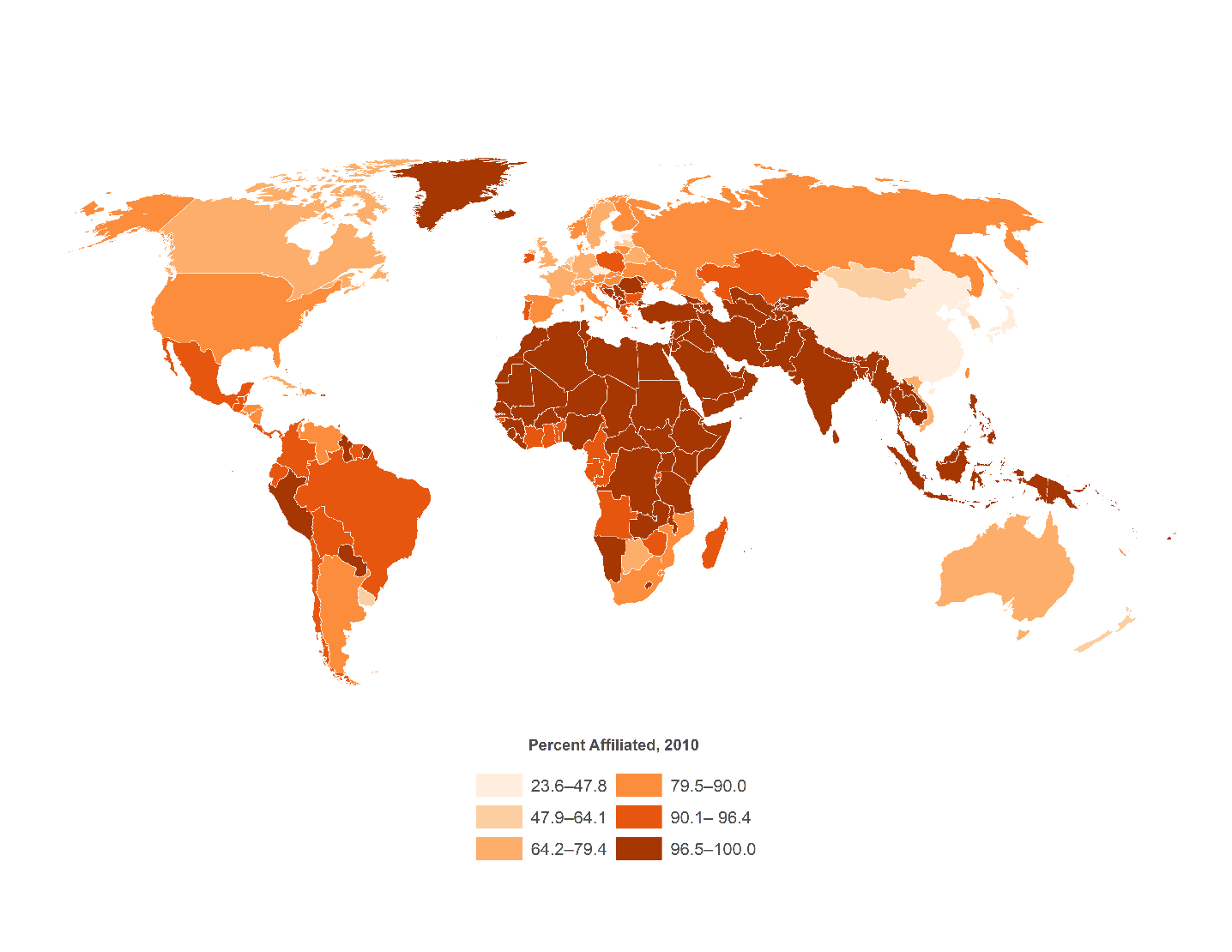
The author and his colleagues discovered that countries with a lower religious population utilize more resources and emit more emissions, but they are also better prepared to deal with the environmental difficulties that emerge since they are wealthier. On the other hand, countries with more religious populations tend to use fewer resources, but they also have less capability to address environmental concerns and are more vulnerable to negative consequences, owing to their high levels of poverty and continued population increase.
The link between religion, poverty, environmental impact, and governance is intricate and ever-evolving; the field continues to call for more research. -
Religious Affiliation and Environmental Challenges in the 21st Century
"As the impacts of climatic change increase, the share of the world population with a religious affiliation is expected to rise (from 84% in 2010 to 87% by 2050). Religion is important for climate change relevant behaviours, including fertility choices or whether one sees climatic change as due to human action or related to forces beyond human control. We conduct exploratory and descriptive statistical analyses to better understand the associations among religion, on the one hand, and economic development, greenhouse gas emissions, exposure to environmental stressors, and attitudes, beliefs and environmental performance, on the other. We show that countries with lower shares that are religious tend to have more emissions, to be better prepared for environmental challenges and have low or negative population growth. Countries with a greater proportion of religiously affiliated tend to have higher population growth, face more environmental risks and to be less prepared for those risks. Identifying groups that disproportionally cause or are exposed to environmental risks represents an issue of environmental justice. Understanding the religious composition of the world along with environmental changes can further help identify which environmental policies that could be more effective." -
IPBES Global Assessment Report Summary on Biodiversity and Ecosystem Services for Policymakers
This report represents a critical assessment, the first in almost 15 years (since the release of the Millennium Ecosystem Assessment in 2005) and the first-ever carried out by an
intergovernmental body, of the status and trends of the natural world, the social implications of these trends, their direct and indirect causes, and, importantly, the actions
that can still be taken to ensure a better future for all. These complex links have been assessed using a simple, yet very inclusive framework that should resonate with a wide range of
stakeholders, since it recognizes diverse world views, values, and knowledge systems. -

People of faith are allies to stall climate change (Nature Magazine)
Tobias Müller is a political scientist who studies how religious groups respond to problems, from environmental crises to domestic violence to racism. In this article, he explores changes in the intersection of climate science and communities of faith. Müller shares with us patterns he's observed and strategies he's learned in his years in the field that help strengthen collaboration and the power to pursue climate justice. Some core ideas include:
1. Collaborate with religious scientists and local leaders.
2. Stories speak louder than graphs.
3. Talk about what matters to you and your audience. -

Green Ramadan
In this letter from Sayyid M. Sayeed, the
President of Islamic Society of North America, he voices the responsibility of Muslim communities as caretakers of the earth and calls for community members to join in the ISNA efforts to adopt environmentally friendly practices.
"I earnestly request that your mosque/Islamic Center join in 'Greening our Ramadan Campaign.' Let us all work together to reduce our carbon footprint. Have a blessed Ramadan." -
Green Muslims Ramadan Toolkit
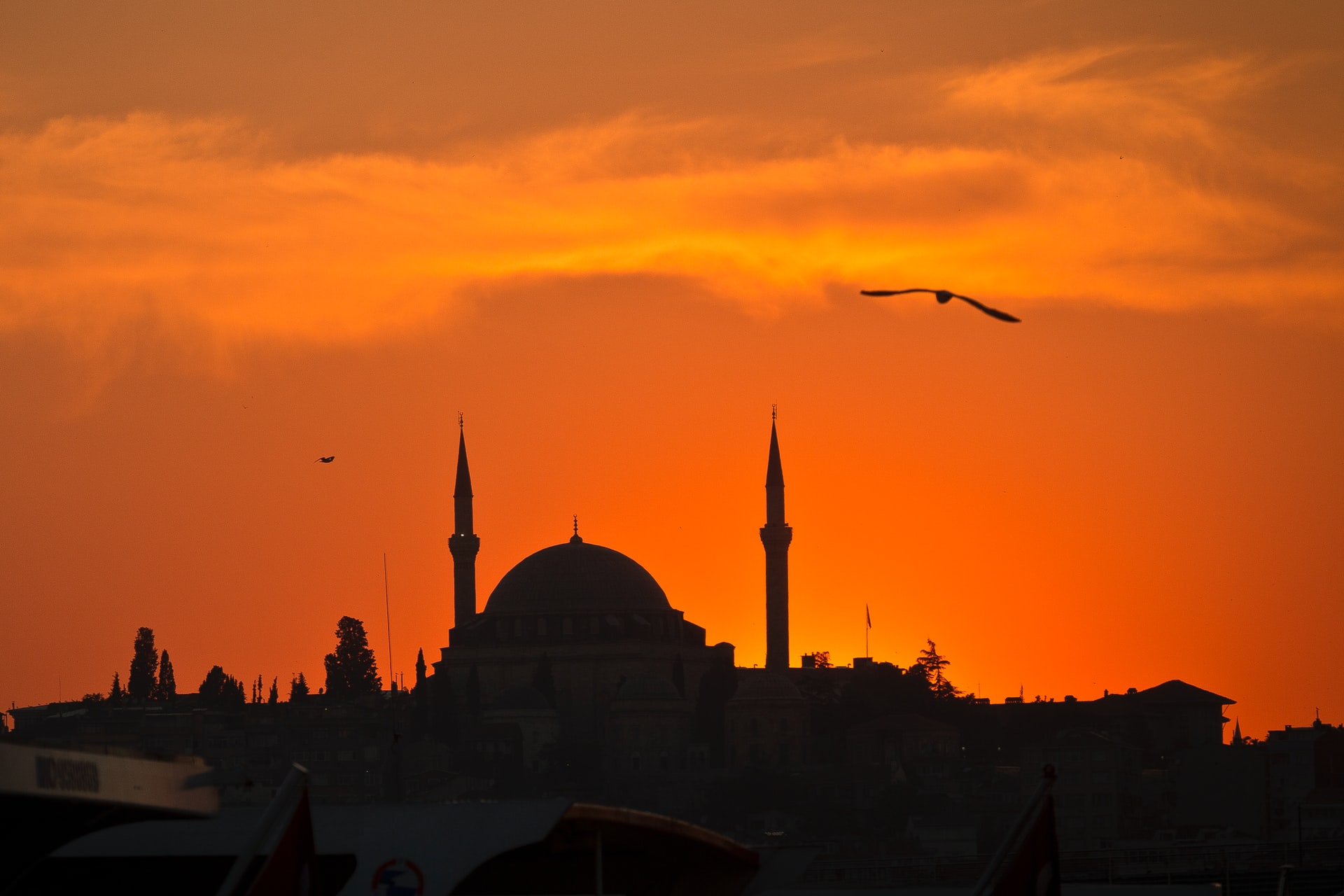
Ramadan is a time to reflect, exercise self-control, and cultivate connections to one's faith. This three-part toolkit hopes to enhance the Ramadan experience using those same concepts but building more environmentally friendly habits while connecting one
with their faith in a unique way.
Each day highlights an Ayah, a quote, or a hadith that aspires to inspire you to action. The “challenge yourself” section of the day gives you a suggestion on how to adjust your habits, and the “reflection” section hopes to help you analyze your current habits in order to make the habit-forming both action-oriented and intellectual. -

Green Umbrella Impact Team: Faith Communities Go Green
MISSION: Partnering with religious communities to create a more sustainable and equitable future for all by mobilizing their moral voice to reduce the risk of catastrophic climate change.
VISION: Religious communities collaborating to integrate care for creation in their lives and society. -

Green Umbrella: Regional Sustainability Alliance
Green Umbrella is the regional sustainability alliance of Greater Cincinnati, with over 200 member organizations and over 200 individual members passionate about enhancing the environmental health and vitality of our region.
Green Umbrella facilitates collaboration among non-profits, businesses, educational institutions and governmental entities to meet the environmental, social, and economic needs of today while preserving the ability of future generations to thrive. -
The Common Orchard Project (Incubated by Green Umbrella)
The Common Orchard Project works to install and maintain hundreds of small orchard plantings across Greater Cincinnati and grows “commonly held” resources by educating communities on fresh food and urban land management. These common orchards provide increased food access, tree canopy, walkable greenspace and community building in neighborhoods that have experienced disinvestment. Founded in 2017 by Chris Smyth, the effort has planted 12 orchards across Cincinnati and two in Cleveland, with plans to install 50 more by 2024.
In 2021, The Common Orchard Project was been adopted by Green Umbrella as an "accelerator project." Chris Smyth continues to serve as the director of the project as it incubates within Green Umbrella and will plant more orchards each year thanks to Giving Grove’s support. Learn more about the project at www.commonorchard.com. -

The Giving Grove
The mission of the Giving Grove is to provide healthy calories, strengthen community and improve the urban environment through a nationwide network of sustainable little orchards to dramatically increase access to healthy food.
The Giving Grove envisions:
- thousands of little orchards in food insecure urban neighborhoods across the nation;
- a system of local food production that feeds people for decades;
- a national network of neighborhood stewards trained in holistic methods for growing fruit; and
- urban neighborhoods transformed by their own work and generosity. -
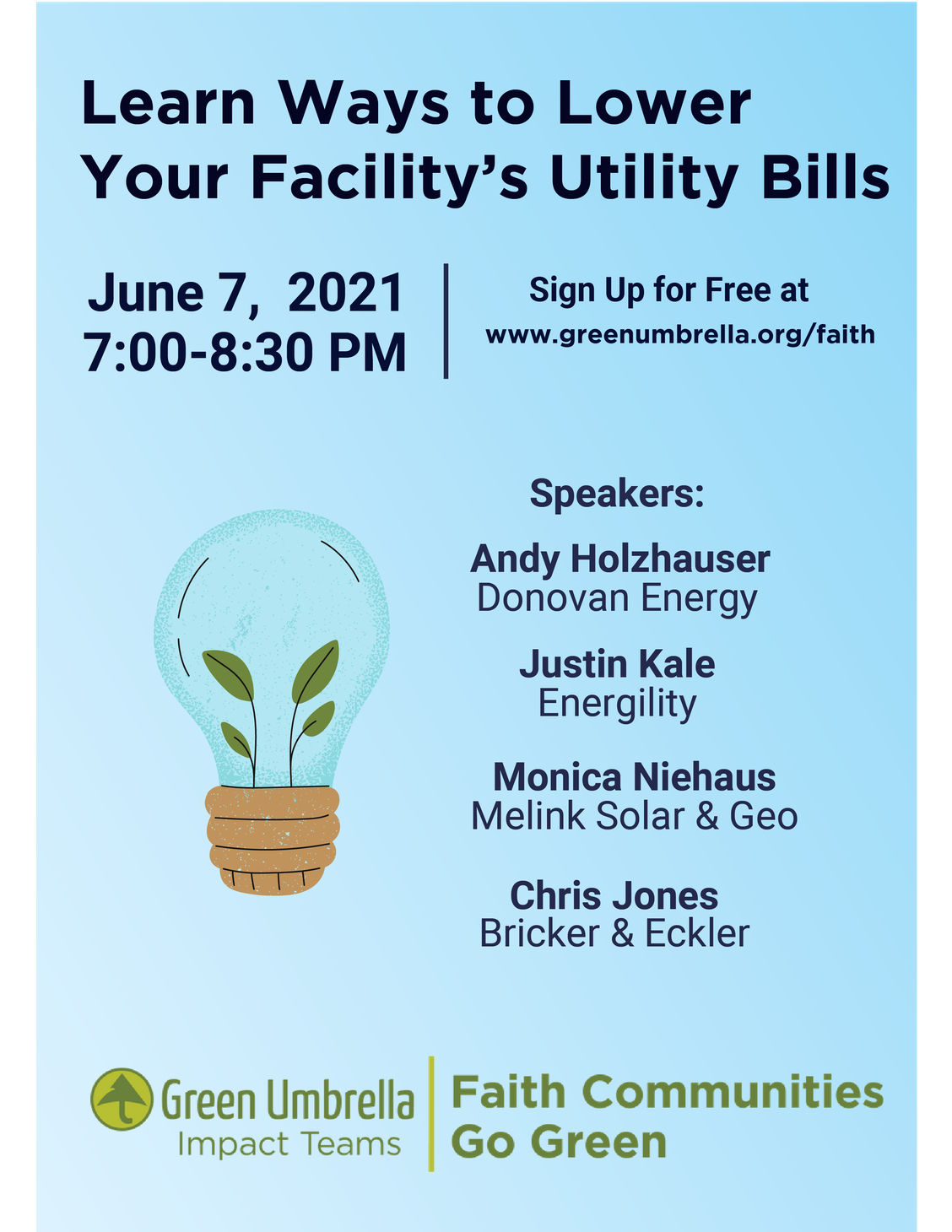
Free Webinar: Learn Ways to Lower Your Facilities Utility Bills
This event is hosted by the Green Umbrella Impact Teams in collaboration with Faith Communities Go Green
Date and time: June 7, 2021 7:00 -8:30 pm
Learn about different types of energy audits, renewable energy choices and PACE financing for nonprofits. There will be opportunities for focused conversations in smaller breakout sessions.
Who should attend?
Executive directors, building supervisors and congregational members: Everyone is welcome. -

Interfaith Cincy
Interfaith Cincy seeks out religious groups and the services they provide in order to enable them to expand their capacity. The website provides a communication network for individuals to share success stories and their best ideas. We use our academic resources to objectively represent the variety of organizations that we have encountered in a growing directory.
InterfaithCincy.org is also an educational tool designed to strengthen interfaith dialogue. -

Laudato Si' Action Platform
The Laudato Si' Action Platform is a collaboration between the Vatican, an international coalition of Catholic organizations, and "all people of good will." Rooted in the strengths and realities of communities around the world, the platform takes a group-up approach to empower all to take "decisive action, here and now" as we journey towards a better future together.
The platform offers:
- Laudato Si Plans for institutions, communities, and families to use and implement their response to Laudato Si'
- A process-oriented approach
- Practical guidance on actions that help build a better future through the Laudato Si’ Goals
- Recognition of progress -
-

Ecological Consciousness in Jainism: Exploring Realities, Constraints, and Traditions
This paper explores the traditions and philosophies of Jainism and how that influences its connection to the environment. The author explains the Jainism cosmology and the distinction between different senses as they apply to animate and inanimate beings. Jain literature understands human connections to the world with an emphasis on the interconnectedness of life forms. To Jains, environmental concerns cannot be separated from socio-economic concerns. -
The Islamic Foundation for Ecology and Environmental Sciences (IFEES)
The Islamic Foundation for Ecology and Environmental Sciences (IFEES) is a foundation founded in the United Kingdom committed to the preservation of the Earth as a healthy environment for all living things. This is also a call on Muslims to live up to their obligations as guardians of Allah's creation (Khalaifa - Qur'an 6:165) and endeavor to ensure that future generations inherit a livable planet.
"Our exertions since the mid-1980s have been directed towards creating mass awareness and include research, the production of teaching materials, training, and project development and we offer this work as a gift to our fellow humans whoever and wherever they may be." -
The 12 Principles of Permaculture: A Way Forward
This blog article describes the basics of permaculture (permanent culture). Permaculture is rooted in the observation of natural systems and indigenous knowledge. The author introduces the solution permaculture offers to help us transition to a more resilient, ethical, and sustainable future better for the planet and its inhabitants.