
Items
-
 UN Environment Programme Faith-Based Activities Compilation "The World Environment Day is a UN day celebrated to promote awareness and inspire action. It has been celebrated since 1974. The event has grown to become a global platform for public outreach that is widely celebrated in over 100 countries...In the celebration of World Environment Day, 482 faith-based related activities were organized all around the world"
 -
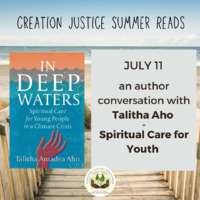 In Deep Waters: Spiritual Care for Young People - an author conversation with Talitha Aho "Join us for a captivating webinar as author Talitha Aho engages in a thought-provoking conversation about her book, 'In Deep Waters: Spiritual Care for Young People in a Climate Crisis.' Discover how the climate crisis impacts the younger generation and the importance of offering ecologically informed spiritual care. Talitha will also discuss practical ways to care for and respect God's world, drawing on science, Scripture, and her expertise. Whether you are a caring adult, a member of Generation Z, or simply interested in the intersection of Christianity and the environment, this webinar is not to be missed. Join us for an enlightening dialogue that will deepen your understanding, provide actionable strategies, and ignite hope in the face of our planet's challenges."
 -
 "Find Your Telos" Women's Retreat "What is your Telos? How do you find your Telos? What is a 3-D life and how do we operate in it? Whether you are single, married, widowed, a parent, or have no dependents, finding joy and life's purpose is a goal for most. This conference will assist women in finding their Telos and walk away with tools to support their journey. Registration through the link below is required for this free event."
 -
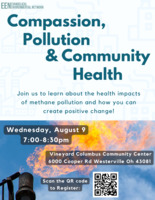 Compassion, Pollution & Community Health This event was created to help people learn about and discuss the health impacts of methane pollution and how to create positive change with the environment and community.
 -
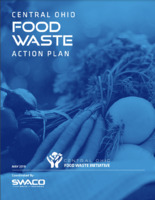 Central Ohio Food Waste Action Plan "Every day, Central Ohioans landfill nearly a million pounds of the very thing that nourishes and sustains us – food. The amount of food wasted in Central Ohio, and throughout the U.S., has grown over the decades and recent years, and the social, economic, and environmental impacts of this wastefulness is enormous. Central Ohio’s community mindset and willingness to collaborate can change this narrative. Reducing food waste is within our control. For this reason, organizations, businesses, non-profits, government agencies, schools, and communities have come together to form the Central Ohio Food Waste Initiative and work collectively to tackle the issue of food waste. Together, we strive to cut food waste in half by 2030. To accomplish this, we need your help. Join us by learning more and taking action."
 -
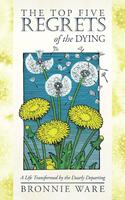 The Top Five Regrets of the Dying "After too many years of unfulfilling work, Bronnie Ware began searching for a job with heart. Despite having no formal qualifications or experience, she found herself working in palliative care.Over the years she spent tending to the needs of those who were dying, Bronnie's life was transformed. Later, she wrote an Internet blog about the most common regrets expressed to her by the people she had cared for. The article, also called The Top Five Regrets of the Dying, gained so much momentum that it was read by more than three million people around the globe in its first year. At the requests of many, Bronnie now shares her own personal story.Bronnie has had a colourful and diverse past, but by applying the lessons of those nearing their death to her own life, she developed an understanding that it is possible for people, if they make the right choices, to die with peace of mind. In this book, she expresses in a heartfelt retelling how significant these regrets are and how we can positively address these issues while we still have the time.The Top Five Regrets of the Dying gives hope for a better world. It is a story told through sharing her inspiring and honest journey, which will leave you feeling kinder towards yourself and others, and more determined to live the life you are truly here to live. This delightful memoir is a courageous, life-changing book."
 -
 Its promised land drying, Mormon Church works to save the Great Salt Lake Due to overuse and climate change, the Great Salt Lake is drying and is estimated to disappear in about five years. In response to this, the Mormon Church of Jesus Christ of Latter Day Saints has started public conservation and water-saving efforts. This article describes these efforts and the role of the Great Salt Lake in the local environment and culture.
 -
 Stop getting your modest clothes from fast fashion brands "The hijab and modest fashion are not immune from the global mainstream shift to fast fashion. Ironically, in light of celebrating diversity and inclusivity, fast fashion businesses have created new niches for underserved audiences, including the Muslim community. Often these businesses outsource production to Muslim majority countries in the Global South. Here garment workers are exploited for less than a living wage..."
 -
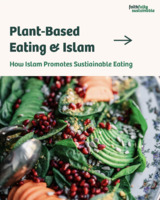 Plant-Based Eating & Islam "As Muslims, when we look at plant-based eating it might be surprising to know that many of the currently popularized health, social and environmental benefits are founded in Islamic Principles. In this article, we will discuss plant-based eating with a focus on agricultural systems in the Western world, the general implications of this diet and how it relates to Islam. This article will only discuss the diet of plant-based eating, However, to learn more about veganism in relation to Islam read our previous two blogs of our series ‘Ethical and Sustainable Living in Islam’"
 -
 A Faithfully Sustainable Ramadan "Join us this Thursday April 22nd (#EarthDay ?) as we collaborate with @drexelmsa to discuss how we can actively practice a Sustainable Ramadan that is in line with the Prophetic Sunnah and the Quran, both within our home and with our communities! ?? The discussion will be led by community leaders and sustainability experts Imam Saffet Catovic and Sister Saarah Latif @saarahlatif. ?"
 -
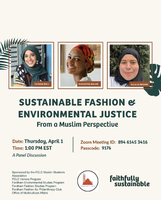 Sustainable Fashion & Environmental Justice from A Muslim Perspective A Zoom panel discussion featuring Faithfully Sustainable cofounders Zainab Koli and Kadiatou Balde, as well as member Saja Elmishri, focusing on clothing sustainability, fast fashion, and how fashion impacts environmental justice.
 -
 Faithfully Sustainable "We envision a world where young Muslims have the community support and necessary resources to create just and sustainable solutions grounded in Islam. Ultimately, these solutions will address the impact of climate injustice, protect the most vulnerable, and serve as a step forward for young Muslims to fulfill their divine duty towards people and the planet. We equip young Muslims and allies with a strong community, and the educational and financial resources necessary for them to create just and sustainable solutions."
 -
 Muslims for Climate Justice Conference "In September 2023 inshaAllah, Muslims dedicated to ending the climate crisis will gather at a summit to hear from renowned scholars and inspirational change-makers. Together, we will form an unbreakable network bound by an Islamic framework and worship of Allah (SWT), utilizing values of empathy, innovation, and justice to invite Muslims into the global climate conversation."
 -
 Love and Environmentalism This chapter from the student-written book “Emerging Perspectives on Religion and Environmental Values in America” explores how love and care impact how people interact with the environment, and how spirituality views and impacts this. It discusses how religion encourages love and how love encourages environmentalism, and how the three work together. Below is the first paragraph of the chapter to introduce the discussion. "My mother had one general rule for me as I was growing up: to respect others, respect myself, and respect the environment. Obviously there were more rules that fell under this— 'clean the dishes after school' being one I was just as frequently reminded of—but they all fell under this principle in some form. This was also the basis of my environmental education: respecting the environment, showing it the care, love and awe that it deserved, was a fundamental aspect of our lives. Every time we would go outside or take a hike, I would be reminded not to touch anything I didn’t have to, to leave things the way I found them, and to appreciate the beauty of our surroundings. These ideas of respecting others and your surroundings are common themes in religious doctrines as well—'love thy neighbor' is a common refrain, and one that is often used in religious environmental arguments. As can be seen in many religious statements on environmental crises, protecting those less fortunate than yourself (respecting others) and protecting the gift of creation (respecting the environment) are the focal points of religious arguments in support of environmental action. Yet the love of nature is often underappreciated or overlooked when it comes to discussions of the environment, despite its universality. Perhaps because the concept is emotional rather than scientific, love is more easily dismissed as a weak persuader, but because it is so basic to humans it stands to be one of the more powerful forces we have available to us. As a common religious and moral value, the love and respect that people are asked to treat their surroundings with is a significant driver in environmentalism, both to better understand the environment and to create a sense of responsibility in preserving it."
 -
 The Sacredness of Water This chapter from the student-written book “Emerging Perspectives on Religion and Environmental Values in America” explores the importance of water across religious traditions and modern life. It explores the importance of water for survival but also as a gift that frequently acts as a spiritual symbol. Below is the first paragraph of the chapter to introduce the discussion. "Pick up any religious text and you are likely to find at least one reference to water. Whether it is used to cleanse, bathe, heal, restore, replenish, or purify: water is one of the most prolific symbols in major world religions, stretching through time, place, and culture. As human beings, this may come as no surprise seeing how our bodies are composed mostly of water, and we rely on it for our very survival – a truth that continues to become more resonant as the effects of climate change take hold in the forms of drought, rising temperatures, and natural disasters. Like many religious symbols, water appears in scripture, ritual and tradition through its simplicity and use in everyday life. In examining a variety of major world religions, namely Islam, Judaism, Hinduism and Christianity, connections between water as a common resource, and water as a sacred and holy gift become apparent. Drawing from these unique and similar understandings of water, we can begin to consider the spiritual motivations one might have in engaging in water conservation efforts. Furthermore, in exploring these religions specifically, we can identify some beliefs about water that may provide helpful wisdom in the face of more rational conversations surrounding water conservation. Because these religions have such strong relationships with water and large followings worldwide, there is hope that these connections between scripture and our contemporary crisis may be brought to life to move toward a more secure and just future."
 -
 Origins of the Pro-Religion, Anti-Environmentalist Conservative Stereotype This chapter from the student-written book “Emerging Perspectives on Religion and Environmental Values in America” explores the relationship between political affiliation and environmental values, as well as the stereotypes surrounding them. It examines how religion interacts with political views and the evolution of environmental values thoughout political and religious history. Below is the first paragraph of the chapter to introduce the discussion. "The conception of someone who is 'anti-environment' usually evokes one of two images: 1) a fat cat in a suit, smoking a cigar while lining the pockets of the fossil fuel industry, or 2) a truck-driving rural American scoffing at the Prius-driving liberals in the cities who preach about their recycling practice. This chapter focuses on the second image...The distinction has been made clear in our minds: liberals care about the environment and conservatives don’t. This, along with another common conception that conservatives are religious while liberals aren’t, paints an inaccurate picture that drives religious conservatives out of the environmental conversation. How did this happen?"
 -
 The Essential Presence of Faith-Based Organizations in Sustainable Community Development This chapter from the student-written book “Emerging Perspectives on Religion and Environmental Values in America” explores the presence of religious organizations providing service to local communities. It discusses the broad range of faith-based organizations and their many projects, and how engaging with these organizations and programs can improve connections to one's environment and spirituality. Below is the first paragraph of the chapter to introduce the discussion. "The presence of faith-based organizations as social, human, and cultural capital within every community, regardless of demographic dimension, politics, race, and income demonstrate the resilience of religion as an asset essential to the cultivation of sustainable community development. Throughout history, religious groups have served as providers of essential services for the less fortunate, and advocates for social justice and equity in both rural and urban communities. Despite trying circumstances, this resolute effort over time and their relative success in providing support to those in need, has afforded faith based-organizations credibility, and in some cases their role is indispensable."
 -
 The Place of Pets in Our Lives: Some Christian and Buddhist Perspectives This chapter from the student-written book “Emerging Perspectives on Religion and Environmental Values in America” explores the impact of animals and pets on our environmental values. The author discusses their own experiences with pets as well as religious texts and perspectives as they relate to animals. Below is the first paragraph of the chapter to introduce the discussion. "If you ask a person to tell you about their favorite pet they’ve had, no matter how long it has been since it lived, their faces will most likely light up with joy as they tell you a humorous or heartwarming story about 'the best cat' or 'the best dog in the world!' Love and appreciation for our pets seems to be a relatively universal trait that, for many of us, is also interconnected with our religious or moral values and feelings toward nature."
 -
 An Existential Analysis of Environmental Values and the Other This chapter from the student-written book “Emerging Perspectives on Religion and Environmental Values in America” examines nature and environmental values from a philosophical standpoint. The authors uses an existential standpoint to assess environmental ethics. Below is the first paragraph of the chapter to introduce the discussion. "Foremost, the existential doctrine is one of choice and freedom. This creates an interesting set of implications for the area of environmental ethics, as the existentialists believe we are responsible for everything we do. In fact, we are not only responsible for ourselves, but the world around us and the effects our actions have on it. Likewise, as with environmental issues, existentialism reveals the intimate relationship one has with others. Just as Sartre expresses, we are always with the other. Similarly, our environmental consequences affect every person in the world, in a multitude of ways. Furthermore, nature itself has been treated as an other and I argue that this is coherent with many existentialist notions. In this sense, I believe existentialism and environmental values share some important similarities which could illuminate how one should act. Moreover, the philosophy of existentialism is one that is deeply related to the human condition, especially as it questions the meaning of existence. For this reason, I will devote a brief portion of this endeavor to reflect on my own relationship with existential values and how they have influenced my worldview. Meanwhile, I provide a substantive comparison with David Loy and Buddhist thinking. In order to develop an understanding of existentialism, I will predominantly draw on the works of Jean-Paul Sartre, Simone de Beauvoir, and Franz Fanon. Finally, I place this existential environmentalism in the context of multiple moral paradigms, including: an existential ethics, virtue ethics and social justice movements. Thus, existentialism provides a unique framework for understanding our relationship with 'the other' and nature, by defining the meaning of our actions. Therefore, I intend to show how this philosophy is particularly useful for directing environmental values, especially with the assistance of ethical theories which bridge the gap between reason and action."
 -
 Technological Takeover or Technological Makeover? This chapter from the student-written book “Emerging Perspectives on Religion and Environmental Values in America” explores the recent and rapid development of technology and its impact on our environmental actions. It discusses trends of consumerism, social conflict, and disconnection. Below is the first paragraph of the chapter to introduce the discussion. "Is it just me or does it feel like the whole world is going crazy? From a global pandemic, to a civil rights revolt, to talk about election fraud, it seems like everything is spiraling out of control and technology seems to be adding fuel to the fire. It feels as if technology is the invisible hand that controls us all on every level, individually and as a culture. As technological advancements push further, the concern for the problems perpetuated by them rises as well. I am not trying to be labeled as a 'Karen' of my generation, but technology is slowly eating away at our brains and degrading the fabrics that hold our society together."
 -
 The Intellectual Martian Society of “Stranger in a Strange Land” by Robert Heinlein This chapter from the student-written book “Emerging Perspectives on Religion and Environmental Values in America” explores the environmental ethics and spirituality of the book Stranger in a Strange Land. Specifically, the author discusses the importance of water and the environmental impact of the book. Below is the first paragraph of the chapter to introduce the discussion. "In 1961, the accomplished science fiction author Robert A. Heinlein shared his latest work with the world. In the fashion of a fairytale, Stranger in a Strange Land begins 'Once upon a time,' and goes on to describe the fantastic culture of Mars and its impact on human society. The timing of its publication in the early 1960s allowed for a short digestion period, so that it was ripe in the mind of the counterculture in the latter half of the decade. Themes of religious reform, free love, and a oneness with the cosmos permeate the book, and coincidentally rose to popularity during this time. The alignment of the novel with the counterculture cannot be understated: in 1967, the Freak Scene recorded a song entitled 'Grok!,' an homage to the word coined by Heinlein in Stranger in a Strange Land, and a year later the Byrds referenced water brotherhood in their song 'Triad.' The verb 'grok' even found its way into the vernacular of the counterculture (Blackmore, 1995). Messages about the sanctity of clean water and the positive potential of religion reached tens of millions, securing the legacy of Stranger in a Strange Land as one of the books which shaped religious and environmental values in the United States (Library of Congress, 2012)."
 -
 A Glimpse at the Reality Existing After Ours through Near-Death Experiences This chapter from the student-written book “Emerging Perspectives on Religion and Environmental Values in America” explores the phenomenon of near death experiences through several first-hand accounts. The author explores the spiritual aspect of these experiences and compares and contrasts each instance. Below is the first paragraph of the chapter to introduce the discussion. "Near-death experiences (NDEs) are gateways for the soul—a profound, transformative experience that has taken place for some who have kissed death and returned. It is estimated that NDEs affect 1 in 10 people (The European Academy of Neurology, 2019). At best, these experiences are dismissed as wild dreams or hallucinations, but we struggle to make sense of what they are. One way some scientists have been trying to explain the reality of near-death experiences is in the connection between psychedelics and psychology. Dr. Rick Strassman (2001), a psychologist who has done extensive research on the topic, is one among many hypothesizing that NDEs are a result of the hallucinogenic chemical dimethyltryptamine, or DMT for short. He suspects that DMT is produced in the pineal gland of the brain, which is an area of the brain we still know little about. Because of the pineal gland’s connection to light (what we do know is that it produces melatonin, a hormone that regulates both the reproductive system and the circadian rhythm), it has been spiritually associated with many ideas of a higher conscious and enlightenment such as the third-eye, crown chakra, and the seat of the soul. Strassman infers that DMT is produced in times of birth, near-death, death, and intense pain."
 -
 Near Death Experiences and their Implications for the Afterlife This chapter from the student-written book “Emerging Perspectives on Religion and Environmental Values in America” explores the science as well as the spirituality behind near-death experiences. The author assesses hypotheses behind this phenomenon and describes some examples of them occurring. Below is the first paragraph of the chapter to introduce the discussion. "What happens after death is a mystery that humans all over the world have speculated on since the beginning of time. In many religions, there is a sense of certainty among the followers regarding what to expect when they pass, as promised by God or a higher power they worship. Although no one really knows for sure, the closest we have come to proving the reality of the afterlife are the stories told by people who have had near death experiences, or even died temporarily and came back to life. Spiritual revelations during these incidents are a cross-cultural phenomenon felt all over the world, with details that overlap and hint at the answer to this unsolved mystery."
 -
 Pilgrim’s Progress: A Spiritual Journey Along the Appalachian Trail This chapter from the student-written book “Emerging Perspectives on Religion and Environmental Values in America” explores the Appalachian Trail and the experiences of those who hike it. The author describes his own experience on the trail and how it created further connections to his environment and a spiritual experience. Below is the first paragraph of the chapter to introduce the discussion. "The Appalachian Trail meanders 2,190 miles through the forest between Springer Mountain, Georgia and Mount Katahdin, Maine. Of the more than one-thousand hikers that attempt to walk the entirety of the trail in one year, known as thru hikers, only about a quarter will complete their trek. Despite the grim odds of success, every person that attempts a thru hike—whether they finish or not— comes away from the experience changed. Time in the wilderness, particularly on long adventures such as a thru hike, is spiritually impactful and life changing. The changes aren’t always readily apparent, but it is impossible to embark on a thru hike and not walk away a different person. Hikers may view these changes through a religious or spiritual lens, or they might not notice them at all, but regardless, Appalachian Trail thru hikers partake in a spiritually transformative experience during their four- to six- month crusade."
 -
 An Insight into Wilderness Therapy This chapter from the student-written book “Emerging Perspectives on Religion and Environmental Values in America” explores the benefits of nature and being in the wild for mental health. The author uses research on wilderness therapy as well as her own experiences to discuss this relationship. Below is the first paragraph of the chapter to introduce the discussion. "Nature has so many captivating qualities. Whether it be the rustle of summer green leaves, the indescribable blue of the sky on a clear day, or the countless creatures that scurry across the earth’s floor, I always find myself amazed by its peculiar yet familiar structure. Nature is something that is often taken for granted. Yes, individuals are constantly reminded of its presence, but do we often think of its value? For me, the wilderness has been a place of refuge and comfort. Somewhere that I look to when I am feeling lost and confused."