
Items
-
 Finding Waters: Spirit of Fly Fishing This chapter from the student-written book “Emerging Perspectives on Religion and Environmental Values in America” explores the practice of fly fishing and pursuing your passions as a way to connect with the environment. The author shares his own experiences with fly fishing and how it affected his relationship with nature to frame the discussion. Below is the first paragraph of the chapter to introduce the discussion. "One of my greatest memories is from a trip up to the northern region of Michigan. It was mid-October and in the prime of fall. The leaves were fluorescent oranges, yellows, and browns. Water clearer than the Bahamas. There were king salmon free-swimming up and down taunting me to throw a fly at one. But I just had to sit back and embrace this moment of true peace between the fish and their home habitat. I just could not throw a line in without admiring the beauty that was painted on a natural canvas in front of my own eyes. These are moments that stay with you and make you rethink your place on this Earth. Fly fishing has given me many different moments just like this one. Fly fishing is not just a hobby for me, but it is an escape from the concrete jungle of everyday life. When you fly fish, it gives you a form of peace within your life and a sense of spiritual solitude that stays with you. Sometimes, the beauty of nature simply awes us, and lifts us up; at the same time, there is a lot of history and technique that make fly fishing such a worthwhile pursuit."
 -
 An Unfamiliar Outlook: The Partnership of Ecofeminism and Daoism This chapter from the student-written book “Emerging Perspectives on Religion and Environmental Values in America” explores the interactions between Daoism and environmentalism, feminism and environmentalism, and Daoism and feminism. The history of these philosophies are explored and the author includes her own experiences and thoughts to help discuss the perspective. Below is the first paragraph of the chapter to introduce the discussion. "It’s not clear how many Daoist ecofeminists are in the world, but I think I may be one of them. Though I was raised as a Baptist Christian, I have found the insights of Daoism, the predominant religion of the homeland of my family, and ecofeminism, the perspective that centers women’s relationship to nature, as complementary to my Christian faith and concern for the environment. I have been able to incorporate this philosophy into my life and found that they are interrelated. My interest in these thoughts was partly sparked by applying to the China Program summer internship with Environmental Defense Fund (EDF), which piqued my interest in learning more about Chinese cultural beliefs. Daoism has played a huge role as a philosophy within Chinese culture for thousands of years, and I am interested in ecofeminism because it is a topic that strongly resonates with me being a woman and its relation to the earth. As someone who grew up having a spiritual and personal relationship with the natural world, I find that many of my values align with the Daoist ecofeminist perspective."
 -
 Humans as Part of Nature: The Benefits of Time Spent Outdoors for Mental Health This chapter from the student-written book “Emerging Perspectives on Religion and Environmental Values in America” explores the impact of connecting with nature and the environment on mental health. The author describes their own experiences with mental health problems and healing through activities in nature to frame this issue. Below is the first paragraph of the chapter to introduce the discussion. "In the summer of 2019, I was a high-school junior going to be a senior the coming year, going on a SCUBA trip out of state with my specialized environmental science class so that I could finish up my certification. This time in life at the end of high school but before college is widely regarded as the most fun and free time for a young person. A time where you’re so close to the end of the life that your parents and the state have laid out for you and still far from the stresses of choosing for yourself in life and dealing with the repercussions of those choices. This expectation was far from where I was at that point in my life."
 -
 The Gardener’s Ethic: Countering Alienation from Nature This chapter from the student-written book “Emerging Perspectives on Religion and Environmental Values in America” explores Michael Pollan's idea of a gardener's ethic and compares it to the wilderness ethic. It assesses texts and philosophies concerning how humans interact with the environment, as well as incorporating the author's thoughts on these ethics. Below is the first paragraph of the chapter to introduce the discussion. "In my first reading of Second Nature: A Gardener’s Education, Michael Pollan challenged the environmental ethic that I have unconsciously held for as long as I can remember. His chapter, 'Nature Abhors a Garden,' particularly sparked this evaluation. In this chapter, Pollan states that, 'gardening quickly teaches you to distrust…absolutes, to frame the question a little differently' (p. 49). To me, the broader absolute Pollan challenges is that many Americans have grown up with a ‘wilderness ethic’ but do not know exactly how they came to hold it, or the implications that come along with it."
 -
 Houseplants and the Balance of Life This chapter from the student-written book “Emerging Perspectives on Religion and Environmental Values in America” explores how participating in the act of growingplants, even house plants, can help connect you to nature and spirituality. The author shares her own experiences with growing plants and how her views were shaped. Below is the first paragraph of the chapter to introduce the discussion. "Growing up I was not a particularly religious person. I grew up in a Christian household, but we rarely went to church. My siblings and I were still somewhat involved in the church, we attended Vacation Bible School. When I outgrew the program, I volunteered as a group leader for the kindergarteners and first graders. I did this for about 4 years but was unable to continue volunteering due to my jam-packed high school schedule and extracurricular activities. Although I grew up learning the very basics about the bible, my knowledge and understanding are limited to the lessons taught to younger children. When asked about my specific denomination, I do not know how to reply. I simply say my church is the Ridgeway Church of Christ."
 -
 The Consequences of the Ego and the Potential of Unselfing This chapter from the student-written book “Emerging Perspectives on Religion and Environmental Values in America” explores consumption, human ego, and the relationship between these and our environment. It discusses human nature and how we interact with each other, technology, and nature. Below is the first paragraph of the chapter to introduce the discussion. "Consumption is one of the favorite pastimes of our developed society, but it is also the source of many environmental problems. As technology has advanced, our society and economy have developed into one dependent on the mass consumption of things. Our habits of mass consumption have acted as a vehicle of destruction by increasing the amount of resources we use and waste we produce, leaving parts of our environment severely degraded. As a result, the people who have more and seem to be successful make more environmental impact, while the environmental consequences of their actions tend to be felt by the have nots. Our symbols of success that we prop up seem to be part of the problem as they have serious environmental downsides, and even though we recognize these downsides we continue to glorify consumptive habits that are destructive. But have you ever considered the roots of our need to consume?"
 -
 Shifting Focus: Meditative Reflection on the Self and Connectedness This chapter from the student-written book “Emerging Perspectives on Religion and Environmental Values in America” explores how connecting with the environment and the self can improve mindfulness and meditation. Additionally, it discusses how meditation and mindfulness can improve one's connection with nature and the self. Below is the first paragraph of the chapter to introduce the discussion. "In the beginning of a meditation, focusing on breathing provides rhythm and a connection between body and mind. My experiences in both guided and solitary meditation begin this way to ground myself and clear my mind, accepting any thoughts that may come through but not dwelling on them. From this awareness of breath, attention is then shifted throughout the body, gradually working from the feet to the forehead. Now that I have pushed up against the boundaries of my body, the next step is to reach out just past myself and focus on the space around me. But what are these boundaries? Meditation practices have roots in various religious ideologies, which analyze these boundaries and deconstruct the notion of the self. While I usually avoid having an end goal in my own meditation, learning about the dissolution of the self has changed my perspectives and techniques when meditating, as well as how I think about myself and my place in the world in general. Meditation now serves as a way of opening my mind and breaking down the perceived barriers around me, in a way that allows me to grow and ground myself."
 -
 My Spiritual Journey: Dissolving Barriers through a Conscious Connection with Nature This chapter from the student-written book “Emerging Perspectives on Religion and Environmental Values in America” explores the author's experience with nature and gaining new perspectives. She discusses how doing service and building a connection with nature and other people helped shape her identity and grow as a person. Below is the first paragraph of the chapter to introduce the discussion. "I am constantly inspired by nature and the idea that taking care of myself means taking care of the environment. Whether I realized it or not, religion has always shaped my beliefs about personal identity and responsibility in the world. I went to Catholic school my entire K-12 career, but never truly resonated with the beliefs taught to me. It was not until high school that I became more connected to a higher power. A service retreat to Louisville, Kentucky, sparked this spiritual awakening. That was nearly four years ago, and today I am still exploring topics like animal welfare, environmental ethics, death, the need to control, and unselfing."
 -
 President Carter’s Environmental Roots This chapter from the student-written book “Emerging Perspectives on Religion and Environmental Values in America” explores the environmental history and values of former President Carter. It discusses how Carter's religion impacted his environmental views and how he acted on those values during his career. Below is the first paragraph of the chapter to introduce the discussion. "Former President Carter, the peanut farmer turned president, has a long and well-known record. He’s been everything from a farmer, navy man, state senator, then Governor of Georgia, President of the United States, Noble Peace Prize winner, and bible study teacher. What’s not as recognized as his noble peace prize winning post-presidency, or his political career, is his strong environmental policies. In his 4 years in the White House, President Carter did more for the environment than many presidents before and after him. He faced many challenges throughout his presidency, most notably the hostage crisis, and the energy crisis. These major challenges in his tenure have hogged much of the attention of his presidency, and people seem to forget his message of good environmental attitudes. The question is, where did his environmental attitudes come from?"
 -
 The Kitchen as a Classroom: Recipe to Unearth Life’s Simple Virtues This chapter from the student-written book “Emerging Perspectives on Religion and Environmental Values in America” explores how the connection between cooking, appreciation of nature, and spirituality. It discusses how food can connect you to family, yourself, and your religion. Below is the first paragraph of the chapter to introduce the discussion. "The art of cooking is a timeless practice, a ubiquitous unifier since time immemorial: in an age of limitless diversification of pressing demands, eating remains one of the few things that we all must do. This venerated act is crucial for cultural continuance and deep spiritual exploration for people all over the world, a practice whose rich appeal and infinite adaptability esteem it a craft for all to enjoy. The delicious epitome of self-care, deliberate preparation of whole ingredients is the antidote to thoughtless consumption of mass-produced, ultra-processed foods, whose impersonality and generally unhealthy nature worsen physical and mental well-being (Lin et al., 2018). The benefits of spending quality time in the kitchen, alone or with others, permeate myriad aspects of life: by choosing to cook, one is 'unplugging to plug back in' by engaging with a simple, mindful practice to restore personal and familial health, build connections and instill a strong sense of community, preserve ethnic heritage, challenge a growing dependency on corporations, and fix our broken food system."
 -
 Nature as the Compass of the Heart: A Poetic Autobiography This chapter from the student-written book “Emerging Perspectives on Religion and Environmental Values in America” uses a collection of the author's poetry to explore his relationship to nature and religion. It explores self-expression and how the arts can help motivate environmental action. Below is the first paragraph of the chapter to introduce the piece. "Dear Reader, How shall you live today? Will you watch the sunrise? The sunset? Will you drive your car with the windows down, sticking your hand out the window to catch the fresh air passing through your outstretched fingers? Maybe cook a meal with a friend in a kitchen filled with delicious smells and sounds? Or will you call a loved one? Hear their voices, their stories."
 -
 The Meaning of Music This chapter from the student-written book “Emerging Perspectives on Religion and Environmental Values in America” explores how music and the arts can help connect you with the environment and your spirituality. The author discusses his personal relationship with music and how it has impacted his spirituality and connection to the world around him. Below is the first paragraph of the chapter to introduce the discussion. "From a young age there have only been a few constant presences in my life: school, sports, and music. The importance of school was instilled in me at a very young age, and while I hope to graduate one day and make a career out of something I love, the reality is that school is more of a job than it is an interest. What about sports? I have participated in and watched sporting events all of my life, however, now that I am no longer playing in officially organized sports, the love for them has shifted more to spectating rather than participating. So what is left, music? Music is weird, where all other things have seemingly lost some significance or taken on more serious responsibility, music is just as interesting now as it was when I was younger. Having become far more interested in self-evaluation and exploration as of late, I have taken a serious interest in attempting to understand why music has not only remained important in my life but is actually becoming more and more so. Music has been around for roughly fifty thousand years, so it is no wonder that it has become almost a universal language of the world."
 -
 The Spirituality of Art: Finding God at the End of a Paintbrush This chapter from the student-written book “Emerging Perspectives on Religion and Environmental Values in America” discusses how exploring the arts and your passions can help connect to yourself, nature, and your spirituality. The author discusses her personal experience with creating art in nature and how this can make one feel more connected to their surroundings. Below is the first paragraph of the chapter to introduce the discussion. "What did I get myself into? These were the first thoughts in my head as I squinted to get a better look at the glacier I was supposed to hike up to… almost too far away to see. With a group of other artists, I was supposed to trek up the steep side of a mountain to Lake Louise and the receding glacier behind it around 8,000 feet above sea level. Here in the Wind River Range in Central Wyoming, the nearest town was a couple hours away so there was no turning back now. We gathered our tripods, panels, brushes, and paint and hoisted our art supplies onto our backs and strapped bear spray to our fronts for easy reach. It was my first ‘advanced’ Plein Air hike, and I was about to discover just how difficult this art form was!"
 -
 Embracing Mystery in the Search for Truth This chapter from the student-written book “Emerging Perspectives on Religion and Environmental Values in America” explores what truth really is, as well as the relationship between science and faith. To discuss this, the author addresses how people create and understand meaning and their spirituality. Below is the first paragraph of the chapter to introduce the discussion. "The evolution of the human brain over the course of history has permitted the mind to achieve consciousness—an awareness of ourselves and the universe that prompts humanity to question the mystery of our own experiences. The complex nature of the brain, according to author Diane Ackerman is 'to liken and learn, never resist a mystery, and question everything, even itself' (Ackerman, 2004). All forms of knowledge and discovery are ultimately based on unverifiable presuppositions, and an element of uncertainty is present whether it be in the field of scientific research, theological beliefs, or artistic expression. Perhaps then, just as multiple instruments and notes are woven together to form a complete sonata, multiple disciplines, perspectives, and ideas can provide a more holistic understanding of the world. There are certain mysterious qualities of the human experience that cannot be reduced to a single concrete understanding of truth. However, this does not imply that truth and morality are purely relative. One can appreciate multiple lenses when understanding the phenomena of our own existence, yet still recognize that truth and understanding are not purely subjective and some ideas hold more merit than others. There is beauty in the never-ending journey towards understanding ourselves and the world we live in—after all, the very process of science induces new discoveries and understandings that then lead to even bigger questions and mysteries."
 -
 Groundhogs, Integral Ecology, and the Meaning of Life This chapter from the student-written book "Emerging Perspectives on Religion and Environmental Values in America" explores the values that guide our morality through the framework of the 1993 film Groundhog Day. It discusses ideas of rebirth, hope, and living by virtues. Below is the first paragraph of the chapter to introduce the discussion. "Every year, my family hosts a celebration that emphasizes hope, freedom from depression, and a love of Creation. This celebration is so intense and widespread that there is not a soul who has known my family for a full year who doesn’t know of it. Most calendars name this holiday on February second Groundhog Day. We have erroneously called it 'Groundhog’s Day' since we began celebrating it over 15 years ago, which is likely a Freudian slip to show that the day belongs to the rodents, not to us. Many people are surprised when they step into my house in the month of January, as they find a groundhog flag, a dozen groundhog plushies, Bible verses about hope hung on the walls, live plants with twinkle lights, and hundreds of cupcakes and cookies decorated to look like groundhogs. Often, the movie Groundhog Day (Ramis, 1993) will be playing on the TV. This is not simply because the movie is about groundhogs, but because it represents many of the values my family celebrates: overcoming the depression of a selfish lifestyle, embracing our creative leanings, and finding worth and pleasure in doing good for others. February second reminds us that by abandoning ideals of egoistic hedonism and embracing a life of virtue, we will not only see our own lives grow richer and more joyful, but the social and ecological world around us will flourish as well."
 -
 Reconnecting with Creation through Regenerative Agriculture This chapter from the student-written book "Emerging Perspectives on Religion and Environmental Values in America" discusses the importance of proper soil treatment in agriculture and how to connect with nature and spirituality through growing. It explores proper agricultural practices and agricultural history to do so. Below is the first paragraph of the chapter to introduce the discussion. "For tens of thousands of years, humans have survived in many environments all around the world. Through thick and thin, humans have been able to fight against predators, weather, and starvation. The unlikely survival of humans can be heavily attributed to one thing: agriculture. With a stable food source, people have been able to do almost everything, live almost anywhere, and support billions of hungry stomachs all across the world. Agriculture is the science of cultivating plants or animals for human use, and it hasn’t changed much since the beginning. Starting around 9500 BCE, humans planted crops for a controlled harvest, planting rice, grains, and chickpeas for stable and healthy societies in the Middle East. Almost 12,000 years later, I continue to perform the same actions in my own backyard, with very little changes."
 -
 Manifest Destiny: The American Dream or an Ecological Crisis? This chapter from the student-written book "Emerging Perspectives on Religion and Environmental Values in America" explores the history of colonial expansion and the concept of manifest destiny in the US. It examines the environmental impacts as well as the religious motivations behind this course of action. Below is the first paragraph of the chapter to introduce the discussion. "A quintessential part of the “American dream” is freedom. Whether it be freedom of religion, freedom of speech, or simply freedom to pursue one’s own dreams, Americans have always idolized the United States as a sort of utopia for individual freedom. 'Manifest destiny' is a mindset that embodies this belief. A staple term in every elementary, middle, and high school student’s American history textbook, it might be considered the epitome of what it meant to be American at the start of American imperialism. The idea of manifest destiny gained popularity in the mid-19th century and was built upon the notion of freedom. Advocates for manifest destiny believed that Americans were free, even bound by fate, to conquer the North American continent and expand the realm of democratic republicanism and Christianity. Under the guise of religious, political, and economic motivations, manifest destiny allowed Americans to pursue the 'American dream' and subdue the 'wild west.' The environmental and humanitarian implications of manifest destiny were frequently overlooked or not considered, resulting in ideology that still today seeps into our behaviors and perceptions regarding domination and superiority."
 -
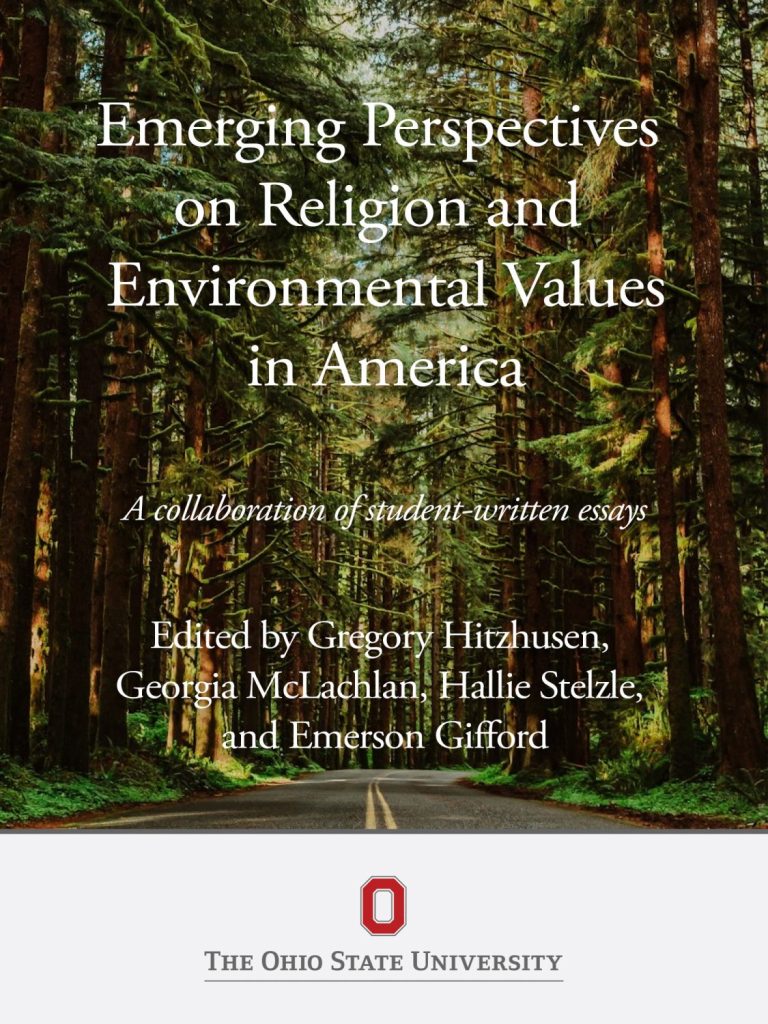 Emerging Perspectives on Religion and Environmental Values in America "Emerging Perspectives on Religion and Environmental Values in America (EPREVA) is a student-written collaboration which explores the numerous, diverse ways in which religious, spiritual, and philosophical beliefs permeate into environmental topics."
 -
 Religion and Environmental Values in America "Religion and Environmental Values in America explores the emerging and increasingly important topic of religion and sustainability, with particular attention to first understanding what it takes, philosophically and practically, to overcome polarizing debates about such topics and to understand environmental issues at their roots. The book then examines a range of case studies highlighting key areas of faith-based sustainability solutions."
 -
 Marianist Environmental Education Center "The Marianist Environmental Education Center (MEEC) is an environmental education community in the Catholic tradition. In Mary's hope-filled spirit, we preserve and act in communion with the land and educate other communities in sustainability through ecology-based simple living, social justice and spirituality."
 -
 Our common home This is a booklet guide to caring for our living planet created through a joint initiative of the Holy See and Stockholm Environment Institute. This booklet contains ten sections detailing topics such as climate, air, water, and actions to combat climate change. It was partly inspired by and contains quotes from Pope Francis' Laudato Si'.
 -
 Catholics look to mindfulness practices to ground climate action, quell eco-anxiety Eco-anxiety is a fear revolving around the awareness of the climate crisis and the loss of hope for solving environmental issues. Many Catholics have started practicing the role of mindfulness, which is rooted in Buddhist practices. Mindfulness is the act of being present and keeping oneself grounded. The news article discusses how mindfulness leads to an appreciation for the natural world and will push people to pursue ways to help the environmental crisis.
 -
 Going Green at Camp This article is written by Colleen Earp, a director at Camp Hanover, which aims to practice Environmental Ministry. Earp writes a bit about her own experiences growing up with camp and how they shaped her interest in environmental conservation. The piece discusses the importance of stewardship and a spiritual connection with creation. It also quotes the executive director Doug Walters, who explains the camp's modeling of environmental practices that are easy for campers to pick up and repeat once they have returned home.
 -
 Dayenu: A Jewish Call to Climate Action Dayenu is a Jewish organization that confronts the climate crisis through spiritual and political action. The organization has several "circles" spread around the United States and Canada that meet at least once a month and participate in 2-3 national campaigns a year. Dayenu offers resources to start a local circle or co-affiliate an already existing organization.