
Items
-
 Faith for Earth: A Call for Action The book covered a range of topics: the growing threats to the planet's life support systems, the reverence all religions have for life on Earth, and individual responsibility for future generations. Initially examined indigenous cultures' relation to nature, moving on to the Abrahamic Scripture and the traditions that value the environment. The book then focused on religious figures from the Jewish, Christian, and Muslim religions who emphasize the need of both individual and institutional faith in combating climate change. Lastly, it delves into Asian and Indic religions teachings and practices with regard to the environment. The rise of faith-based action and advocacy on behalf of the environment from religious groups globally has underlined the relationship of religions with nature and the inherent unity of values at the center of all of our hope for a sustainable future.
 -
 Nature & the Divine: The Spirituality of the Hudson River School This article describes the correlation between The Hudson River School & art, nature, and spirituality. More specifically, the article explores the presence of the “Divine” within the natural landscape paintings from this movement. The author also mentions various painters from the movement, including Thomas Cole, who had significant influence as the so-called “founder” of the Hudson River School.
 -
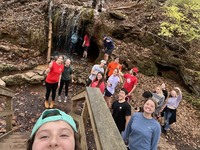 Exploring Faith and Nature Through Buckeye Bible Study Buckeye Bible Study is an on-campus Ohio State University non-denominational Bible group that allows people to explore the Christian faith. The group's goal is to find evidence for and/or an explanation for having a relationship with God. The club has weekly teachings every Sunday, and group activities on the OSU campus every Tuesday. Most activities are outside on the open grass and fields when the weather warms. But activities range from game nights, group dinners, outside sports and expeditions, and most importantly, service projects. BBS has participated in on campus trash pick-up as well as promoted walking and carpooling for on-campus traveling— and already have many upcoming plans for community volunteer work. There have been nature retreats, where the group hikes and walks on paths at Yellow Springs and talks about a healthy relationship with God. This club opens a path for students of any background willing to come and explore a Christian faith, while delving into the nature and creation of God.
 -
 Goat Yoga Katherine Harrison of Harrison Farms (Groveport, OH) and local yoga teacher Dana Bernstein team up to bring goat yoga classes to Columbus in March-October! Connect with nature and friendly farm animals mindfully in an outdoor yoga class.
 -
 United Women in Faith- Climate Justice All creation is God’s, and we are responsible for the ways in which we use and abuse it … God has granted us stewardship of creation. We should meet these stewardship duties through acts of loving care and respect.” (Social Principles, ¶160) Protecting God’s creation and those who are disproportionately affected by global climate change is more than our belief; it is one of our core principles.
 -
 A Spiritual Dimension and Environmental Education: Buddhism and Environmental Crisis This article describes the Buddhist perspective on environmental crises and elaborates on the potential impact of pairing these beliefs with scientific research to effectively promote environmental education. The article also explains how some Buddhist principles could be used to create and develop environmental policies.
 -
 Green the Church: On a Mission of Faith for Sustainability Green the Church: On a Mission of Faith and Sustainability is an article by Betsy Lopez-Wagner for the non-profit Earth Justice. The article details Green the Church's history and founding. Lopez-Wagner also brings into discussion the work that Green the Church is doing.
 -
 Conservation Good Turn Conservation Good Turn is an article on the Boy Scouts of America website that describes the BSA's mission for conservation. As rooted in the Boy Scout tradition, conservation is an integral part of responsible citizenship. This article provides a general overview of scouting and its dedications, recognitions, and partnerships.
 -
 Interfaith Rainforest Initiative Faith Toolkits According to their website, The Interfaith Rainforest Initiative (IRI) "...is an international, multi-faith alliance that is working to bring moral urgency and faith-based leadership to efforts to end tropical deforestation." The IRI provides 8 unique "Faith Toolkits" to encourage the conservation of tropical forests and their inhabitants through guided reflections, prayers, meditations, lesson plans, and other teaching tools. Crafted to promote engagement with specific religions, the website provides kits for communities of the following faiths: Baha'i, Buddhism, Catholicism, Hinduism, Islam, Judaism, Evangelicalism, and Protestantism.
 -
 Mother Earth, Sister-Spirit: A Sister-Led Retreat in Ohio This retreat led by Catholic nuns is designed to educate attendees on how to get involved in environmental justice action. It takes place at a 100-acre environmental education center near Dayton, Ohio. For the two-day event, they provide self-guided and collaborative events that include sessions specific to sustainability in the Dayton area as well as nature walks, art, social time, and prayer.
 -
 How Religion Impacts Americans' Views on Climate Change This article discusses the findings of a survey conducted by the Pew Research Center in 2015. Surveys of Mainline Protestants, Hispanic Catholics, and Evangelicals demonstrated that views surrounding climate change vary by religious affiliation. More specifically, religious observance was also found to be correlated with specific views on climate issues.
 -
 Environmental Protection in Sikhism In this article, Dr. Dalvinder Singh Grewal explains Sikhism's commitment to protecting humans and the environment, highlighting the organization "EcoSikh," a five-year plan created by the USA-based Sikh Council on Religion and Education (SCORE). In this article, Grewal also translates portions of Japuji, the Sikh sacred verse written by Guru Nanak, which describes an integral relationship between nature and God. This article helps readers from any religious background gain a deeper understanding of Sikhism and its connection to the environment.
 -
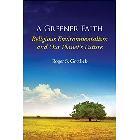 A Greener Faith: Religious Environmentalism and Our Planet's Future Roger S. Gottlieb outlines principles of religious environmentalism and its implications for social and political issues. Gottlieb addresses issues of consumerism and fundamentalism while offering the perspective of religious environmentalism to guide how we should treat other beings. Through these discussions, Gottlieb proposes his dream for the future of our world.
 -
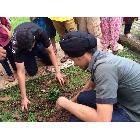 Sikhism and Caring for the Environment in Practice This article describes Sikh values and how they relate to Sikh environmental beliefs. The Sikhs believe that every man and woman, regardless of status or creed, is born with unalienable rights to happiness and liberty. This belief leads to the Sikh stance on environmental ethics, arguing that fighting climate change is a universal effort that can only be achieved with love and compassion for humanity in mind.
 -
 Evangelical Group Releases Climate Change Report, Urges a Biblical Mandate for Action The article discusses a new report called “Loving the Least of These: Addressing a Changing Environment” by the National Association of Evangelicals that cites a “biblical basis” for stopping climate change. The report was written to spur fellow evangelicals to rally together and address the issue. It cites the Bible, with verses about caring for creation and each other, as well as basic climate science about air pollution as its reasoning. An interview about evangelicals’ current views on the issue with Dorothy Boorse, one of the authors of the report, is included.
 -
 The Orthodox Fellowship of the Transfiguration The Orthodox Fellowship of the Transfiguration is based out of Santa Rosa, California, and is comprised of a dedicated group of Orthodox Christians who provide an Orthodox response to the environmental crisis on Earth. Although this group is based in the United States, its messages are heard around the world. Since the beginning of their organization, they have created lectures, conferences, and a newsletter. This group offers programs and resources that allow readers to engage themselves in conservation efforts with an Orthodox Christian philosophy.
 -
 United Methodist Church Climate Resources The United Methodist Church has provided a webpage that combines most of their environmental resources. This statement calls on Methodists to form a ministry of reconciliation between God, humankind and creation. More specifically, they focus on work in and alongside frontline communities experiencing environmental injustices. Through this link, you can also find more information about clean water, climate justice, food justice, and sustainability.