
Items
-
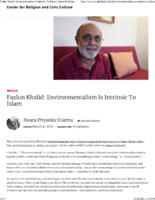 Fazlun Khalid Fazlun Khalid was born in Sri Lanka and is currently the founder and director of the Islamic Foundation for Ecology and Environmental Science. He believes that his religion means that taking care of the environment and respecting it is imperative. He has also worked for the World Wildlife Fund. He has accomplished a lot for nature.
 -
 Naturally Ambivalent: Religion's Role in Shaping Environmental Action This article, published in the journal Sociology of Religion, compares interviews from Christian, Muslim, and Jewish congregations in two major American cities (Houston, Texas and Chicago, Illinois)with the hope of finding patterns that raise suggestions for how religion shapes environmental action. The findings of the article revealed that religious institutions can encourage environmental actions from their members, but "religion may inhibit environmental concern when respondents believe environmental commitment undermines their religious beliefs" (p. 472). This article also raises the point that religious individuals may not consider their environmental actions to be motivated by their religious beliefs, but rather by institutions.
 -
 Is God green? Religion and Environment This resource dives into the debate on whether or not Evangelical Christians are to support or deny that the world is in need of environmental protection. Both sides of this argument are included within the text. The author also writes about popular groups who have chosen to affiliate with the environmentalists and groups who have denied any claims that the environment needs saving.
 -
 Hindu Declaration on Climate Change The statement covers the core beliefs of Hinduism, specifically the aspect that Hinduism is based around protecting and preserving nature. India has the largest concentration of Hindus, but the statement calls on Hindus worldwide to make lifestyle changes to help combat the effects of climate change. There is a sense of urgency in the statement, to make these changes to help prevent further environmental digression for future generations.
 -
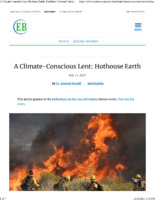 “A Climate-Conscious Lent: Hothouse Earth,” from EarthBeat This particular article, “A Climate-Conscious Lent: Hothouse Earth,” from EarthBeat comes from Fr. Emmet Farrell, who is director of creation care ministry for the Diocese of San Diego. EarthBeat is a website that highlights “stories of climate, faith, and action”. It highlights the destructive intensity of climate change and offers different readings and practices communities can take to take ownership of these issues.
 -
 10 ways Catholics can protect the environment Bill Patenaude, an engineer who also holds a Master of Arts in theology, provides 10 different and is simple ways that Catholics can protect the environment. The ways that he claims can help protect the environment say form religious to also day to day routines. His goal is to connect the spiritual practice of Catholicism as a way to erect our natural world.
 -
 Rethinking Christian Stewardship: An Interview with Tri Robinson by Jim Pool In this article, Tri Robinson, the founding pastor of Vineyard church in Boise, Idaho, talks about his experience leading his congregation in an environmentally-friendly way. He found that once his congregation started doing more to help the environment, including creating a recycling program and helping with disaster relief from hurricane Katrina, he received a large amount of positive attention from various organizations. He believes that regardless of political affiliation, Christians are called to address the issues facing the environment. He believes helping the planet is not a political agenda, but a biblical one.
 -
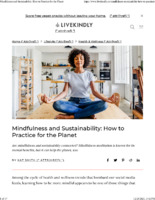 Mindfulness and Sustainability: How to Practice for the Planet Kat Smith at LiveKindly discusses the connection between mindfulness and sustainability, and how developing a regular mindfulness practice can inspire eco-friendly habits. She explains the process of mindfulness meditation, including its roots in Buddhism and purpose of increasing awareness of your surroundings and personal feelings. She argues that because meditation makes us more mindful of our actions, this mindfulness can manifest itself in our daily actions, strengthening our attention and awareness of what we do and leading to more environmentally conscious decisions. She then provides resources and advice on how to better meditate and become more conscious about your decisions and their impact on the environment.
 -
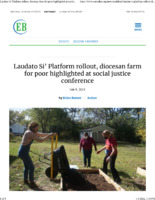 Laudato Si' Platform rollout, diocesan farm for poor highlighted at social justice conference The annual Catholic Social Ministry Gathering, hosted by the United States Conference of Catholic Bishops and held virtually this year in February, included several workshops and videos centered around the climate crisis and environmental justice. These segments discussed a variety of updates and plans regarding climate change, such as pushing for the Vatican's Laudato Si' Action Platform -- which debuts this May -- to be relevant for Catholics in the United States as well. The platform, named after Pope Francis's 2015 environmental encyclical, categorizes goals in four areas; spirituality, social action, advocacy and sustainability. "The platform charts a path for seven levels of the church — families, parishes, dioceses, schools, colleges and universities, religious orders, and healthcare institutions — to become fully sustainable in the spirit of the encyclical within seven years."
 -
 Evangelical Lutheran Church Statement on the Environment Through their statement, the Evangelical Lutheran Church makes stances on how they view the environmental crisis we are now facing in the world. They mention our increasing need for sustainability of our natural resources among other issues while reminding christians of their role with God's creation. Overall, this statement is used as a "call for action" by the Evangelical Lutheran Church. "Humans, in service to God, have special roles on behalf of the whole of creation. Made in the image of God, we are called to care for the earth as God cares for the earth. God's command to have dominion and subdue the earth is not a license to dominate and exploit. Human dominion (Gen 1:28; Pss 8), a special responsibility, should reflect God's way of ruling as a shepherd king who takes the form of a servant (Phil 2:7), wearing a crown of thorns."
 -
 Shomrei Olam Shomrei Olam is a Cincinnati organization that engages in Jewish climate activism. Their work includes education and activism in order to protect the environment and care for the planet. They host wilderness cleanups and essay contests as well as creating a collective call to action that can be signed by anyone.
 -
 Personal and Planetary Well-being: Mindfulness Meditation, Pro-environmental Behavior and Personal Quality of Life in a Survey from the Social Justice and Ecological Sustainability Movement This report analyzes the interconnectedness between mindful meditation, ecologically sustainable behavior, and subjective well-being. While other works have suggested that transitioning to ecologically sustainable behavior may diminish subjective well-being due to mass alterations in consumer behavior, this particular thesis argues that under specified circumstances, sustainable behavior may improve subject well-being. Ultimately, the search for personal well-being can be found outside of our normalized consumer culture, and establishing a relationship with nature has the potential to lead to ecologically sustainable behavior as well as subjective well-being.
 -
 Religion and attitudes toward the environment: a comparison of Mormons and the general U.S. population This text discusses environmental issues and contemporary Mormon beliefs on these issues in comparison to that of the general U.S. population. Mormon views that paint them as anti-environmentalist are examined, as are esteemed essays from Mormon officials who support environmentalism. Mormon environmental concern is analyzed alongside differing communities.
 -
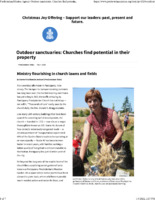 Outdoor sanctuaries: Churches find potential in their property This article describes efforts being made within multiple Presbyterian congregations to create natural spaces as part of their ministry. Locations in New Jersey, Washington, and Nebraska have all been revolutionized by these nature programs. This has contributed to sustainability, education, and fellowship.
 -
 Unitarian Universalist Association Climate & Environmental Justice This website can be used as a resource to find a congregation near you as well as information about events associated with Environmental Justice and Sustainability. This congregation strives to be involved in Environmental Action through their program the Green Sanctuary. The Green Sanctuary strives to connect staff and volunteers to organize a community to learn and collective to renew the Environment across the United States. Included on their website are new-letters and information about a range of Environmental Topics as well.
 -
 How Religions Shape the Environmental Movement in Indonesia In Indonesia, religious groups have been playing a large role in climate change response. Due to the island makeup of thousands of smaller islands, Indonesia is experiencing the effects of human-made climate change earlier than most countries. The island's religious groups, mainly Muslim populations, have been participating in environmental campaigns and translating policy language for religious audiences. The religious organizations in Indonesia hope that with the action of millions of local communities, global reform will be made.