
Items
-
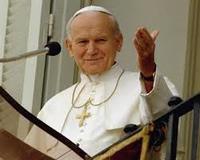 Common Declaration on Environmental Ethics On June 10, 2002, Pope John Paul II and Ecumenical Patriarch Bartholomew I issued a declaration on the environment. The introduction to the declaration is stated below: "We are gathered here today in the spirit of peace for the good of all human beings and for the care of creation. At this moment in history, at the beginning of the third millennium, we are saddened to see the daily suffering of a great number of people from violence, starvation, poverty and disease. We are also concerned about the negative consequences for humanity and for all creation resulting from the degradation of some basic natural resources such as water, air and land, brought about by an economic and technological progress which does not recognize and take into account its limits."
 -
 Message of His Holiness Pope Francis on the Occasion of the 20th Conference of the Parties to the United Nations Framework Convention on Climate Change Pope Francis's statement on climate change was issued at the High Level segment of the United Nations Climate Change Conference on December 10, 2014. The introduction to the Holy See's message is stated below: "At this very decisive moment in the history of climate negotiations we have to come to the point where we must overcome inaction. As Pope Francis said in his Message to our Conference, the issues we are debating 'affects all humanity, especially the poor and future generations: […] it is a serious ethical and moral responsibility […] There is a clear, definite and urgent ethical imperative to act […] We can only find adequate solutions if we act together.' The longer we wait, the more it will cost; more victims will suffer from our inaction and the greatest weight will fall on the most vulnerable, the poorest peoples and future generations: what is at issue here is respect for their fundamental human rights."
 -
 Address at the United Nations Climate Change Conference given by H.E. Archbishop James Patrick Green H.E. Archbishop James Patrick Green provides a statement on the impact of climate change on poverty at the United Nations Conference in Lima, Peru on December 10, 2014. He discusses the interdependence of humans and the Earth. He emphasizes Pope Francis's call for intervention to fight against global warming in order to protect the planet and, in particular, those at the poverty level.
 -
 Catholic Bishops' statement in Lima on the road to Paris During the High-level event at the COP20 in Lima, Bishops from around the world called for a fair and legally binding climate agreement to be signed at the COP21 in Paris, 2015. One segment of the introduction is shown below: "Following the evangelical option for the poor, we work closely with the most vulnerable communities and the excluded and as such are closely attuned to how the problem of climate change is affecting them. Our message to political leaders and all people of good will is rooted in the experience and suffering of these poor communities. Humankind on the Planet Earth is ordained to live in equity, justice and dignity, peace and harmony in the midst of the order of Creation. Humankind is ordered to treat respectfully Creation, which has a value in itself. We Catholic Bishops recognize the atmosphere, rainforests, oceans and agricultural land as common good that require our care."
 -
 Declaration of Religious Leaders, Political Leaders, Business Leaders, Scientists and Development Practitioners Business and political leaders, and scientists from around the world have congregated at the Pontifical Academies of Sciences and Social Sciences to address the climate change crisis. The introduction to the declaration is stated below: "We the undersigned have assembled at the Pontifical Academies of Sciences and Social Sciences to address the challenges of human-induced climate change, extreme poverty, and social marginalization, including human trafficking, in the context of sustainable development. We join together from many faiths and walks of life, reflecting humanity’s shared yearning for peace, happiness, prosperity, justice, and environmental sustainability. We have considered the overwhelming scientific evidence regarding human-induced climate change, the loss of biodiversity, and the vulnerabilities of the poor to economic,social, and environmental shocks."
 -
 Climate Change and the Common Good: A Statement of the Problem and the Demand for Transformative Solutions The Pontifical Academy of Social Sciences prepared the following statement on climate change. It covers a wide range of associated sustainability issues. Various suggestions for societal interventions are also included within the statement.
 -
 Laudato Si’ -- On Care For Our Common Home Laudato Si appears to be increasing interactions between environmental professionals and faith communities, and as such, is a very important document for all people to understand–not just Catholics! Roman Catholicism is the largest religious denomination in the world (1.2 billion). An encyclical is one of the most authoritative declarations that a Pope can put forth. Laudato Si is both a reflection of the larger moral and religious landscape of environmental values, and perhaps simply the most prominent such statement of values yet crafted. It is symbolic of this moment in time when religious and ethical voices are gaining currency in environmental thinking, regardless of any particular doctrine.
 -
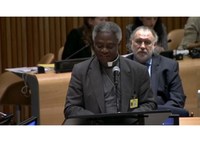 Statement by Cardinal Peter K. A. Turkson at the High Level Event on Climate Change Cardinal Peter K. A. Turkson provides a statement on climate change at the United Nations High Level Event on Climate Change on June 29, 2015. He emphasizes that the plight of the poor and the fragility of the planet are intimately related. As stewards of the Earth, he therefore greatly urges individuals to make courageous choices in order to reverse the trend of global warming.
 -
 Remarks by Cardinal Peter K. A. Turkson on the Encyclical Laudato si’ to Child-Focused Agencies Cardinal Peter K. A. Turkson addressed child-focused agencies at UNICEF House on June 30, 2015. His message is about the relevance of Laudato si' encyclical with regard to children and our common home. He urges individuals to contemplate the negative impact of climate change and how this will impact the future for our children.
 -
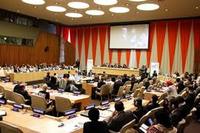 Presentation by Cardinal Peter K. A. Turkson of the Encyclical Laudato si’ in the ECOSOC Chamber Cardinal Peter K. A. Turkson gave a presentation about Laudato si' at the United Nations Economic and Social Council (ECOSOC) Chamber on June 30, 2015. He emphasized that the environment, our common home, can not be considered in isolation, but rather is a product of integral ecology. Midway through the presentation, the question of the meaning of life is broached, asking the audience to ponder how the earth should be left for future generations.
 -
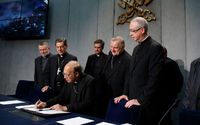 World bishops' appeal to COP 21 negotiating parties In preparation for the 2015 United Nations Negotiations in Paris, the heads of Catholic bishops' federations on every continent issued a joint appeal to COP 21 delegates that they produce a "comprehensive and transformational agreement" to address global climate crisis. Salient themes include the challenges and opportunities of climate change, and sustainable development to benefit the poor. They also call for leaders to become motivated to work towards enforceable agreements.
 -
 Engaged Organizations: Sadhana: Coalition of Progressive Hindus Sadhana is a non-profit organization that is committed to promoting environmental and social justice through the values of the Hindu faith. The NYC Service website summarizes what Sadhana is about: "We have mobilized Hindus in New York City and beyond to stand up for social justice causes including environmental justice, racial and economic justice, gender equity, immigrant rights, and anti-casteism. We bring a Hindu voice to the interfaith justice movement. We have chapters and members around the country and abroad. We engage and mobilize progressive Hindus nationally and internationally using social media."
 -
 Engaged Organizations: Center for Earth Ethics at Union Theological Seminary The Center for Earth Ethics maintains a vision of world value that is based on the sustained well-being of humans and the planet. Their mission also includes policy change that supports their vision. Their four core programs that support this vision and mission are: Eco-Ministry, Environmental Justice and Civic Engagement, Original Caretakers, and Sustainability and Global Affairs.
 -
 Pope Francis' Speech on UN World Environment Day Pope Francis's speech on the United Nations World Environment Day emphasizes the importance of world solidarity to counter what he deems a current culture of waste. One prevailing message is the danger of consumerism. The pope extends a challenges to forgo excessive wealth in exchange for living a more simplistic lifestyle, which can help combat world health and hunger issues.
 -
 Pope Benedict XVI on the Environment The following website contains from quotes from Pope Benedict XVI from a book published in 2012 by Our Sunday Visitor called: The Environment by Pope Benedict XVI. Salient messages include the inter-connectedness of humans and the environment, a call to protect and care for the Earth, the need to alleviate environmental justice, and actions that can foster sustainability.
 -
 Catholic Views on Climate Change - a statement from the Catholic Bishops of Australia The Catholic Bishops of the Climate Institute, Australia created a statement on climate change. The statement emphasizes various responsibilities of individuals and entities that are necessary to provide a safe and healthy environment for all parts of the world. They also warn against further ecological destruction for future generations.
 -
 Anglican Views on Climate Change - a report compiled by the Climate Institute of Australia Interfaith Center for Sustainable Development posted a report, compiled by the Climate Institute of Australia, on Anglican views of climate change. A predominant them includes the toll that greed and selfishness takes on God's creation. It focuses on specific actions that individuals can take to reduce energy usage and foster environmental justice for the world population.
 -
 North American Pollinator Protection Campaign (NAPPC) - Brochure on Christianity and Pollinators Various Christian groups in the United States (North American Pollinator Protection Campaign) have created this leaflet that discusses the importance of protecting endangered pollinating species in urban areas. The concluding section focuses on actions that congregations, and specifically youth groups can take to assist pollinators.
 -
 Christian Ecology Interfaith Center for Sustainability Development posted a Christian ecology statement, based on the 1995 Windsor Statements, on their website. The following is an excerpt discussing the challenges that have persisted over time with regard to the care for creation: "In the words of the Orthodox Patriarchate, ‘This may well mean that just as a shepherd will in times of greatest hazard lay down his life for his flock, so human beings may need to forego part of their wants and needs in order that the survival of the natural world can be assured.' The challenge to all Christians is to discover anew the truth that God’s love and liberation is for all creation, not just humanity, and to seek new ways of living that restore balance and hope of life to the endangered planet."
 -
 Buddhist Faith Statement on the Environment Interfaith Center for Sustainable Development posted a Buddhist faith statement on the environment on their website. According to the Vietnamese monk Venerable Thich Nhat Hanh: “Buddhists believe that the reality of the interconnectedness of human beings, society and Nature will reveal itself more and more to us as we gradually recover—as we gradually cease to be possessed by anxiety, fear, and the dispersion of the mind. Among the three—human beings, society, and Nature—it is us who begin to effect change. But in order to effect change we must recover ourselves, one must be whole. Since this requires the kind of environment favorable to one’s healing, one must seek the kind of lifestyle that is free from the destruction of one’s humanness. Efforts to change the environment and to change oneself are both necessary. But we know how difficult it is to change the environment if individuals themselves are not in a state of equilibrium.”
 -
 Judaism Ecology Interfaith Center for Sustainable Development posted a statement of Judaism ecology, based on the Windsor Statements, on their website. Key points include a warning with regard to altering creation, wasteful destruction, and the urgency for preservation.
 -
 Sikh Faith Statement on the Environment This Sikh faith statement on the environment, based on the 1995 Windsor Statements, is posted on the Interfaith Center for Sustainable Development. Below is the introduction to the statement: "The Sikh scripture, Guru Granth Sahib, declares that the purpose of human beings is to achieve a blissful state and to be in harmony with the earth and all creation. It seems, however, that humans have drifted away from that ideal. For the earth is today saturated with problems. It is agonizing over the fate of its inhabitants and their future! It is in peril as never before. Its lakes and rivers are being choked, killing its marine life. Its forests are being denuded. A smoky haze envelops the cities of the world. Human beings are exploiting human beings."
 -
 Hindu Ecology Among other philosophical beliefs of Hinduism, adherents advocate for the sacredness of all life forms, simple living, and inner peace. This Hindu statement on ecology, compiled and edited by Ranchor Prime and published by the World Bank in 2003, is posted on the website for Interfaith Center for Sustainable Development:
 -
 Baha'i Faith Statement on the Environment The Interfaith Center for Sustainable Development posted a Baha'i faith statement, from the Baha'i Office of the Environment, on their website. Below is the introduction within the statement: "In this age of transition toward a world society, protection of the environment and conservation of the earth’s resources represent an enormously complex challenge. The rapid progress in science and technology that has united the world physically has also greatly accelerated destruction of the biological diversity and rich natural heritage with which the planet has been endowed. Material civilization, driven by the dogmas of consumerism and aggressive individualism and disoriented by the weakening of moral standards and spiritual values, has been carried to excess. Only a comprehensive vision of a global society, supported by universal values and principles, can inspire individuals to take responsibility for the long-term care and protection of the natural environment. Baha’is find such a world-embracing vision and system of values in the teachings of Baha’u’llah, which herald an era of planetary justice, prosperity, and unity. "
 -
 Sufism Ecology This Sufism ecology statement posits that nature takes a central position in life - a place where one can find truth. Conservation and protection of the natural environment is a spiritual priority with the Sufism faith. The Interfaith Center for Sustainable Development posted this Sufism ecology statement on their website: