
Items
-
 United Church of Christ – Environmental Ministries The United Church of Christ has taken an active role in environmental stewardship. They have made multiple statements about various aspects of the environment. This link provided by Environmental Ministries discusses various critical environmental justice issues. If you are looking for ideas on how to live more Eco-friendly in your own life, or simply searching for a great set of resources, check them out!
 -
 Environmental Statement – Presbyterian Church The Presbyterian Church has an environmental statement that is similar to many other churches, citing biblical text and discussing our responsibilities as stewards of the earth. This document goes into what humanity has done, and why the Presbyterian church is responding to the massive amount of environmental degradation.
 -
 Environmental Statement – Church of the Brethren The Bible is filled with examples that demonstrate our responsibility to care for all creation on our planet. From Genesis to the parables of Jesus, it is explicitly stated that we must be caring stewards of the earth. In order to reverse the damage that humankind has done, the Church of the Brethren is calling its own members and all people to action. In addition, they are also calling upon the government to be more supportive of environmental policies and clean up.
 -
 Environmental Statement – American Baptist Churches Environmental problems that exists today have stemmed from humanity’s current and past greed. Science and technology are being abused and threaten to make problems worse, even though they have the power to make things better. American Baptists advocate that we must be stewards of our home and not abuse it if we wish to continue on as a species. In order to fix what humans have caused, we are called to recognize and preserve the earth and natural resources we have.
 -
 Environmental Statement – Evangelical Church Evangelical Christians are calling for all people to be stewards of the earth. It is our fault that there has been so much damage done to the planet. We were entrusted to look after all of creation, and therefore, must start to take responsibility for our actions. According to the Evangelical Declaration, The Bible tells us what our role is and what it is we must do. This statement by the Evangelical faith concedes that we must develop the earth to an extent, but we have taken it too far. We owe it to the future generations to preserve resources and help stop environmental degradation. To truly live out the Word of God, we must become more sustainable.
 -
 Water Issues in Appalachia Some people may think that water issues in the United States only exist in the west. This is far from the truth. In addition to algae bloom issues throughout the midwest, the Appalachian region of the United States has been experiencing severe water contamination due to mining and chemical spills for the past several years. Fortunately, the residents of this region are kept informed by the Catholic Committee of Appalachia. Once a year, residents from all over the state meet in one location to discuss the issues of their region and try to come up with solutions.
 -
 The People’s March In addition to the People’s Pilgrimage, the People's March was another religious based event that took place during COP-21. The People’s March, was an organized demonstration in major cities around the world. For those who could not attend the convention in Paris, marches were held around the world to demonstrate solidarity for environmental stewardship and justice. Many people who participated in this march in Paris were also members of the People’s Pilgrimage. However, in Paris there was also conflict due to lingering tensions from the November 13th terrorist attack.
 -
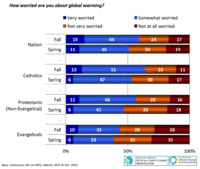 The Francis Effect With the release of Laudato Si’ and the visitation of Pope Francis to the United States, there has been a noticeable increase in the number of both Americans and Catholic Americans who have demonstrated concern over Climate Change. Individuals of various faiths have expressed more trust the Pope due to the overwhelmingly positive reception of his message.
 -
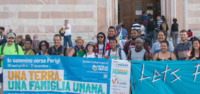 The People’s Pilgrimage COP-21 was recently held in Paris, where leaders from countries all over the world met to discuss potential climate change plans. In addition, hundreds of thousands of people of various faiths made their way to the convention. They journeyed to Paris in a pilgrimage of solidarity. People of all faiths were in attendance to rally together and show how religious consciousness is now linked with environmental stewardship. One group walked 1,500 km. from Rome to Paris. Among this group was Yeb Saño, the representative of the Philippines in COP-19. He has become a well-known activist, as his homeland was ravaged by Typhoon Haiyan during COP-19. The pilgrimage brought copies of Laudato Si, the Islamic Declaration on Global Climate Change, and the Buddhist Climate Change Statement to World Leaders 2015 to show how invested the faith communities are when it comes to climate change and environmental issues.
 -
 Balinese Water Temples Balinese Water Temples have been an integral part of the agricultural rice paddy systems in Bali for over 1,000 years. Water is distributed from the Supreme Water Temple of Bali throughout the land. This distribution cycle involves neighbors meeting in a democratic subak to discuss the synchronization of their planting. Steve Lansing's video link below goes into further detail about the Bali water temples.
 -
 Catholic Bishops Push Ohio Towards Clean Energy The Catholic Bishops of Ohio are against an indefinite freeze of Ohio’s clean energy target standards. The Ohio Mandates Study Committee has called for this freeze due to a need for continual studying of energy standards and their impact on the state. The Bishops, however, feel that there is no need to freeze the standards, as alternative energy sources benefit the environment as well as society. This is not the first time that the Bishops of Ohio have voiced such a stance. Back in 2014, a similar issue arose with SB 310, which proposed the original freeze of Ohio’s advanced energy portfolio standard that was established by SB221. The Bishops voiced opposition to SB 310 at that time.
 -
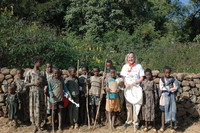 Ethiopia’s Church Forests The beautiful forests of Ethiopia are rapidly disappearing due to human activity. However, the forests around the Ethiopian churches remain intact and teeming with diverse life. Dr. Margaret D. Lowman, known as Canopy Meg, has teamed up with one of these churches to study and survey the wildlife, mostly insects in the area. The children of the church community are being engaged to become the next generation of stewards in order to ensure that the forests and creatures are preserved. Project leaders also aim to help build walls in order to keep these forest areas more protected from human development.
 -
 Engaged Organizations: Cincinnati Climate Change Task Force In 2009, the Archdiocese of Cincinnati signed on to the St. Francis Pledge to Care for Creation. Since then, they have started their own Climate Change Task Force. This task force has adopted the mission of committing themselves to work towards a sustainable world based off of the responsibility to Care for God’s Creation. They work to implement the five pillars of the pledge: praying, learning, assessing, acting, and advocating for the environment and the poor.
 -
 EarthConnection Cincinnati EarthConnection, a ministry of the Sisters of Charity of Cincinnati, is a center for learning and reflecting on how to live lightly on Earth. They focus on the interconnections of all of Creation and strive to integrate spirituality and sustainability throughout their programs. Their website lists all of the programs they have to offer and they all include a focus on sustainable agriculture, alternative energies, ecojustice, and ecospirituality.
 -
 Religion-Environment Photo Contest Winner: Tony Losekamp Winner Tony Losekamp is a second year seminarian in the Roman Catholic Archdiocese of Cincinnati, Ohio. He graduated from The Ohio State University with a Bachelor of Science in Environment and Natural Resources in 2017. He has been Catholic his whole life and chose to study environmental sciences out of a love of science and nature and a desire to help make the world a better place. While in college his faith became his own when he had to decide for himself to go to Mass on Sundays, go on retreats, join Bible Studies, go to adoration to worship Jesus in the Eucharist, and build a personal relationship with Jesus. At some point he realized that if he was going to be Catholic, he was going to have to give everything to the one who gave him everything. In giving himself completely to Jesus, he became more free to love. He finished his degree while giving more and more time to Saint Paul’s Outreach and the Newman Center, gaining missionary experience and building a love for life. That is what brought him to Mt. St. Mary’s Seminary of the West. Tony’s photo won second place in the Religion-Environment photography contest with “Spiritual Tree.” Tony stated that, “I took this photo in Hocking Hills, Ohio, on the trail between Old man’s cave and Cedar Falls. It was spring and the forest was exploding with life. The air hummed with excitement and power that is comparable with excitement and power of a rich spiritual life in communion with God.”
 -
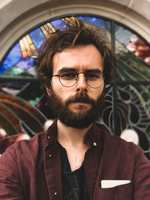 Religion-Environment Photo Contest Winner: Jacob Taylor Biography Jacob Taylor is a lifelong resident of the Mill Creek watershed in SW Ohio. He earned his BA at the University of Cincinnati for literary and cultural studies, and is currently studying environmental theology at the Methodist Theological School in Ohio. His interests include community gardening, herbalism, reading the mystics, and pining for the revolution. Jacob’s photo won first place with the title, “Theotokos in the Apothecary.” He states this about his photograph: “The guiding question behind my work concerns what it means to live incarnationally & eucharistically in the age of the Anthropocene. How can I, with Mary as a model, bear Christ into a world where the heavy foot of human domination and extractive economics has driven our common home into a mass extinction event? I continue to draw strength and meaning from my tradition’s central sacred story of incarnation — it gives me the courage to keep moving and struggling towards shalom against the odds, trusting the mystery of “God with us” as we face this bewildering moment in human/geological history. Theotokos calls me to remember that something profound occurs when we consent to the invitation of God. At the core of the Christian eschatological vision is the unwavering assertion that all things are being made new and that human beings are invited to conspire with God in this process of restoration. May we, with Mary, have the courage to say yes, come hell or high water. ”
 -
 Sisters of Earth: Hopes and Dreams How to Face the Mess We’re in without Going Crazy is the subtitle of Joanna Macy’s book Active Hope. The book was the inspiration for the Sisters of Earth gathering that took place July 12-15, 2018 at Mount Saint Joseph, home of the Sisters of Charity in Cincinnati, Ohio. Cincinnati was chosen as the location partly because of the ancestral inspiration of Sister of Charity Paula Gonzalez, who promoted solar power and sustainability projects and teachings throughout the Catholic world. This year, nearly 100 women from the United States and Canada gathered, in part, to remember Sister Paula and also to address concerns about the ecological/spiritual crises of our times by asking questions such as: Who are we? Where are we? How did we get here and what is possible? And — where do we go from here?
 -
 Engaged Organization: The Dream Corps The Dream Corps is a social justice organization, designed to reach across racial, social, and partisan lines to create a future with freedom and dignity for all. The founder, Van Jones, is scheduled as the keynote speaker at the Midwest Regional Sustainability Summit held in June in Cincinnati. They support economic, environmental, and criminal justice leaders in order to tackle America’s social justice challenges. Their slogan is “21st-century jobs, not jail." Initiatives include #YESWECODE, #CUT50, and Green for All.
 -
 The Midwest Regional Sustainability Summit The 2017 Midwest Regional Summit welcomes stakeholders throughout the Ohio Valley region and adjoining areas to exchange their practices, have thoughtful discussions, and celebrate the environmental work that is going on throughout the Midwest. This year’s summit will look focus on the issue of equity and its relationship to sustainability. Green Umbrella is partnering with the City of Cincinnati Office of Environment and Sustainability and the Department of Economic Inclusion, the Brueggeman Center for Dialogue at Xavier University, Hamilton County Planning and Development and the Greater Cincinnati Green Business Council to present a daylong conference to share the ideas and practices in environmental sustainability at the Midwest Regional Sustainability Summit. The keynote speaker, Van Jones, is a globally recognized, award-winning leader in the green economy along with being experienced in linking the economy, the environment and social justice. He is also the best-selling author of a book on green jobs, The Green Collar Economy: How One Solution Can Fix Our Two Biggest Problems.
 -
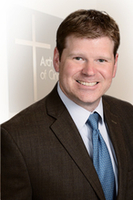 Profile: Tony Stieritz – Honoring Faith Traditions and Shared Values Tony is the director of Catholic Social Action of the Archdiocese of Cincinnati. He helped the Catholic Archdiocese of Cincinnati form a network of climate change leaders. He inspired leaders by connecting their faith and climate solutions. Through a partnership with the Greater Cincinnati Energy Alliance (GCA) 10 archdiocesan parishes, schools, and other facilities received over $290,000 in incentives to implement over $1.4 million in energy efficiency upgrades. Though Tony has had much success with climate change initiatives he still wants more people in the Archdiocese to make climate change a priority. “We took climate change out of a political conversation and put it into a personal values conversation.”
 -
 Profile: Caroljean Willie Caroljean Willie is a Sister of Charity of Cincinnati. She holds a Bachelor of Arts in Sociology, a Master’s Degree in Reading and a Ph.D. in Multicultural Education. She has extensive experience working cross-culturally throughout the United States, the Caribbean and Latin America. She is a frequent speaker at regional and national conferences and has also given presentations in Africa, Asia, Europe, the Caribbean and Latin America. She recently completed two terms of office as the NGO representative at the United Nations for the Sisters of Charity Federation and currently serves as the program director at EarthConnection, her congregation’s environmental center in Cincinnati.
 -
 Profile: Jim Rogers An A.B. graduate of the University of North Carolina, Chapel Hill and J.D. graduate of George Washington University, Jim Rogers has a varied background working in law and the non-profit and for-profit sectors, with notable tours as a Legal Aid Attorney, lobbyist and public relations staff for the ACLU of Ohio, and a program reviewer for United Way of Greater Cincinnati. For the last four years he has served on the Green Team of the Community of the Good Shepherd Church in Montgomery Ohio and the Greater Cincinnati Archdiocese Task Force on Climate Change. For the latter, he has served as Chair of the Legislative Advocacy Committee which has built a relationship with several green businesses in Greater Cincinnati and has had meetings with legislators and government officials on both sides of the aisle in Columbus. Though a life-long Christian, Jim is a committed ecumenist, believing that we will be able to address the environmental crisis and other challenges of our time only when we unite the forces of the world’s great religions. Jim serves several faith communities and supports his Christian walk with the regular practice of Yoga and “Light” energy through Sukyo Mahikari.
 -
 Faith Community Alliance of Greater Cincinnati The faith Community Alliance of Greater Cincinnati is a group of interfaith communities who have gathered to share stories and come together to support environmental initiatives. Typically, they will look into what the government is doing and urge for better policy.
 -
 Beyond the Bin St. Anthony Parish in Cincinnati, Ohio has starting their own recycling program. One of the parishioners had recently discovered that nearly 50% of all trash could be diverted by being recycled or composted. Their creation care committee launched the Beyond the Bin program by installing a 96-gallon bin in an alcove near the rectory. Word spread through the congregation, parishioners have started to bringing in their own recycling, and the program has been embraced by the entire church community.
 -
 Food Security: Dream of Feeding Hundreds Comes True Brother Paul Kennedy, a member of the Dominican Order, grew up in Cincinnati with a dream of running a restaurant. Today, he is fulfilling that dream in an unexpected way. Every weekday, he is in charge of feeding the physical and spiritual hunger of more than 300 people at the Holy Family Soup Kitchen in Columbus. Brother Paul offers that, “What always was important to me about the restaurant business was the chance to communicate with people as much as the chance to feed them. But regardless of what I did, every job I’ve had in the past was focused on service to people. Here at the soup kitchen, I get the chance to do the kind of work I wanted to while growing up, while at the same time getting to know the people we serve and developing a rapport with them.”